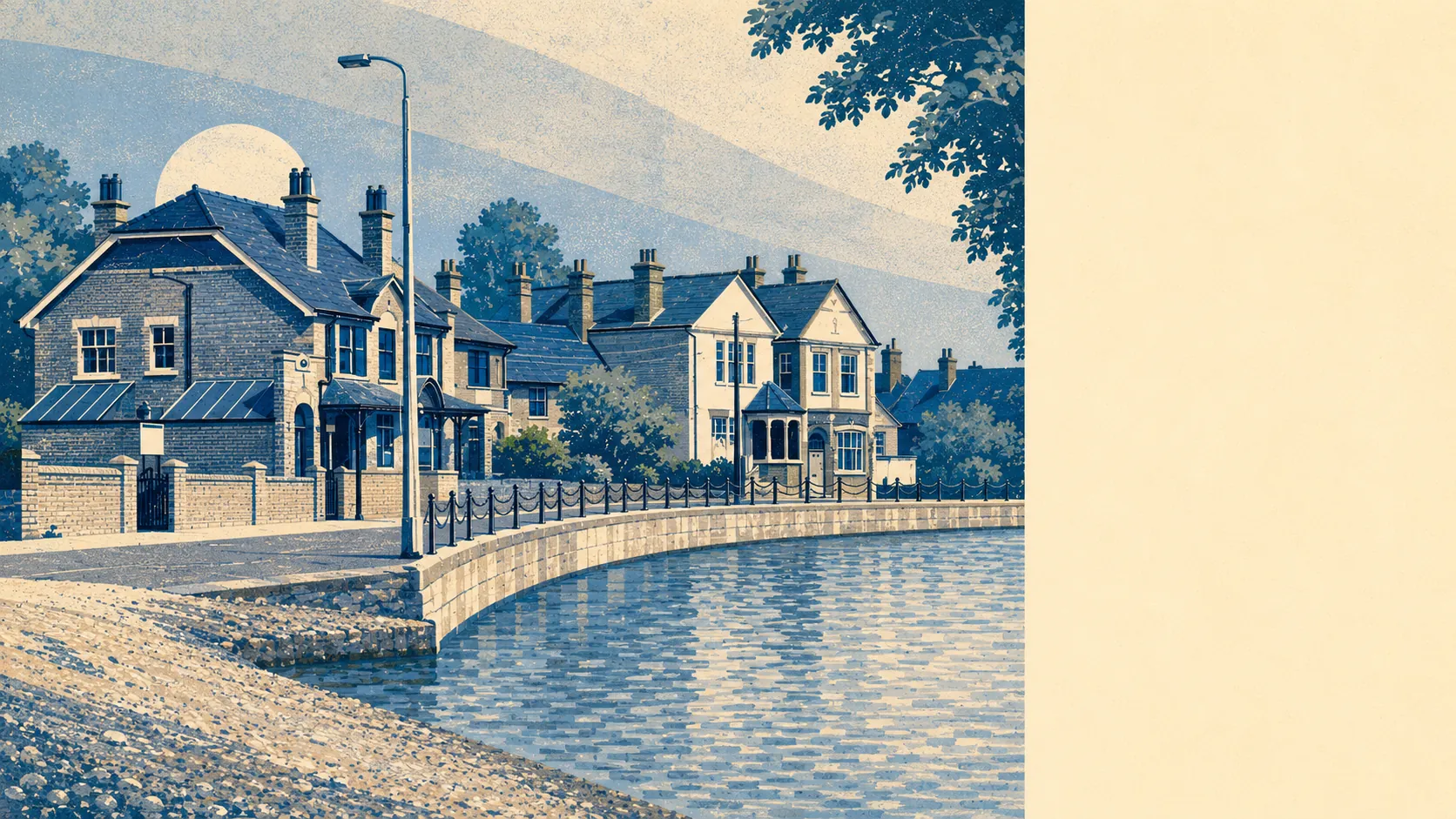
Bishopstoke is the village that lost a naming war to its own railway station. It was here first, recorded as Stoke in 948 AD, when a king handed the land to a thegn and nobody had heard of Eastleigh. Then the railway turned up a mile to the west in 1839, a town grew around the station, and by 1923 the sign just said Eastleigh and the older place had been quietly written out of the story. What is left is a settled Hampshire village where roughly three-quarters own their homes, the typical resident is 44, and crime runs at about half the district average. Not a boomtown. A place that has already decided what it is.
The housing tells the same settled story. Most of it is houses, getting on for a quarter are flats, and the dominant vintage is post-war, the 1950s to early 1980s build-out rather than anything with a blue plaque on it. Fewer than one in ten homes date from before 1930, so anyone hunting period features is mostly out of luck. On the energy ratings it lands where post-war stock usually lands: about four in ten homes sit at band D, roughly half scrape to band C or better, and under one in ten are down at band E or worse. Nothing dramatic in either direction, which is Bishopstoke's whole personality in one dataset.
On price, the typical home sold for about £334,000 over the past year across 146 sales, and the spread does what you would expect. A detached house runs to roughly £440,000, a semi around £325,000, a terrace just over £280,000, and a flat under £200,000 for anyone who wants the postcode without the mortgage that usually comes with it. Council tax mostly sits in band C, with about a quarter of dwellings in the lowest two bands. This is the middle of the market being the middle of the market, which is more reassuring than it sounds if your last search was Winchester.
Renting is best read at the wider scale, because the neighbourhood is too small to quote on its own. Typical private rent across the Eastleigh area is about £1,210 a month. That is the district figure, not Bishopstoke's own, so treat it as the gravity the village sits inside rather than a quote for a specific two-bed off the Itchen.
Safety is where Bishopstoke quietly wins. The published crime rate is about 34 recorded crimes per thousand residents, which is roughly 48 percent below the Eastleigh average. That is the recorded rate as published, not a number anyone has cooked up by dividing incidents by heads. For a place a mile from a town centre, sitting well under the local average is the kind of stat that does not make the estate agent's window because it is boring, and boring is exactly what people buying here are paying for.
Connectivity is the honest weak spot dressed as a convenience. The town centre is under fifteen minutes by car, there are around forty bus stops scattered about, and barely one in a hundred residents commute by train, which is what happens when the station that made your neighbour famous is in your neighbour's name and not yours. Broadband makes up for it: superfast covers effectively every address and gigabit reaches roughly six in seven. You will work from home faster than you will get to London, and about a third of the village already does.
The surroundings are the standout. Green space averages about 130 metres from the front door, with fifteen or so separate patches within a kilometre, and the River Itchen and the old Itchen Navigation canal, completed in 1710 and worked until 1869, thread through the eastern edge. That water is also the catch. Around one in nine addresses carries a high surface-water flood risk and a similar share a medium one, even though the formal river flood zone covers under one percent of the place. The village and its river are a package. You buy the walks and you check the drains.
Heritage sits light here, which suits people who want to change their house without asking permission from three separate bodies first. There are eleven listed buildings, all of them grade two, the gentlest tier of protection, plus a single conservation area and one scheduled monument. Compared with a Winchester terrace where you cannot sneeze near a window without a consent form, Bishopstoke leaves you largely to get on with it.
The neighbourhood character reads as comfortable rather than moneyed. Roughly three-quarters own their homes, the median age of 44 skews a shade older than the national middle, and household income runs at about £62,000. This is the demographic that has stopped renting, stopped moving every two years, and started caring about the bin collection. It is not young and it is not trying to be.
It suits a family or a couple who want a house with a garden, a river within walking distance, low crime, and a short drive to everything without paying Chandler's Ford prices for the privilege. It suits remote workers who value the broadband over the branch line.
It is a poorer fit for anyone whose life runs on the railway, because the trains are fine but not yours, and for anyone chasing period charm, because the housing stock mostly postdates the Coronation. If a driveway, a fast train, and a Georgian frontage are all non-negotiable, this is not your village.
For the record of who once lived here, the brief keeps modest company: Richard Dummer, Edith Escombe, William Gilbert, Henry Hamilton Bailey and Samuel Sewall have all been claimed by Bishopstoke at one time or another, which is a longer list than a village that lost its own name to a train timetable has any right to.
So, good place to live. Above average overall, and it earns that rating on the things that are hard to fix once you have moved: the crime figures and the green space both sit at the top of the scale, so you get quiet streets and countryside on the doorstep as a matter of record, not marketing. The softest spot is schooling, which lands squarely average, so families should do their own homework on catchments rather than take the postcode's word for it. Bishopstoke will not thrill you and it will not pretend to. It will just keep being the sensible option long after the place that stole its name has stopped being interesting.