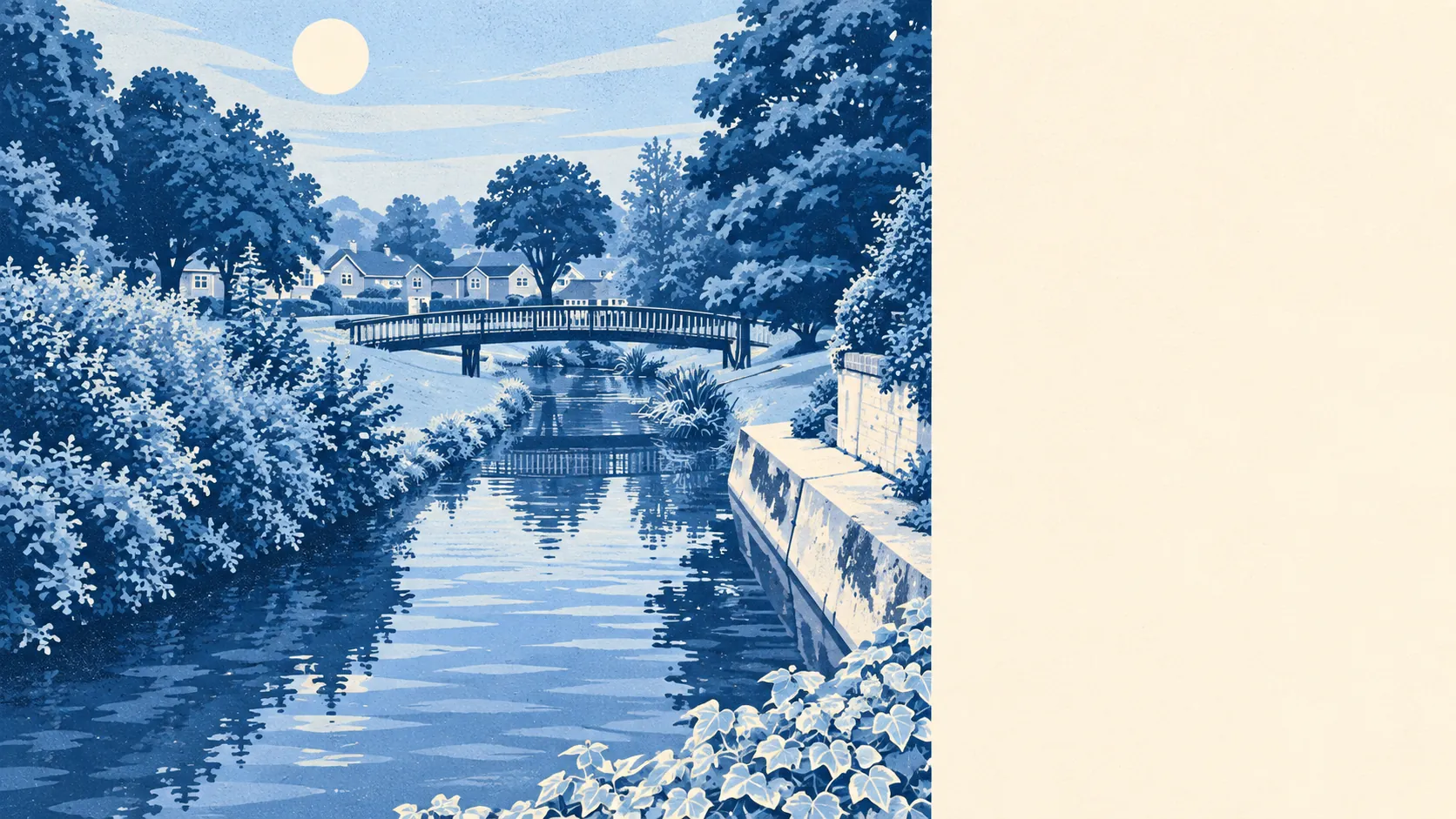
The area around Weybourne is greener than a post-war suburb has any right to be. Green space is round almost every corner. Water is a short stroll away. Most homes come with a proper garden of their own. Nobody here needs a gym membership to find somewhere to walk.
Green space is the headline. The typical home sits about 170 metres from the nearest green space, with around 19 of them within a kilometre. That's a patch of grass closer than most people's nearest postbox, and enough choice that dog walkers here develop opinions about which one is theirs.
Water is close too. The nearest river, pond or lake averages about 470 metres from home, with around 17 bits of blue space within a kilometre. It's not the seaside, and nobody's selling it as such, but it's there for anyone who likes a walk to end somewhere with ducks.
The National Cycle Network is less handy, averaging about 1.9 kilometres away, and no postcodes here sit close to it. Cyclists will be doing the first stretch on ordinary roads. There's no ancient woodland inside the area either.
For everyday life, the rated-premises records for the surrounding postcodes count 302 shops, 46 pubs and 40 restaurants, alongside 479 offices. The offices outnumber the pubs by some distance, which says plenty about how the wider area earns its living. The pubs, at least, are keeping up with the restaurants.
For air quality, fine-particle pollution across the Waverley council area averaged about 6.5 micrograms per cubic metre in 2024. That's a borough-wide figure, not a reading taken on any particular street.
The feel is residential edge-of-town, with neighbours rather than landmarks. Badshot Lea, Upper Hale, Heath End and Hale sit around it, Aldershot is close by, and Farnham Park and Farnham Castle are the nearby weekend outings when visitors need to be shown something older than the house. Weybourne itself is where people come home to, not where they bring the camera.
Private outdoor space is generous. The area has around 140,000 square metres of private garden for every 1,000 residents, which in plain terms means most households have somewhere of their own to sit outside, grow tomatoes or ignore the lawn. That's the part of the green space that doesn't need sharing with anyone's spaniel.
Inside the area itself, the valuation list holds 77 rateable business premises, with the single largest category accounting for 27 of them. These are premises on the rating list rather than a count of businesses trading today, and the modest total confirms what the streets suggest: Weybourne is a place to live, and the commerce happens on its edges.
Eating out is reassuring on the hygiene front. Of 41 rated food premises, about 63% hold the top five-star score and about 7% sit at the lower end. Most kitchens here would survive an unannounced visit from a fussy mother-in-law, and the rest are a minority worth checking before booking.
No protected-landscape designations overlap the area: no area of outstanding natural beauty, no site of special scientific interest and no ancient woodland. The green space here is the ordinary, usable kind, parks and playing fields and verges, built for walking on rather than admiring from a signposted viewpoint.
Surroundings are one of Weybourne's real strengths: green space close to every door, water within an easy stroll and gardens most town-centre buyers would envy. The scenery is practical rather than spectacular, and daily life is better for it.