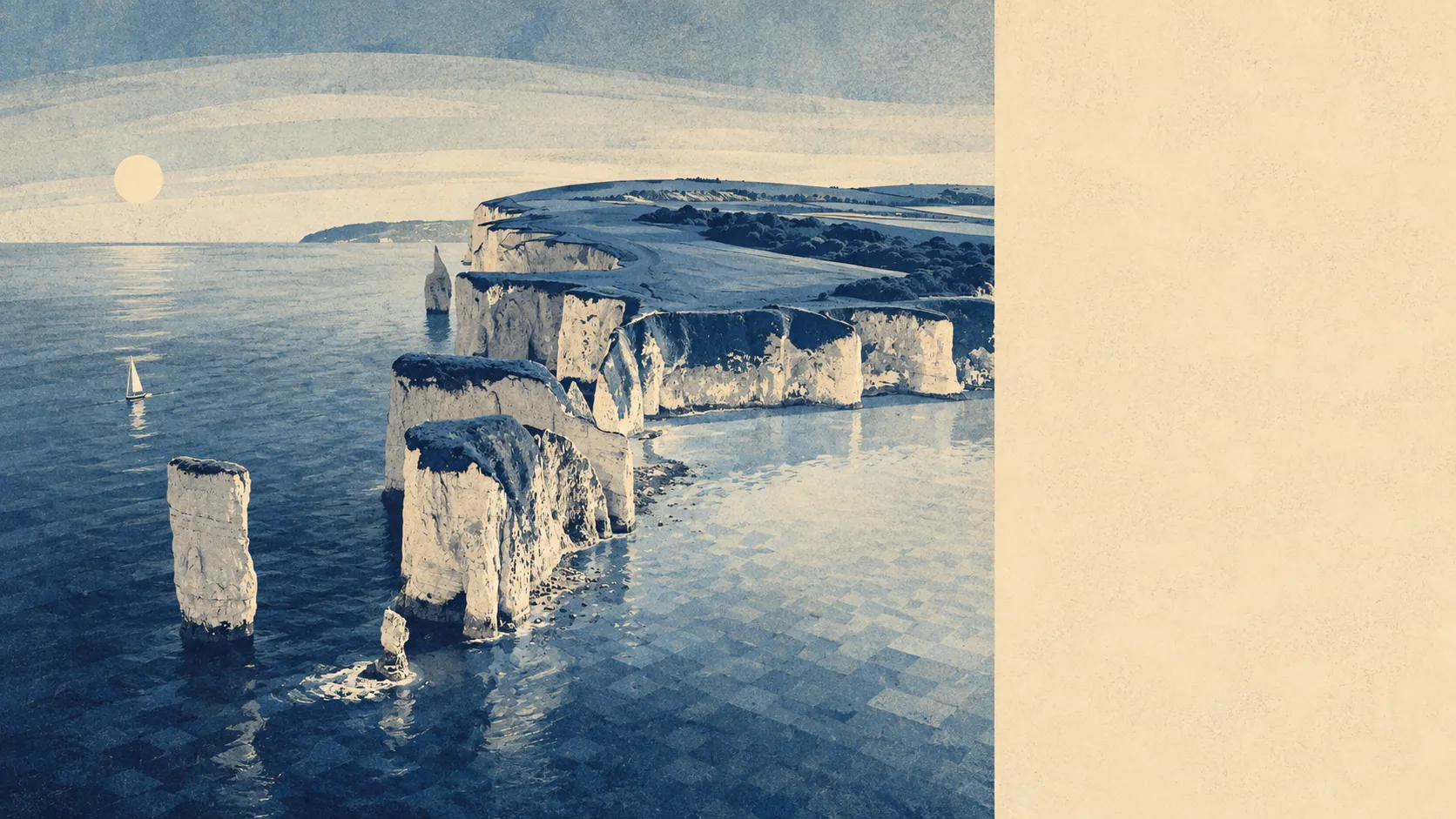
Yes, if you can live somewhere that empties. Most people here own their homes outright and the typical resident is closer to sixty than forty. A third of households are one person. The whole place sits inside a protected landscape, and the sea is a few minutes from almost every front door. It is a good town to live in and a difficult one to be twenty-five in.
The housing stock is where the trade-off starts. Flats make up about a third of everything on the council-tax valuation list, with detached houses at around a fifth, bungalows and terraces at roughly a seventh each, and semis making up the rest. About 32% of the town's dwellings went up before 1930, and only about 4% arrived between 2000 and 2008, which tells you how little new building has landed here in living memory. The energy certificates back that up: band D is the single largest group at around 39% of certificated homes, with about 16% sitting at band E or worse, and only around 45% reaching band C or better. Mains gas heats roughly 77% of households, but about 9% run on electricity alone, and an electric-only Victorian or post-war property on this coast is a running-cost problem you want to know about before the second viewing, not after the first winter bill.
On price, the Land Registry's last twelve months put the median sale at £355,000 across 143 transactions. The spread underneath that median is the useful part. Flats came in at a median of £245,000, terraces at £338,000, semis at £362,000, and detached houses at £587,500. That is not a gentle gradient, it is a cliff, and the median hides which side of it you are shopping on. Council tax runs mostly through band C, which is the most common band in the town, with around 20% of dwellings in bands A and B combined. The price per square metre for sales that could be matched to a certificate's floor area sits at about £4,600, on a median floor area of around 94 square metres.
Renting is a different conversation and a shorter one. The typical private rent across the Dorset area is about £1,040 a month, up around 4% over the year to April 2026. That is a local-authority average covering a lot of countryside, not a Swanage figure, and in a town where 333 properties are on the rating list as holiday lets, anyone hunting a long-term rental is competing with a business model that pays more per week than they can pay per month.
Crime sits at a published rate of about 42 recorded offences per thousand people over the twelve months to May 2026, which is roughly 23% below the Dorset average. Violence and sexual offences make up around 41% of the recorded mix and anti-social behaviour around 20%, both broad categories that run high everywhere, and the total is small enough that a handful of incidents shifts a share by several points. Dorset Police charge in about 14% of cases against a national rate of around 12%. For a seaside town with a summer trade, that is a quiet record.
Connectivity is the weak flank. There is no main-line station in the town: the Swanage Railway is a heritage line, and the mainline connection at Corfe Castle station operates on the same preserved route. About half of working residents drive to work, roughly 24% work from home, and under 1% commute by train. Around 52 bus stops sit within the town, nearly all of them carrying a weekend service, with an average of about 69 scheduled weekday departures per stop. Modelled journey times put the nearest hospital at around 46 minutes by car and about an hour by public transport, which is the number that matters most as the median age climbs. Broadband is better than the roads: gigabit capability reaches about 73% of premises, superfast about 98%, and no premises fall below the universal service obligation.
The Environment Agency's mapping is worth reading carefully because two different measures apply here. About 9% of the town sits in the river-and-sea flood zone 3, with around 4% in zone 2, rising to roughly 15% once climate allowances are applied. Separately, about 14% of postcodes carry a high rating on at least one flood indicator including surface water, with a further 8% at medium. One flood event is on the recorded register, from February 2014, caused by sea defences overtopping. Against that, the green-space access is close to unbeatable: roughly 150 metres to the average patch of open space, about 18 within a kilometre of the typical postcode, water at around 220 metres, and effectively the entire area inside the Dorset national landscape designation. Ground conditions are benign, with the geological survey placing shrink-swell, landslide and dissolution hazards all in the lowest class.
Heritage is the constraint that catches people out. There are 159 listed buildings in and around the town, one of them grade one and one grade two star, plus three conservation areas covering Swanage, Herston and Langton Matravers, and two scheduled monuments. If your plan involves replacement windows, a loft conversion or anything visible from the street, the consenting process is the project. This page also covers Studland and Worth Matravers, where the same protections bite harder still.
Around 70% of homes are owner-occupied and the median age is 57. Modelled household income runs at about £48,100 gross a year, with net household income closer to £37,000. That is a town of people who arrived with equity rather than salaries, and it shapes everything from the shop mix to the volunteer register.
It suits downsizers, remote workers who genuinely do not need an office, walkers, and anyone whose retirement plan involves a coast path rather than a golf club. It suits families willing to accept one secondary school in town and a long drive for a hospital.
It does not suit a two-career household with a daily commute off the peninsula, and it does not suit anyone who needs a city on a Tuesday night. The A351 through Corfe Castle is the only reliable road out, the alternative is a chain ferry, and both know it.
Paul Nash lived here in the mid-1930s and made a serious body of work from the light, with Eileen Agar staying in the town at the same time. Two surrealists found the place worth painting, which is a fair verdict on the setting and a slightly ominous one on the atmosphere.
Swanage is a good place to live and an above-average one on balance. Its real strength is the surroundings: a nationally protected landscape, water at the end of the street, and green space closer than the nearest bus stop in most towns. The weak spot is the freedom to do anything to your own house, because between the listing schedule and three conservation areas, someone else has a view on your windows. Buy for the setting, and budget for the planning consultant.