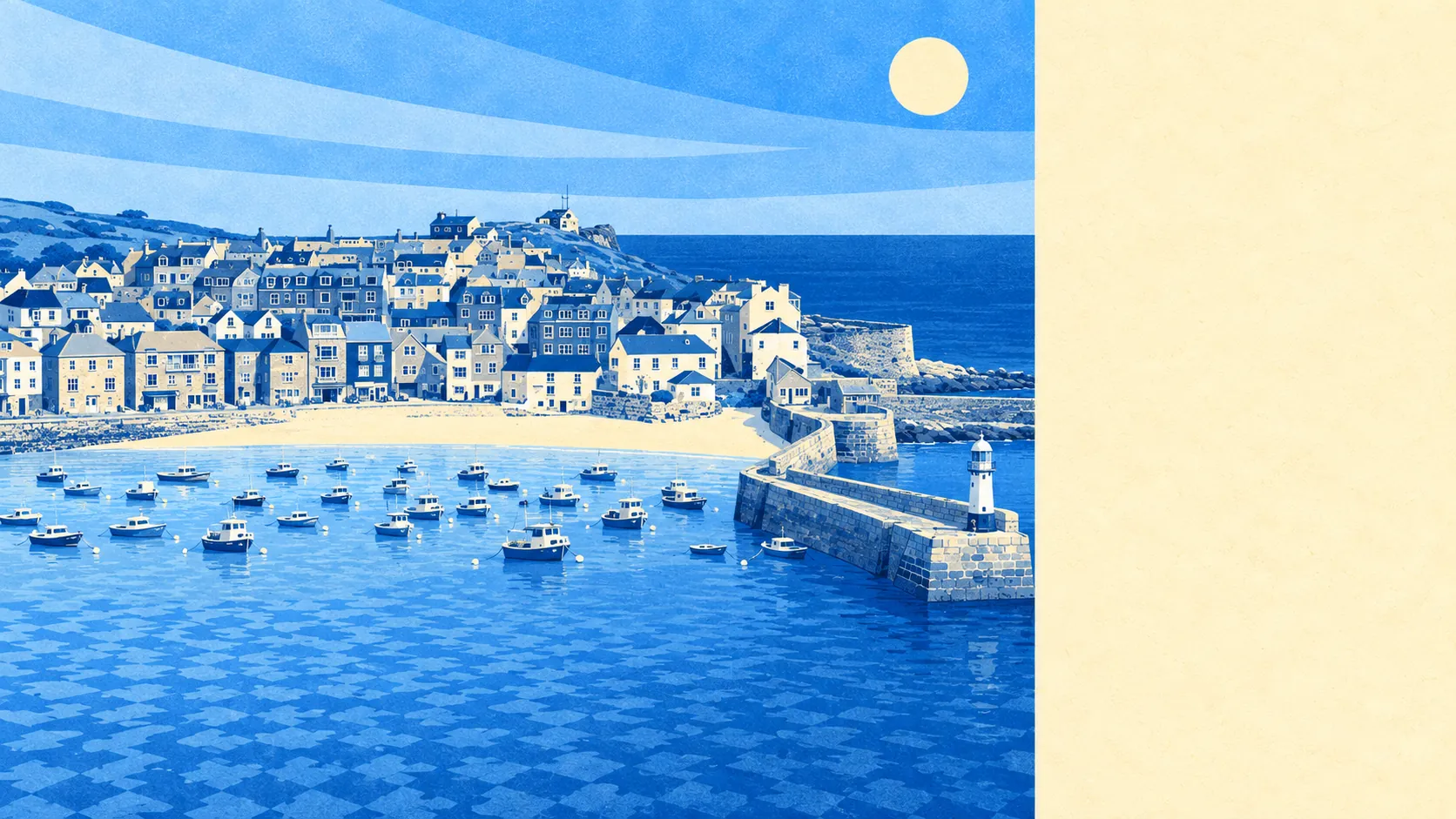
Yes, if you can stand being the off-season. St Ives is a working town that lets visitors believe it is a set. About four in ten homes are rented. The typical resident is past fifty. Recorded crime runs well above the county's. A good place to live, then, with an asterisk where the tourists park.
The dwelling stock is older and tighter than the holiday photographs suggest. On the council tax valuation list, which covers every home rather than only the ones with a recent energy certificate, about 35% are terraced, 26% flats, 15% semi-detached, 14% detached and 9% bungalows, and roughly 40% were built before 1930. That age shows up in the energy certificates, where about 42% of certificated homes reach band C or better, 35% sit at band D, and 23% are band E or worse. Around 67% are on mains gas. About 12% are heated by electricity alone, which in a granite cottage with original windows is the sort of detail worth knowing before the viewing rather than after the first February bill.
On price, the Land Registry recorded 78 sales in the year to May 2026 at a median of £335,000. The split by type is the interesting part. Terraced homes came in around £342,000, semi-detached around £270,000, flats around £287,500, and detached around £515,000. A terrace costing more than a semi is not a quirk of the dataset, it is the price of the walk to the harbour, and the harbour is what people are actually buying. Council tax lands low by national habit: band B is the most common band, and about 49% of dwellings sit in band A or B.
Renting is harder to pin down at town level. The national rent index puts typical private rent across the Cornwall area at about £1,000 a month as of April 2026, with two-bedroom homes around £880, and that is a county-wide average rather than St Ives's own figure. In a town with roughly 1,445 holiday lets on the rating list, the long-let market a tenant actually faces is thinner than a county average implies.
Safety is the weakest thing here and there is no gentle way to phrase it. Police.uk recorded about 97 crimes per 1,000 residents in the twelve months to May 2026, against roughly 74 per 1,000 across Cornwall, which puts the town about 31% above the county rate. Violence and sexual offences account for around 50% of recorded crime against about 35% nationally, though that category is a broad statutory grouping that includes assault without injury, so it flatters nobody and explains little. Anti-social behaviour makes up about 18%. Devon and Cornwall Police charge around 8% of recorded offences against about 12% nationally, and the force sits 42nd of 42 on that measure.
Getting about is a tale of two systems. The branch line from St Erth still runs into St Ives Rail Station, calling at Lelant and Carbis Bay, and it survived the Beeching cuts by being too scenic to kill. Almost nobody commutes on it: about 1% travel to work by train and 2% by bus, against 39% driving, 26% walking and 25% working from home. There are 69 bus stops in the area, and of the 30 with published service data the average is 87 scheduled weekday departures, with about 93% of those stops served at weekends. Broadband is better than the roads: superfast is available at about 94% of premises, gigabit at about 54%, and no surveyed postcode falls below the minimum service standard. About 95% of postcodes get a fourth or fifth generation signal from every operator. Department for Transport modelling from 2019 puts the town centre 7 to 8 minutes away by car and 17 minutes on foot, a doctor's surgery about 15 minutes' walk, and the nearest hospital 25 minutes by car or 47 by public transport.
Water is the recurring theme, in both the good and the awkward sense. Around 14% of postcodes carry a high rating on at least one flood indicator including surface water, and about 23% a medium one. On the narrower river-and-sea measure, roughly 13% of the area sits in the Environment Agency's flood zone 3 and 2% in zone 2. There are 25 recorded flood events, the most recent in January 2014, caused by the sea overtopping defences. Two-thirds of postcodes sit within 500 metres of the coast, the closest within about 10 metres, and the shoreline management policy for the frontage is to hold the line. The compensation is real: green space averages about 150 metres away with roughly 16 sites within a kilometre, and open water about 160 metres, without any area of outstanding natural beauty or site of special scientific interest designation over the built-up area to complicate it.
Heritage is the other constraint, and it is a serious one. There are 183 listed buildings, one at Grade I, two at Grade II star and 180 at Grade II, plus a conservation area covering the town and two scheduled monuments. The Church of St Ia, the Porthmeor pilchard cellars and studios, Knill's Monument and the harbour wharfs and piers with their two lighthouses are all on the list. Owning inside that grid means consent conversations about windows, solar panels and anything visible from the street, and it means the thing you liked about the town is also the thing standing between you and double glazing.
The resident profile explains a lot. About 57% own their homes, the median age is 51, and modelled gross household income averaged roughly £43,000 in the financial year to March 2023. Around 36% of households are one person, and about 20% are a pensioner living alone. This page also covers Zennor, out along the coast road, where the quiet is the entire proposition and the bus timetable is a lifestyle decision.
It suits people who want the sea at the end of the street and have made peace with sharing it. Retirees, people working from home, second-time buyers trading space for position, anyone whose week does not depend on a fast train or a parking space.
It suits far fewer families who need a commute, a driveway and a quiet August. If your household runs two cars and a school run, the stock, the streets and the season are all working against you, and the towns inland will hand you the garage and the faster road out without asking for the harbour premium.
The town has been collecting people who came for a fortnight and stayed since at least the market charter of 1487, though the town's treatment of an awkward guest peaked in 1549, when the portreeve John Payne was hanged for being a busy rebel after lunch. Virginia Woolf spent her childhood summers here. Barbara Hepworth stayed and left a sculpture garden behind, and Margaret Mellis, Bryan Wynter and Sven Berlin all worked in the same few streets. The Sloop Inn has been open since roughly 1312, which makes it older than most of the arguments about parking.
St Ives is average overall, and average here is built out of extremes rather than mediocrity. Its real strength is the surroundings: green space and open water within a couple of minutes' walk of nearly every front door, with nothing in the way. The weak spot is safety, where the recorded crime rate sits meaningfully above the county's and the charge rate sits below the national one. Buy here for the geography, price in the season, and stop expecting a resort to behave like a suburb.