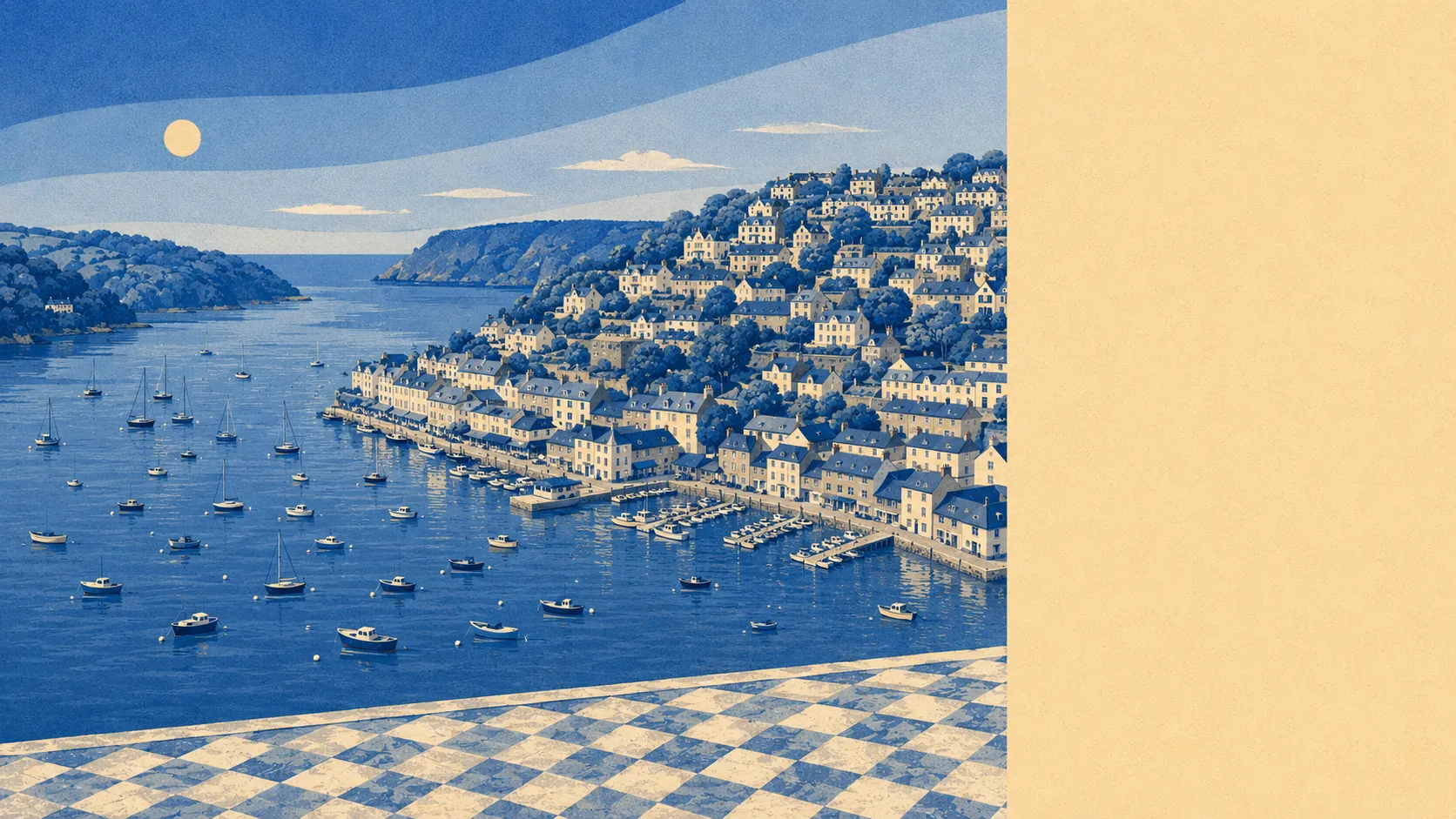
Salcombe is a good place to live once the commute, the bargain and the busy Tuesday are all behind you. The typical resident is closer to sixty than forty. Seven in ten own their home. Nobody catches the train, because there is no train to catch. Hundreds of the addresses in town are somebody else's fortnight in July. It is a comfortable, extremely good-looking, well-defended way of life, and the thing it defends best is quiet.
The council tax list carries 2,830 dwellings, and the mix is flatter than the postcard suggests. Detached houses are the largest single type at about 23%, bungalows and flats sit at about 21% each, terraces at about 20%, and semis last at about 14%. Around 31% went up before 1930, which in a town whose Victorian houses were built by shipowners and masters is roughly the era you can see from the water. Energy performance splits the place in two: about 43% of certificated property sits in bands A to C, about 34% is band D, and about 22% is band E or worse. Around 56% is on mains gas and about 14% runs on electricity alone, which is the difference between a January bill you grumble about and one you ring somebody about.
The Land Registry recorded 27 sales in the year to May 2026 at a typical £595,000. Detached houses ran to about £950,000 across eleven sales, terraces to about £473,000, flats to about £450,000. Where a sale could be matched to a certificate's floor area, the median came out at about £8,700 per square metre, on about 26% of sales, so treat that as a strong hint rather than a rule. Council tax lands mostly in band E, and only about 18% of dwellings sit in band A or B, which is the clearest statement anywhere in the data of how few genuinely small, cheap homes are left standing.
Renting is measured across the South Hams area rather than the town itself. The typical private rent across the South Hams area is about £1,000 a month as of April 2026, up 3.4% over the year, with area averages of about £730 for a one-bedroom, £910 for two, £1,120 for three and £1,610 for four or more. Those are district-wide figures covering everywhere from farm cottages to market towns. Salcombe is the end of the district with the water, and a table cannot see a view.
Recorded crime runs at about 41 offences per thousand residents over the twelve months to May 2026, roughly 16% below the South Hams average of about 49. That is the published rate, not the local incident count divided by the people who sleep here. One line in the mix deserves a buyer's attention: burglary accounts for about 9% of recorded crime against about 4% across England and Wales, though the totals are low enough that a few incidents move a share by several points. Devon and Cornwall Police charged in about 8% of cases over the same period against about 12% nationally, which places the force forty-second out of forty-two. Quiet is not the same as covered.
Schools are one primary, Salcombe Church of England Primary School, with an average scaled score of 104 in Key Stage 2 maths. Across Devon, Ofsted has graded 172 settings, of which 138 are good or better and three are outstanding, with 31 requiring improvement and three inadequate. Secondary is where the geography starts charging rent: the modelled trip to a secondary school is about 17 minutes by car and about 42 minutes on public transport, against about seven minutes by car to the primary. Those modelled times date from 2019, and the car figures have aged considerably better than the bus ones.
Nothing about getting out of Salcombe is easy. No residents travel to work by train, about 0.3% go by bus, about 45% drive, about 17% walk, and about 33% work from home, which makes the spare bedroom the best-performing transport link in town. There are 14 bus stops, ten with published service data, averaging around 16 weekday departures each and about 1.6 buses in the peak hour, all ten with a weekend service. Modelled journeys put the nearest town centre at about 18 minutes by car or 34 by public transport, a general practitioner at about 10 minutes by car, and the nearest hospital at about 58 minutes by car. Broadband is the pleasant shock: about 96% of premises can get superfast, about 46% can get gigabit, and none sit below the universal service obligation. Mobile coverage reaches about 100% of premises for at least one operator and about 91% for all of them. There are two electric vehicle charge points and neither is rapid.
About 15% of postcodes carry a high rating on at least one flood indicator including surface water, with about 7% medium and about 15% low. On the Environment Agency's river-and-sea flood zones, about 9% of the area falls in zone 3 and about 4% in zone 2, rising to about 11% once the climate allowance is applied. Three flood events are on record, the most recent in October 2004, caused by the sea overtopping defences. The shoreline management policy here is hold the line, which is an intention rather than a promise, and the long-running tide gauge at Devonport has sea level rising at about 2.35 millimetres a year. About 85% of postcodes sit within 500 metres of the coast, median about 200 metres. Against that, green space averages about 124 metres away with roughly 15 sites within a kilometre, water about 246 metres with around 50 features, and the entire town sits inside the South Devon Area of Outstanding Natural Beauty. Every postcode also falls in the upper radon bands, the highest among them, so a radon test belongs on the survey bill rather than in the eccentric column.
Sixty buildings are listed, four at grade two star and the rest grade two, and there are no conservation areas, which is not the constraint profile the harbour front implies. What actually governs what you can build is the protected area covering all of it, plus one scheduled monument at Fort Charles, the fort that held out for the King from January to May 1646 and was slighted on Parliament's orders for its trouble. Planning has been busy: 387 applications since April 2024, 168 of them in the last twelve months, and 40 withdrawn, which is the number that records how many people learned what they could not do only after applying.
About 71% own their homes, the median age is 59, and median household income is around £51,000 before tax for the financial year to March 2023. About 38% of households are one person and about 21% a single pensioner. There are 310 registered holiday lets and 81 shops against 893 households, and 277 titles in the postcode district are held by companies, three of them overseas. The shops sell Fat Face, Joules, Musto, Henri Lloyd and White Stuff, Jack Wills was founded at 22 Fore Street in 1999, and Cranches has been at it long enough to be the oldest sweetshop in Devon. The Moult, the first holiday home here, went up in 1764, so nobody in Salcombe can claim the second-home economy crept up on them.
It suits the retired and the semi-retired, the remote worker who wants a gigabit line and no station, the sailor, and the downsizer arriving with equity from somewhere with worse weather and better trains. It suits anyone who wants a protected coastline two minutes from the front door and has made peace with paying the postcode for it.
It does not suit a family weighing several secondary options within a short drive, anyone earning a local wage and hoping to buy on it, anyone who needs a hospital inside an hour, or the buyer who wants the town to feel like theirs in August. Kingsbridge is where the practical errands live, and that trade is honest in both directions.
Salcombe's real strength is what surrounds it. The whole town sits inside a protected landscape, green space is a short walk in any direction, the water is closer than that, and no amount of money buys a better version of that anywhere on this coast. The weak spot is connectivity, and it is not a close call: no railway, a bus network that exists rather than serves, and a hospital run on the wrong side of an hour. Everything between those two poles lands somewhere near ordinary, which is a peculiar verdict for a place this photogenic and the correct one. You are not buying a town. You are buying a view, a mooring and an empty street in February, and the cost of all three is that August belongs to someone else.