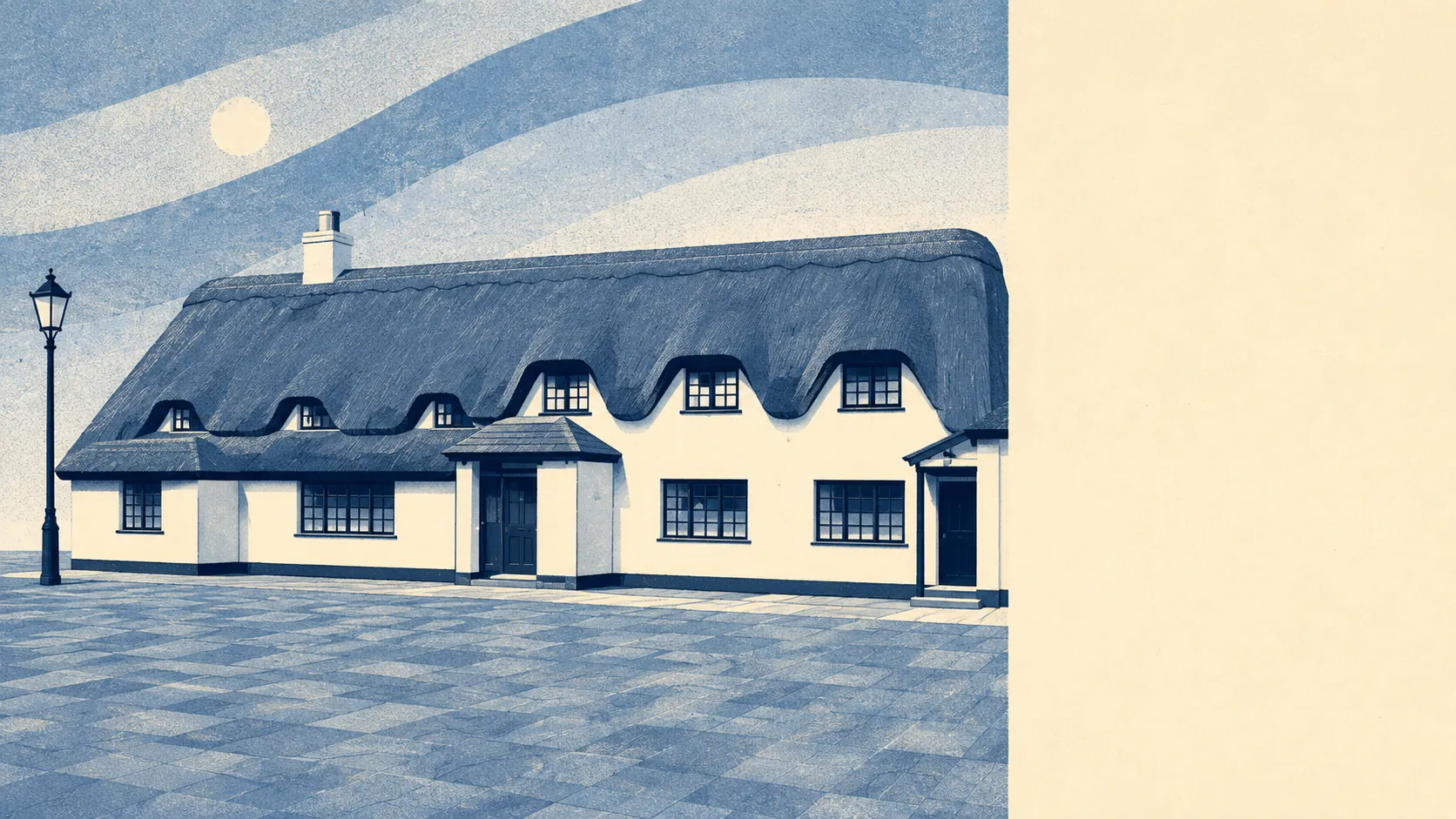
Yes, if you have made peace with the driving. The Pimperne area sits inside the Cranborne Chase and West Wiltshire Downs protected landscape, with green space a few minutes' walk from most front doors. Around seven in ten households own their homes. The typical resident is closer to fifty than thirty. This is a place that sorted itself out a long time ago and has been quietly declining to change ever since.
The housing is not the flat-and-terrace stock a townie buyer arrives expecting. Across every dwelling on the council-tax valuation list, roughly 28% are detached, 23% semi-detached, 20% terraced and 18% bungalows, with flats at about 7%. That bungalow share is the tell: this is a place built for people who did not fancy stairs, and about 27% of the stock predates 1930. Heating is the part worth knowing before the viewing rather than after. Only around 48% of homes run on mains gas, roughly 7% are on electricity alone, and the energy certificates put about 39% of certificated homes in band D with a further 27% in band E or worse. Only around 34% reach band C or better. An older stone or cob house off the gas grid is a different proposition in January to a 1970s bungalow with a boiler, and the certificate is the cheapest thing you will read all week.
On price, the Land Registry's last twelve months put the typical sale at about £378,000 across 47 transactions in the Pimperne area. Detached homes ran to around £440,000, semi-detached to about £370,000 and terraced to roughly £280,000, which is a spread wide enough that the median tells you almost nothing about the house you are actually looking at. Council tax sits mostly in band C, with only about 19% of dwellings in bands A or B. Band D bills run to roughly £2,765 a year. Nobody moves here for the council tax.
Renting is thinner ground, because the reliable figure is a wider one. The typical private rent across the Dorset area is about £1,040 a month, up around 4% over the year, and that covers everything from Weymouth flats to farmhouses. Treat it as the regional shape rather than a Pimperne quote. One-bedroom places across Dorset average about £720 a month, three-bedroom homes about £1,170, and detached properties about £1,420.
On crime, the published rate for the Pimperne area is about 42 recorded crimes per thousand people over the year to May 2026, which sits roughly 24% below the Dorset average. Dorset Police charge in about 14% of cases, a little above the England and Wales figure of around 12%, and close about 35% of cases with no suspect identified. The category mix is the ordinary rural pattern: violence and sexual offences at roughly 39%, anti-social behaviour at about 20%, criminal damage and arson at around 11%. The totals are small enough that a handful of incidents moves any one of those shares by several points, so treat the mix as a sketch rather than a settled character reference. Safety is the dimension where this area does best on the numbers, and it does it undramatically.
Schools are the quietly strong hand. Ofsted has graded 86 settings across Dorset, of which 68 are good or better and two are outstanding, with 17 requiring improvement and one inadequate. The village has a Church of England primary of its own, and Archbishop Wake, Dunbury, Durweston and Milldown are all within the wider area, with The Blandford School as the local secondary. Key stage two maths in the district averages a scaled score of 103, marginally above the national benchmark of 100. There is also a striking concentration of independent schools nearby, Bryanston, Clayesmore, Hanford, Milton Abbey and Sandroyd among them, which shapes the local sense of what school choice means more than most parents will admit at the gate.
Connectivity splits neatly into two answers. Digitally, it is genuinely good: gigabit broadband reaches about 89% of premises, superfast about 94%, and only around 1% sit below the universal service obligation. Every postcode gets a fourth or fifth generation mobile signal from at least one operator, and about 97% get all of them. Physically, it is a car place and makes no apology. Roughly 55% drive to work and about 33% work from home, while trains and buses together account for well under one in a hundred commutes. Department for Transport modelling from 2019 puts the town centre at about 15 minutes by car and around 31 by public transport, a general practitioner surgery at about 14 minutes by car, and a hospital at roughly 42 minutes by car against 83 by public transport. There are 188 bus stops in the area and about 19 weekday services at the average stop, but only 40% of stops see any weekend service at all. If you cannot drive, this is the fact that decides everything else.
Flooding is a small, specific concern rather than a general one. About 3% of the area sits in the Environment Agency's river-and-sea flood zone two and roughly 2% in zone three, rising to about 7% under the climate-change allowance. On the wider postcode indicators, which include surface water, around 8% of postcodes carry a high rating on at least one measure, 6% medium and 21% low. No historic flooding is recorded across the area. Ground conditions are worth a survey line: roughly 84% of the area falls in a moderate soluble-rocks class, which is chalk behaving like chalk, and radon sits in the low band throughout. The compensation is the setting. Green space averages about 450 metres from a front door with four sites within a kilometre, water is even closer at around 390 metres, and roughly 79% of the area lies inside a protected landscape.
Heritage is where the enthusiasm meets the planning officer. The area holds 525 listed buildings, 18 of them grade one and 27 grade two star, along with 17 conservation areas and 56 scheduled monuments including Pimperne Long Barrow, Hod Hill and Hambledon Hill. That density is not decoration, it is a constraint. Replacing windows, adding solar panels, extending sideways or doing anything visible from the road becomes a conversation rather than a decision, and the answer arrives on the council's timetable rather than yours.
The character follows from all of that. Around 71% own their homes outright or on a mortgage, the median age is 49, and gross household income averages about £59,400 across the area. About 26% of households are single people and around 16% are single pensioners. It is settled, comfortable and not remotely interested in your opinion of it.
It suits people whose lives are already built around a car and a garden: families wanting a primary school where the head knows the child's name, downsizers who want a bungalow with a view of the downs, and anyone working from a spare room who values gigabit broadband over a station platform.
It does not suit anyone who needs a train, an evening that starts after eight, or a house they can reshape at will. If your plan involves knocking through, glazing the back and putting panels on the roof, check the listing status and the conservation boundary before you offer, not after.
Pimperne is a good place to live, and an honest one about what it costs you. Its real strength is the ground it stands on, the chalk downland, the protected landscape and the walking that starts at the end of the lane. The weak spot is the freedom to change your own house, which the listings and conservation boundaries have thoroughly spoken for. Buy the setting, and take the planning constraints as the price of admission rather than a surprise on the survey.