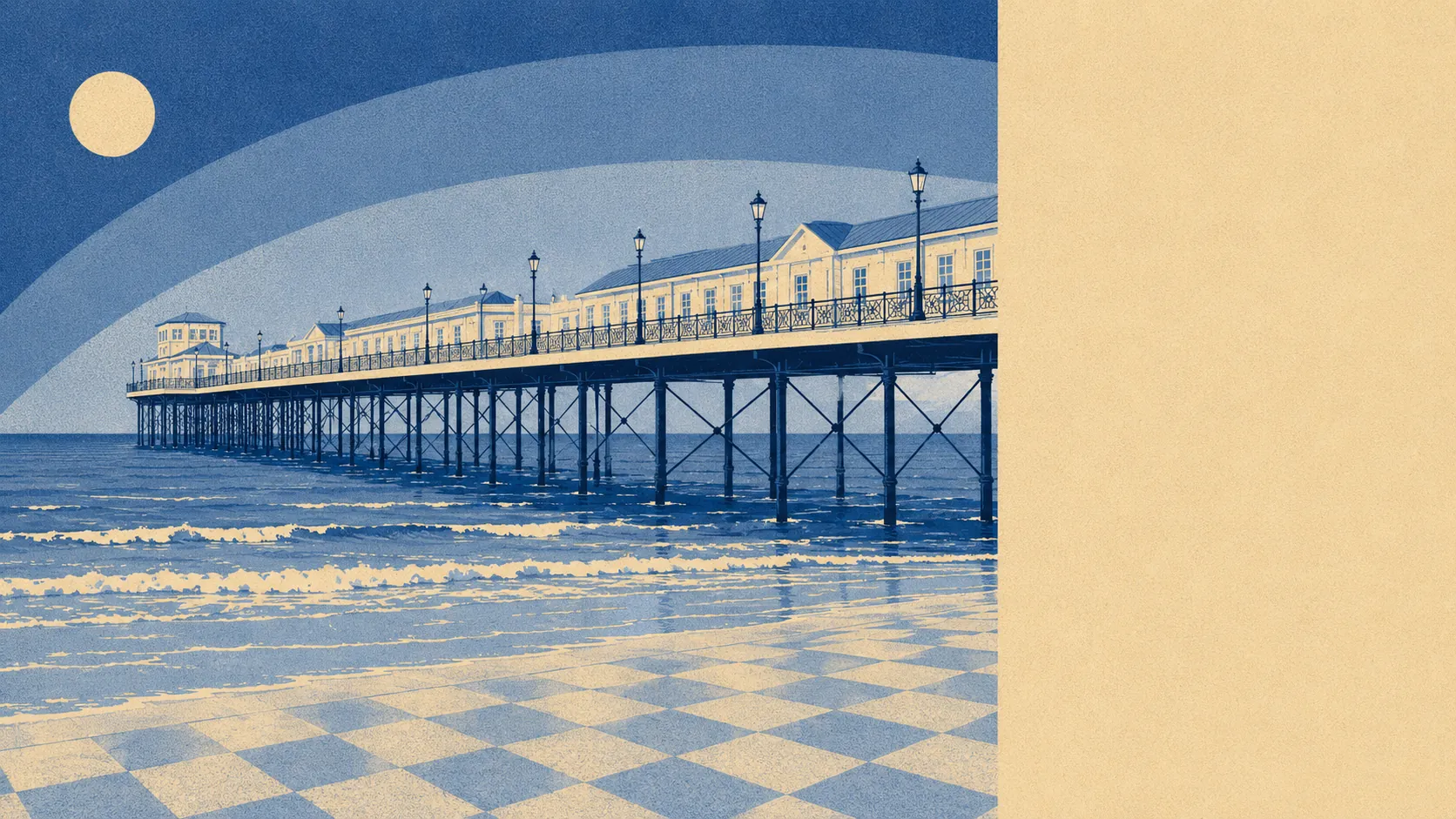
The surroundings are the strongest argument for living here. Green space sits roughly a hundred and sixty metres from a typical front door. Water is closer than most people's nearest post box. Around twenty parks, greens and playing fields fall within a kilometre of the average postcode. Nothing here carries an official designation for natural beauty. It simply has the stuff, in quantity, at the end of ordinary streets.
On green space, the mapping puts about 20 sites within a kilometre of a typical postcode and the nearest about 160 metres away. That is not one big park doing the work for a whole town. It is a scatter of them, close enough that a dog gets walked without anybody getting in a car, which is the difference between green space you have and green space you visit twice a year.
Water is the other half of it. The average postcode sits about 481 metres from open water, with roughly 30 pieces of blue space inside a kilometre. Those are numbers that only occur when a town is wrapped around a bay and threaded with the streams running down to it.
Cycling is where the picture thins. The nearest National Cycle Network route averages about 6,800 metres from a postcode, and no postcodes here sit close to one. The coast path is on the doorstep and the signed cycle network is not, which is an odd gap for a place this committed to being outdoors.
The high street, measured as premises rather than atmosphere, runs to 1,059 shop units, 70 pubs and 83 restaurants. That is a lot of retail frontage for a town this size, and the reason is the same reason the promenade exists: this place was built to serve more people in August than it houses in February.
Air quality across the Torbay council area registered about 5.3 micrograms per cubic metre of fine particles in 2024. Coastal towns tend to do well on this measure for the obvious reason that the wind rarely stops.
The character sorts itself geographically. Goodrington and Preston sit along the shore, Broadsands beyond them, with Galmpton and Stoke Gabriel out towards the Dart, and Marldon and Collaton St Mary inland where the pavements give up and the lanes start. Cockington sits over the boundary with its own conservation area. The South West Coast Path runs the whole edge of it, the zoo and the steam railway to Kingswear pull in visitors who never see the residential half, and Compton Castle and Berry Pomeroy Castle sit within a short drive for anyone who likes their history structural.
Private outdoor space is unusually generous. Across the 46 neighbourhoods measured, gardens account for about 108,000 square metres per thousand residents, which for a town of this density is a genuine surprise. The plots came with the post-war building, and nobody has since managed to build over them at scale.
The wider business picture, taken from the rateable premises on the valuation list, runs to 1,855 entries including 388 offices and 580 holiday-let premises. That holiday-let count is the town's second economy sitting in plain sight on a government spreadsheet, and it explains a good deal about which streets feel busy in July and empty in January. Premises on a list are not the same as businesses currently trading, so read it as capacity rather than a directory.
For eating out, 382 premises carry a food hygiene rating, about 73% of them at the top score and about 4% at the low end. Slightly better than the national temperament would predict for a resort town with this many places to eat.
One honest absence is worth recording. No area of outstanding natural beauty overlaps here, no site of special scientific interest, and no ancient woodland registers within the area. The landscape has never been formally decorated. It has simply been available, continuously, at close range, which for daily life is worth more than a designation on a map.
The surroundings are what Paignton is genuinely excellent at, and the town has the good manners not to charge extra for it.