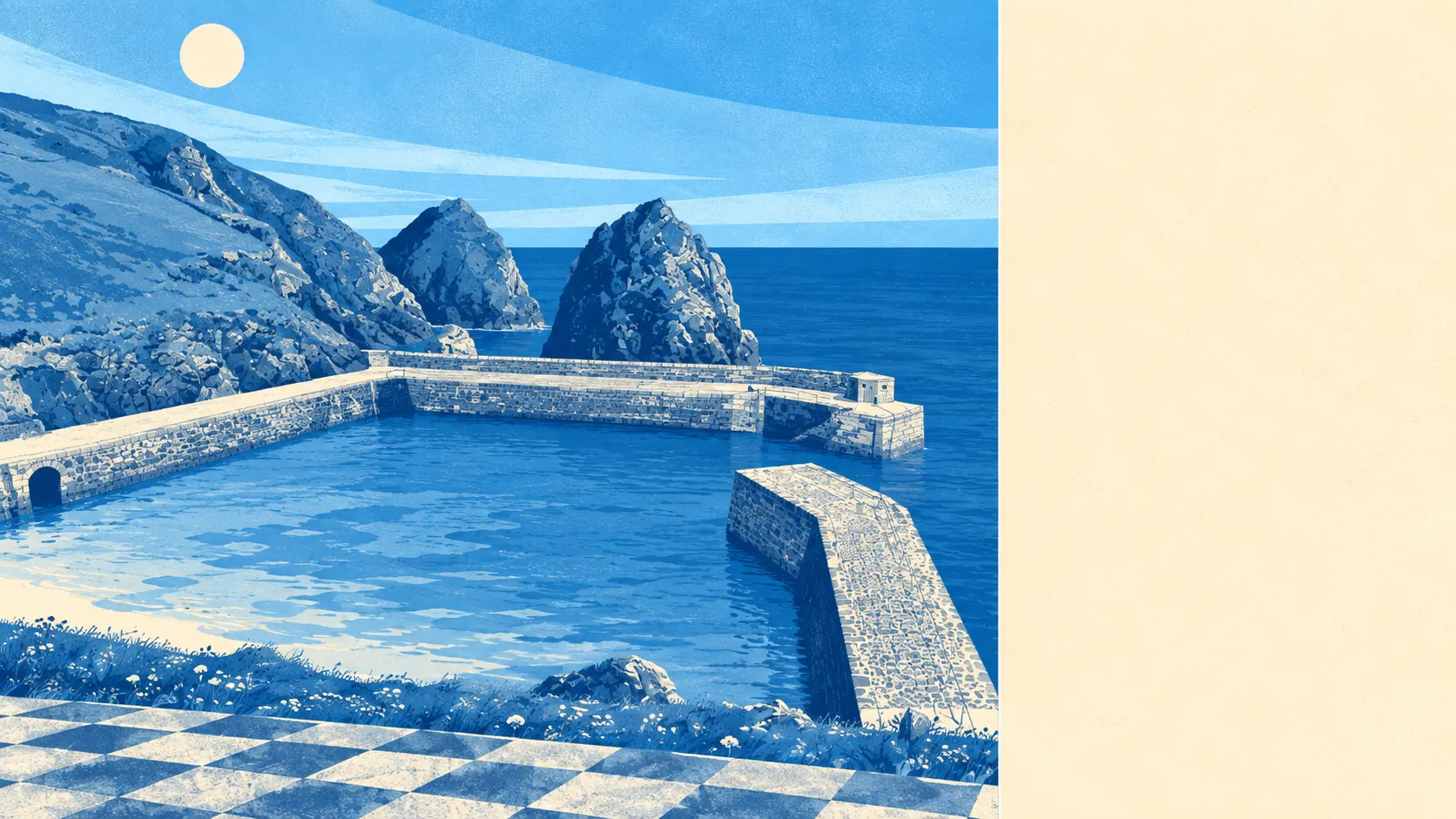
The area around Mullion is better than the village itself, and everyone who lives here knows it. Open ground starts at the end of the street. The sea is close enough to walk to before breakfast and far enough that you do not have to listen to it. Gardens here are the size that people in cities have stopped believing in. This is a place where the surroundings do the entertaining, because nothing else is going to.
Green space is the headline. Homes here sit an average of roughly 150 metres from accessible open space, with about nine separate spaces within a kilometre. That is not a park at the end of a bus route. That is a front door that opens onto somewhere to walk.
Water is nearly as close. Open water averages about 550 metres away, with around 15 separate stretches within a kilometre, which on the Lizard means coves, pools and the coast rather than a boating lake. Mullion Cove, Polurrian Cove and Poldhu Cove all sit at the bottom of the valleys running west from the village, and the South West Coast Path runs along the cliffs beyond them.
The local economy is the other reason the area works. The rating records count 63 shop premises, 17 pubs, six restaurants and six offices across the area, which for the largest village on the peninsula is a functioning centre rather than a row of closed shutters and a post office counter in a Spar. Mullion supplies the hamlets around it, which is what the smaller places, Trewoon, Cury, Cross Lanes, Chyanvounder and Predannack Wollas, rely on it for.
Air quality barely registers as an issue. Fine particle levels across the Cornwall council area averaged about five micrograms per cubic metre in 2024, which is the sort of number that comes from having the Atlantic upwind and almost no heavy road traffic.
The texture of the place is small settlements strung between farmland, heath and cliff. North of the village the land is worked for crops and grazing. South of it, Predannack Downs rises onto open heath, with Predannack Airfield sitting out in the middle of it, still a satellite of the naval air station nearby. Mullion Island sits offshore, where the seining companies once posted a lookout to watch for pilchard shoals. Further down the peninsula, Lizard and Ruan Minor carry on the same pattern with fewer shops and more weather.
Private outdoor space is the number that separates rural Cornwall from the rest of England. The area holds roughly 240,000 square metres of private garden per 1,000 residents. Gardens here are not a feature described in a listing. They are simply what a house comes with.
On the business side, the non-domestic valuation list carries 98 rateable premises within the mapped area, heavily weighted towards one category, which accounts for 41 of them, with 18 in the next largest. Those are premises with a rateable value rather than businesses currently trading, so read the list as capacity rather than as a directory of what is open this week.
Eating out is a small field with a good record. Of the 12 food premises with a published hygiene rating, about 83% hold the top score, and none sit at the bottom of the scale. Twelve is not a restaurant scene. It is enough to eat somewhere different on a Friday.
One honest absence: no area of outstanding natural beauty boundary, site of special scientific interest or ancient woodland overlaps the built-up area itself. The protected coast and downland sit beyond where the houses stop, which is a good arrangement for anyone who wants the landscape without inheriting its paperwork.
The surrounding area is the single best thing about living here, without serious competition. Buy in Mullion for what is outside it, because the outside is doing all the work.