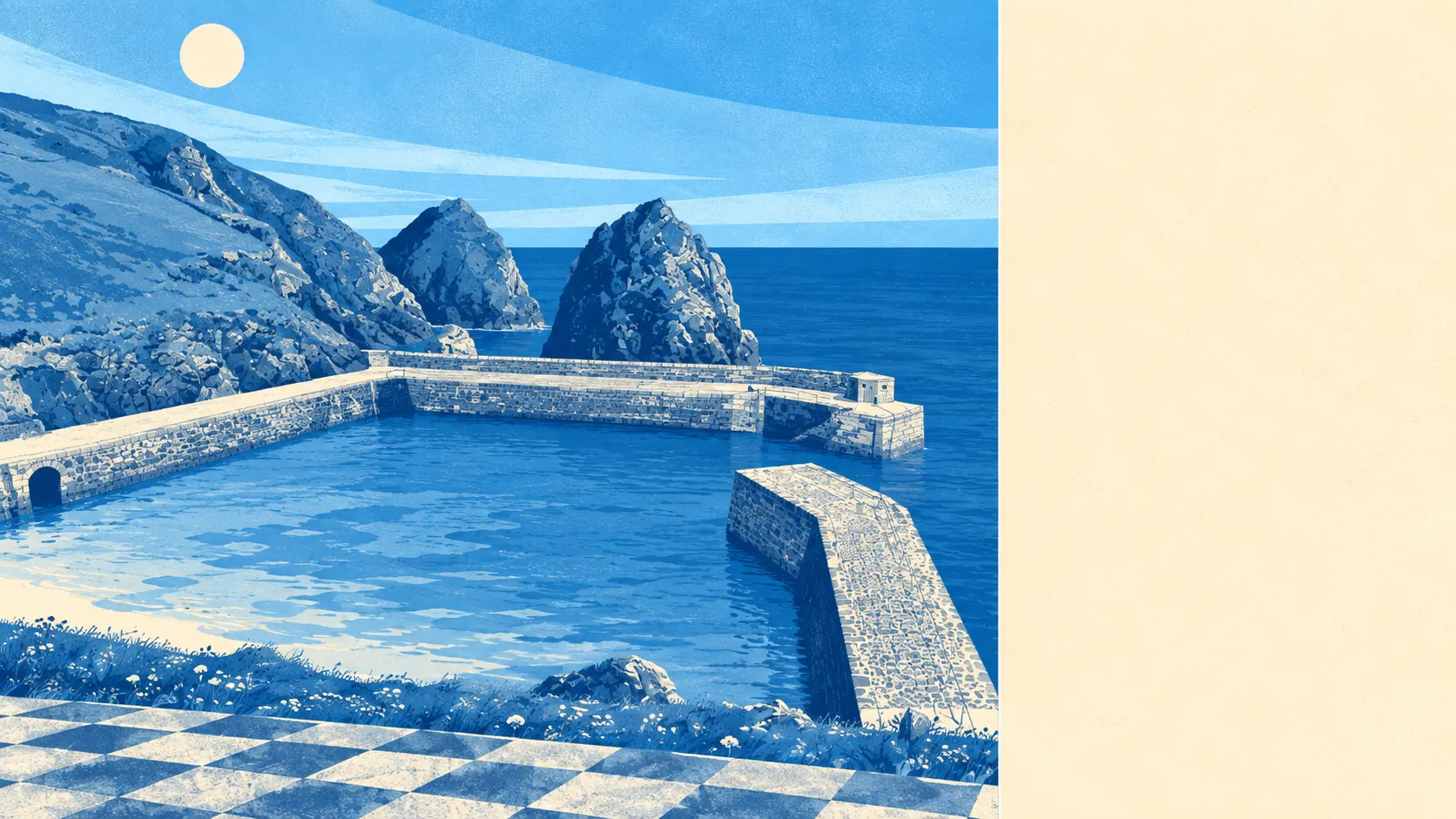
Mullion is a good place to live for people who have finished being in a hurry. Seven in ten own outright or with a mortgage. More than a third of the homes are bungalows. Almost everyone drives, because the alternative is a timetable. None of that is an insult, it is the deal the Lizard has been offering for a couple of centuries, and the village is the biggest thing on the peninsula precisely because enough people took it.
Start with what you would actually be buying. On the council tax valuation list, which covers every dwelling rather than only those sold or certificated recently, bungalows make up 37% of the stock, detached houses 23%, terraces 17% and semis 16%. Flats account for about 5%, which in practice means they barely exist. Around 24% of the housing predates 1930, so the bulk of Mullion went up in the post-war decades, when a sea view and a single storey were considered the reasonable ambition. The energy certificates are where the romance thins out: 29% of certificated homes sit in band C or better, 29% in band D, and 42% in band E or worse. Only 6% of households are on mains gas. Another 26% heat with electricity alone. An electrically heated house in band F, in a village that catches every weather system the Atlantic sends, is a running cost you want to understand before the second viewing rather than after the first winter.
Prices are Cornish-coastal without being Cornish-coastal-famous. The Land Registry recorded 35 sales in the twelve months to early February 2026, at a median of £312,000. The spread by type is wide: detached homes at a median of £447,500, terraces at £270,000, semis at £230,000. Council tax settles on band D as the most common, with 37% of dwellings in bands A or B, and a band D bill of roughly £2,590 a year. The cheap end of Mullion is genuinely cheap by the standards of anywhere with a coast path at the end of the lane.
Renting is harder to pin to the village itself. The typical private rent across the Cornwall area, measured by the Office for National Statistics rather than from advertised listings, was about £1,000 a month as of April 2026, up roughly 5% over the year. Across Cornwall, two-bedroom homes average about £880 a month and three-bedroom homes about £1,080. Treat those as the county's shape, not Mullion's own.
On safety, the published rate for the area is 63 recorded crimes per 1,000 people in the twelve months to May 2026, about 15% below the Cornwall average. The category mix leans towards violence and public-order offences rather than vehicle crime, though the totals are small enough that a handful of incidents moves any share by several points, so nobody should treat that mix as a fixed characteristic of the place. The less comfortable number belongs to the force rather than the village: Devon and Cornwall Police charged in 8% of cases over the same period, against about 12% nationally, which places it last of the 42 forces in England and Wales. Low crime and low charge rates are not the same reassurance.
Getting about is a car conversation. Around 57% of working residents drive to work, 23% work from home, 14% walk, and the share using a train rounds to nothing. There are 19 bus stops in the area, averaging about 28 scheduled weekday departures each, and every stop with service data runs at weekends too, which is better than rural Cornwall's reputation. Department for Transport modelling from 2019 puts the nearest town centre 24 minutes away by car and 38 by public transport, and the nearest hospital 50 minutes by car against 91 by public transport. Those public transport figures age badly as services are withdrawn, so lean on the car numbers. Day-to-day, the walking times are the good news: about seven minutes to a food shop, nine to a doctor's surgery, ten to a primary school, 14 to the secondary. Broadband is a straight win. Superfast reaches every premises, gigabit service reaches 87%, nothing sits below the universal service minimum, and 95% of the area gets a signal from all mobile operators.
The surroundings are the reason anyone is reading this. No part of the area falls inside the river-and-sea flood zones. On the postcode indicators, which include surface water, 9% of postcodes carry a high flagging, 7% medium and 37% low. Green space averages 151 metres from the front door, with about nine separate spaces within a kilometre, and open water about 550 metres. The coast is the constraint as well as the attraction: the closest postcodes sit around 120 metres from it, the shoreline management policy across the area is no active intervention, and the tide gauge at Devonport has been recording sea level rising by about 2.35 millimetres a year. Radon is the other thing to price in, with 95% of postcodes in band three or above and a maximum classification of elevated, which means testing rather than panicking.
Heritage restriction is unusually light for a Cornish village with this much history. There are 12 listed buildings, one at Grade I, one at Grade II*, ten at Grade II, including the Church of St Mellanus and Bochym Manor House, plus one scheduled monument. There are no conservation areas. For most owners that means replacing windows or extending is a normal planning question rather than a heritage negotiation.
The people, in outline: 71% of households own their home, the median age is 53, and household income across the area averaged about £45,700 gross in the financial year to March 2023. Eighteen percent of households are a single pensioner. The coverage here takes in Lizard and Ruan Minor as well, further down the peninsula and further from everything, where the same pattern runs harder.
It suits retirees, remote workers with good chairs, families who want a primary and a secondary inside a short walk, and anyone whose weekends involve the sea rather than a car park with a shopping centre attached.
It does not suit anyone who needs a train, anyone commuting to a hospital shift, anyone expecting a rental market, or anyone who wants the energy bills of a new-build with the character of a 1960s bungalow.
The village has always attracted people who wanted to be somewhere specific. Stephen Halden Beattie, who won the Victoria Cross for driving the destroyer Campbeltown into the dock gates at Saint-Nazaire, died here. James Erisey sailed as a privateer with Francis Drake. The fighter pilot Geoffrey Wellum and the broadcaster Sheila Tracy both belong to the parish list. Before any of them, the seining companies posted a huer on Mullion Island to watch for the dark shadow of a pilchard shoal, and a slab of native copper dug out at Wheal Unity was shipped to the Great Exhibition in 1851. Mullion has produced considerably more history than a place this size has any business producing.
The verdict lands above average, and the reason is the ground it stands on. Its real strength is the setting: green space at the end of every lane, water in walking distance, no river or sea flood zone, and a national nature reserve for a back garden. The weak spot is the community measure, where the area sits in the fourth decile nationally on deprivation and has moved down rather than up since 2019, which is what a village economy built on visitors, second homes and a five-mile drive to the nearest town tends to do. Buy here for the peninsula and the bills you can budget for. Do not buy here expecting the village to carry you.