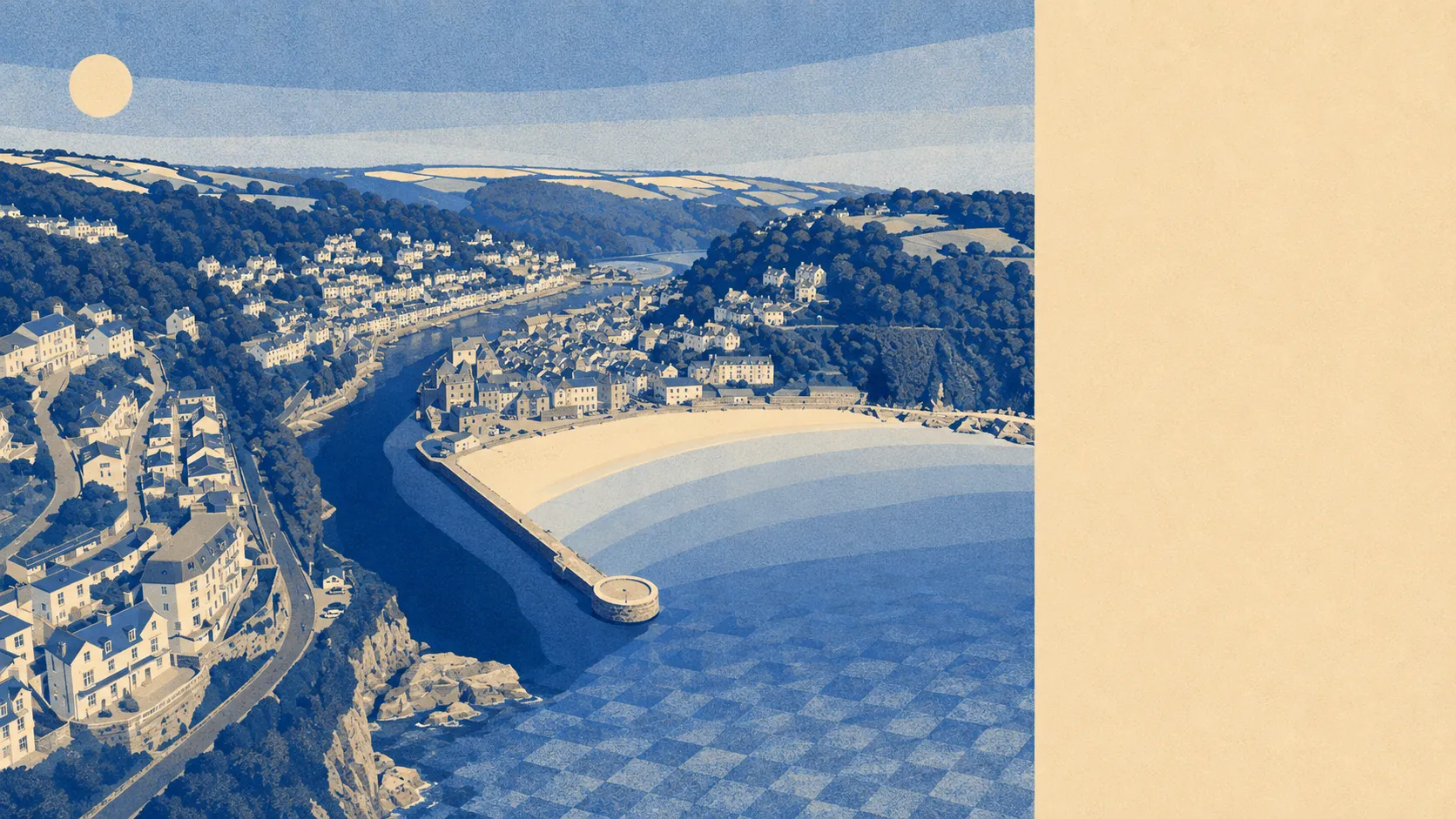
Yes, if you have already made your peace with the hill. Two-thirds of people here own their homes outright or with a mortgage. The typical resident is in their mid-fifties. The nearest hospital is the better part of an hour in the car. That is not a town on the way up or the way down, that is a town that decided what it was and stopped taking questions.
The housing stock is broader than the harbour postcards suggest. Across every dwelling on the council-tax valuation list, flats make up 24%, bungalows 21%, detached houses 20%, terraces 19% and semis 13%, which is an unusually even spread for a Cornish coastal town and reflects a place that kept building outward while the old core stayed fossilised. Around 31% of dwellings were built before 1930, so the fisherman's cottage stereotype is real for roughly a third of the town and a post-war reality for most of the rest. On energy, the certificated stock leans middle-to-poor: 36% sit in band D and 23% in band E or worse, against 41% making it into bands A to C. About 66% of homes run on mains gas, but 13% are on electric-only heating, which in a pre-1930 building with solid walls is the single most expensive sentence in this paragraph. Ask which one you are buying before you fall for the view.
On price, the Land Registry's last twelve months put the typical Looe sale at £272,500, from 79 transactions. The spread by type is wide enough to matter: detached houses ran to a median of £385,000, semis £252,500, terraces £230,000, and flats £168,225. Price per square metre across the sales that could be matched to a floor area came in around £3,050. The council-tax picture is the giveaway that this is not a uniformly expensive place: band B is the most common band, and 51% of dwellings sit in bands A or B combined. A band D bill in this area runs to about £2,591 a year.
Renting is a different proposition, and the honest caveat is that the reliable figure is not Looe's own. Typical private rent across the Cornwall area is about £1,000 a month, up 4.6% over the year, and that is a whole-county average rather than a harbour-town one. By size, one-beds average £689, two-beds £882, three-beds £1,078. In a town carrying 477 holiday-let hereditaments, the long-term rental market is competing for stock with people who only want the property for twelve weeks a year, and the county average is unlikely to be flattering that competition.
On crime, the recorded rate is 68 per thousand people over the twelve months to May 2026, which sits about 8% below the Cornwall average. That is a published rate on a police-boundary population base, not something you can arrive at by dividing incidents by residents. Violence and sexual offences make up 49% of recorded crime against 35% nationally, and criminal damage 14% against 7%, but the totals are small enough that a handful of incidents moves a share by several points, so treat the mix as noise rather than character. Devon and Cornwall Police charge in 8% of cases against 12% nationally, and record no suspect identified in 26%.
Connectivity is where the town runs out of road, occasionally literally. Looe Rail Station sits on a branch line, with Sandplace and Causeland further up it, and 0.4% of working residents commute by train. Buses average 45 weekday services per stop and 77% of stops have some weekend service, which is better than most of rural Cornwall and still not a network. Driving takes 47% of commuters, walking 17%, and 28% work from home. The modelled car journey to a hospital is 50 minutes; by public transport it is nearly two hours. Broadband is the same shape: 97% of premises can get superfast, but only 23% can get gigabit, and no premises fall below the universal service obligation. Mobile signal is near-universal, with all operators covering 95%.
The water is the defining environmental fact, and Looe has never pretended otherwise. Around 20% of postcodes carry a high rating on at least one flood indicator including surface water, with 10% at medium. In the Environment Agency's river-and-sea flood zones, 14% of the area falls in zone 3, rising to 17% under the climate-change allowance. Forty-two flood events are on the recorded register, the most recent in September 2025 from the sea. Around 7% of the area has flooded historically. The coastal management policy for the town is hold-the-line across the twenty, fifty and hundred-year horizons, and the nearest tide gauge at Devonport records sea level rising 2.35 millimetres a year. Set against that, the outdoor access is genuinely excellent: green space averages 272 metres away, water 220 metres, with around six green spaces within a kilometre of the typical postcode. Radon is high band across the whole area, which means a test and, if needed, a fan rather than a reason to walk away.
Heritage constrains what you can do to a building here more than most places. There are 106 listed buildings in the area, one of them Grade I and six Grade II\*, plus the Looe conservation area and the scheduled Old Guildhall. One entry sits on the Heritage at Risk register. Practically, that means window replacements, roof materials and anything visible from the street become a conversation with the council rather than a weekend job, and it is the single most common thing buyers underestimate about a harbour town.
The character of the place follows from the numbers. Around 68% own their homes, the median age is 56, and household income runs to about £40,800 gross, or £33,100 net. A third of households are single-person and 20% are single pensioners, while couples with children make up 11%. This page also covers Pelynt and Lansallos, both quieter and further inland, where the coastal premium thins and the bus timetable thins with it.
It suits people who are done commuting. Retirees, remote workers with a decent connection and a tolerance for hills, second-career types who want the sea within a couple of hundred metres and do not need a Waitrose. Families are better served than the reputation suggests, with Looe Primary Academy and Looe Community Academy in the town and Ofsted grading 95 of Cornwall's 120 graded settings good or better.
It does not suit anyone who needs a hospital in fifteen minutes, a train that goes somewhere useful before nine, or a ground-floor flat they have not checked against a flood map. If your work requires you in an office in a city on Tuesday mornings, this is a holiday, not an address.
The town has form for attracting people who needed somewhere to recover or think. Katherine Mansfield came here in 1918 while recovering from tuberculosis, and the portrait Anne Estelle Rice painted of her in Looe now hangs in New Zealand's national museum. John Mayow, who worked out a good deal about air and breathing in the seventeenth century, came from here. So did the geologist William Pengelly. A place that produces people who look closely at rocks and air is a place with time on its hands.
Looe is a decent bet without being an obvious one. Its real strength is the setting: the water, the green space, and the fact that both are a few minutes' walk from almost every front door in town. The weak spot is getting anywhere, whether that is the branch-line timetable, the hour to a hospital, or the gigabit connection you probably cannot have. Buy here because you want to be in Looe, not because it is convenient for somewhere else, because it is emphatically not.