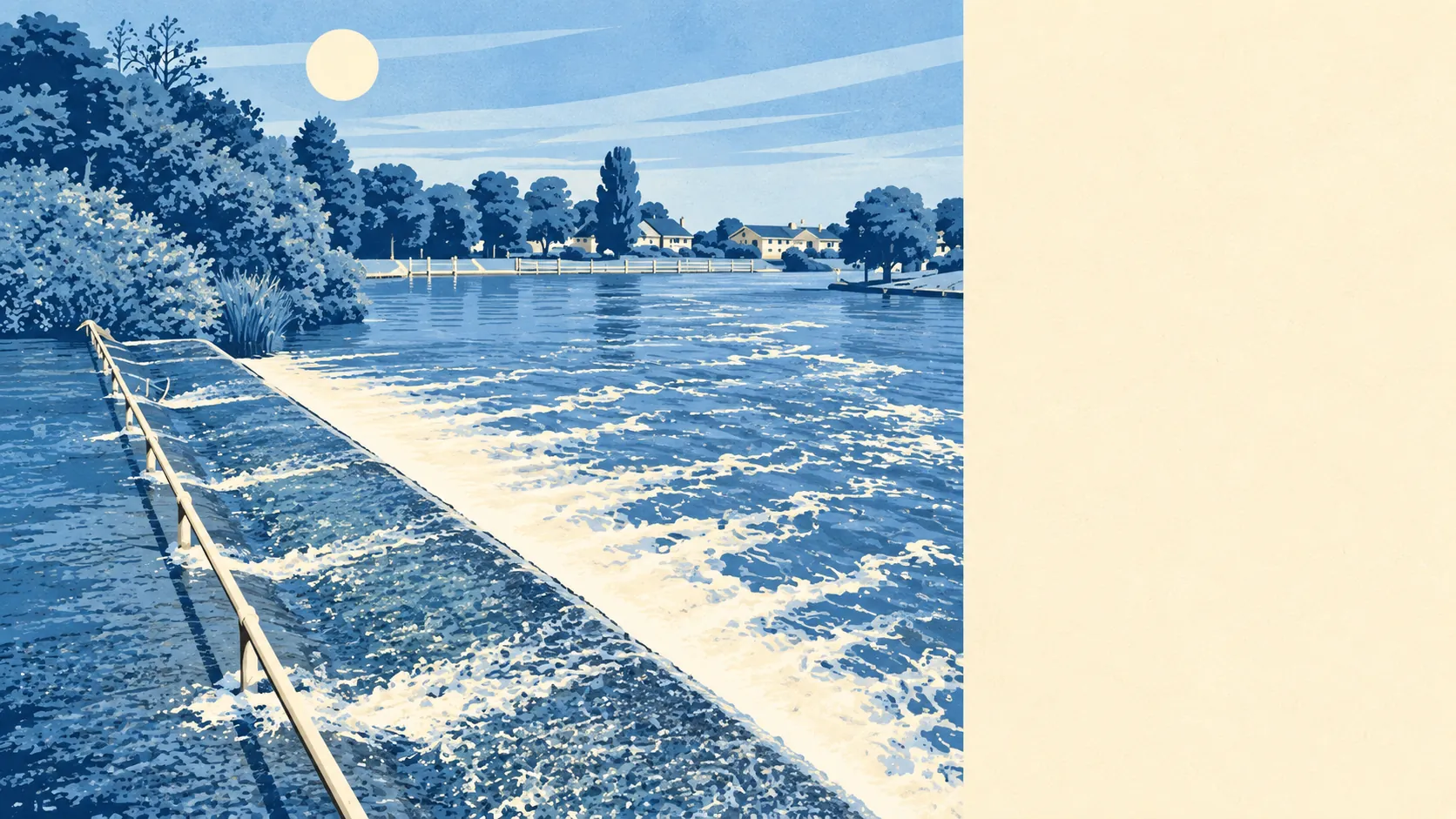
Laleham is a good place to live, provided you get on with the river. Nearly nine in ten households own their home. Crime runs at about half the borough's rate. A good share of the village carries some flood risk. The Thames gives Laleham most of what it's worth, and it reserves the right to visit.
Away from the clustered centre around All Saints, Laleham is post-war houses, and a lot of bungalows. On the council-tax valuation list for the surrounding area, semi-detached homes are the biggest group at about 29%, with flats at 18%, terraces at 17%, detached houses at 16% and bungalows at 11%. Only about 8% of that list was built before 1930. Of the 472 homes here with an energy certificate, about 41% are band D, a quarter are E or worse, and roughly a third reach C or better. About 79% of homes heat with mains gas, so the oil-tank surprise that catches buyers in some riverside villages is less of a risk here. The old village is the postcard, though the rest of Laleham was built for people who wanted a garden and a drive.
The Land Registry's last twelve months, to May 2026, put the typical sale at about £565,000 across 27 sales. Detached houses went for around £627,000 over 11 sales, and semis for about £552,000 over 12. Only three terraced houses sold, at a median of about £367,000. Council tax follows the same line. Band E is the most common band, and only about 10% of homes are in bands A or B. Three terraces in a whole year means the cheap way into Laleham is mostly a rumour.
Renting is rare. Fewer than one in ten households rent privately, so there isn't much stock to choose from. Spelthorne's typical private rent was about £1,630 a month in April 2026, up about 1% on a year earlier, a borough-wide average that has to cover flats in Staines as well as houses near the towpath.
Surrey Police recorded crime here at about 51 per 1,000 people over the twelve months to May 2026, against a Spelthorne average of about 91 per 1,000. Violence and sexual offences make up about 37% of the total, close to the national share. Totals are low enough here that a handful of incidents can move that mix by several points, so read it as a snapshot of one year.
Laleham has no station. The nearest ones are Staines, Shepperton, Ashford (Surrey) and Chertsey, and the 2021 Census shows how much use they get. About 2% of working residents took the train, 47% drove, and 41% worked from home. There are 14 bus stops in and around the village, averaging about 32 weekday departures each and two an hour at peak, with weekend services at all of them. The Department for Transport modelled the trip to the nearest town centre in 2019 at about 19 minutes by public transport and 10 by car. Buses get withdrawn faster than towns move, so the public transport figure has aged worse than the car one. Gigabit broadband reaches about 64% of premises and superfast about 99%. Every station Laleham uses has another place's name on it.
The river is the best and the worst of it. Green space is about 160 metres from the average home, with around nine sites inside a kilometre, water is about 150 metres away, and the National Cycle Network is roughly 260 metres off. The flood mapping is the cost of all that. About 21% of postcodes carry a high risk on at least one flood indicator, surface water included, and about 45% carry at least a medium one. In the Environment Agency's river-and-sea flood zones, about 29% of the area is in Zone 3 and about 38% in Zone 2. The Agency has 31 recorded flood events here, the latest in February 2014. Where a postcode shows as "defended", the Agency's model includes a defence. It doesn't promise the defence will keep a particular kitchen dry. Get an insurance quote for the exact address early, while walking away still costs nothing.
Laleham has 21 listed buildings, including All Saints at Grade I and 20 at Grade II. The village centre has been a conservation area since 1970. If you buy inside that conservation area, replacement windows, demolition and some extensions go through the council's planning team first. A listed building adds a layer of consent on top. The village's one scheduled monument is a Roman camp under the Matthew Arnold School playing field, so the best-protected open space in Laleham is somewhere children play football.
About 86% of households own their home, the median resident is 50, and the Office for National Statistics models gross household income at about £66,000 for the year to March 2023, averaged across a wider area than the village. About a third of adults hold a degree. Ownership that high, at that age, reads like people who bought once and saw no reason to move again.
Laleham suits people who want the Thames at the end of the road and are happy to drive to everything else. Families get Laleham CofE Primary in the village and the Matthew Arnold School on the edge of it, and across Surrey Ofsted rates 147 of its 159 graded settings good or better. Rowers have Burway Rowing Club. There's also an archery club, which is more than most villages this size can say.
It suits people less well if they want a station, a high street or a starter home. Three terraced sales in a year leave first-time buyers very little to go at. Buyers who need a train to work every day will find themselves driving to it, and anyone who refuses to think about flood mapping is buying in the wrong village.
Matthew Arnold, the poet and critic, was born in Laleham and is buried in All Saints' churchyard. His father, Thomas Arnold, ran Rugby School, travelled widely and still chose to settle the family here. The church was largely rebuilt in brick around 1600 and got its present tower in 1780. Laleham turns up in the Domesday Book as Leleham, and Westminster Abbey held the manor for generations. Over a thousand years of owners, the village has mostly attracted people who wanted a riverbank and a good reason to stay put.
Laleham is above average as a place to live. Its real strength is the surroundings, with green space and the river close to almost every front door and crime well below the rest of the borough. The weak spot is value. The houses cost what a Thames village costs, and the village never built the cheap end of the market. If you can pay that and read a flood map calmly, the river is a good neighbour. It just doesn't knock first.