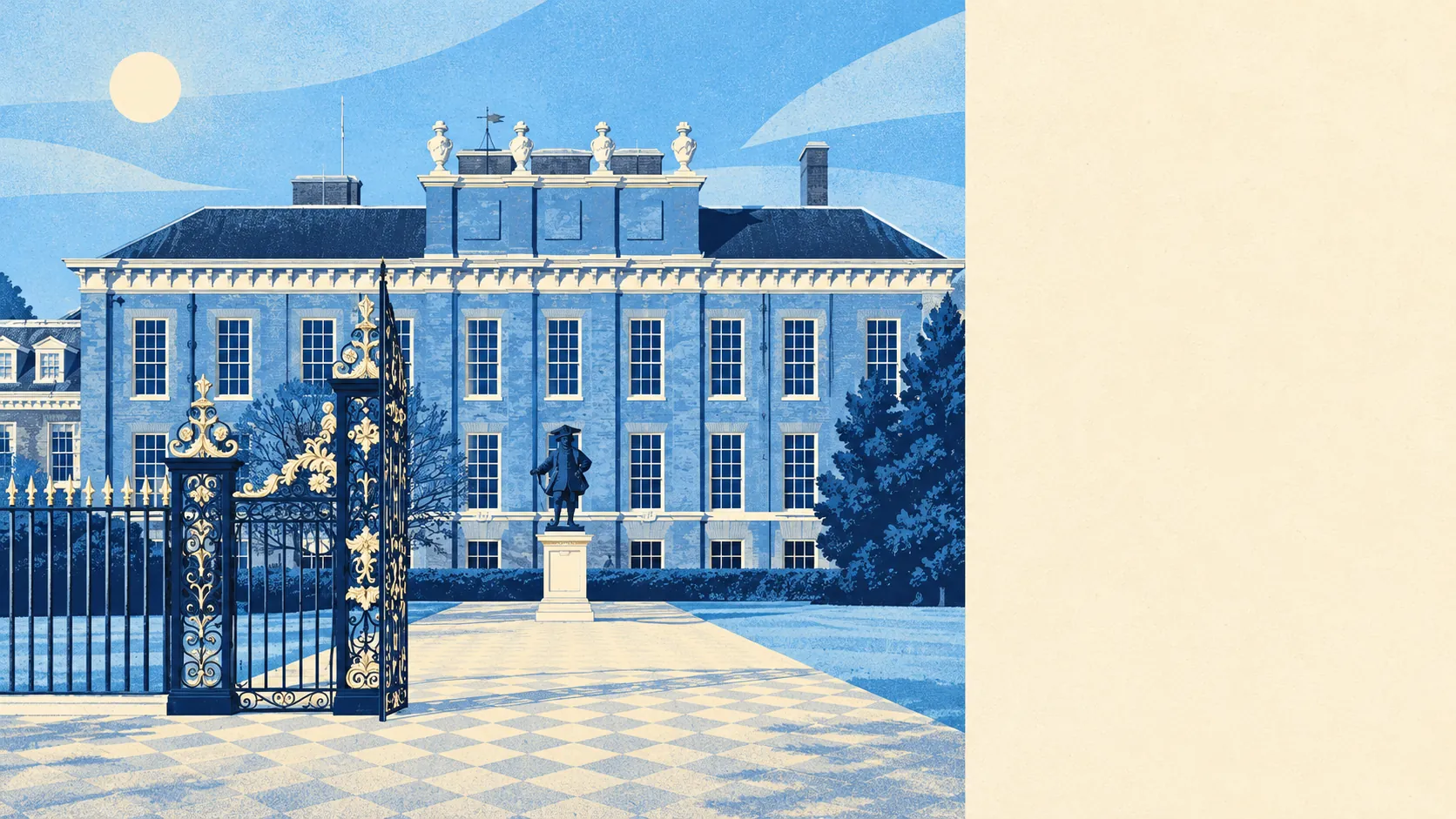
Kensington has two great parks, with a neighbourhood built in between. There's green space at the end of most streets. Dozens of parks and squares lie within a kilometre of the average home. There is water within an easy walk. The high street does far more eating than drinking.
The average home in Kensington is about 130 metres from public green space, with around 34 green spaces within a kilometre. The two big ones are Kensington Gardens, which runs straight on into Hyde Park, and Holland Park, on the north side of the High Street. The rest are mostly garden squares. Many of those are communal gardens kept for the people who live around them, so if a flat's particulars mention a garden square, ask whether the key comes with the flat. Between the two parks and the squares, most residents have something green in sight.
Water is about 640 metres from the average home, with around nine bodies of water within a kilometre. The Serpentine is in Hyde Park, with the Peter Pan statue on its western side. For a borough nowhere near the river, Kensington has plenty of water to walk to.
The National Cycle Network is about 2,550 metres from the average home, and 0% of the area counts as close to it. Kensington has no ancient woodland. Cyclists here ride on streets and through the park paths, because the national routes run somewhere else.
The rated-premises list counts 387 shops, 71 restaurants and 19 pubs in the area. Kensington eats out far more than it drinks out.
Kensington and Chelsea recorded fine-particle pollution of about 9.4 micrograms per cubic metre in 2024.
For a residential area, Kensington has an unusual amount to visit. Exhibition Road runs up to the museums, past the Victoria and Albert Museum and the Natural History Museum, and the Royal Albert Hall and the Albert Memorial face each other across Kensington Gore at the park's southern edge. The Orangery at Kensington Palace is listed in its own right. So is the Roof Garden at 99 High Street Kensington, a registered garden on top of what used to be the department stores. Even Kensington's shops have a garden on the roof.
Private outdoor space comes to about 20,600 square metres per 1,000 residents. For an area this dense, that is a real amount of garden, though much of it belongs to the terraced houses, and most flats get a window box, a communal square or a walk to the park.
The business rates valuation list records 1,416 rateable premises in the area, and offices make up the biggest category, with 646. Those are premises on the list, which isn't the same as businesses open today. Even so, it shows that a fair share of the buildings around the High Street are workplaces.
Of 240 rated food premises, about 88% hold the top hygiene score and about 1% sit at the bottom. In Kensington, eating out is rarely the risky part of the evening.
No protected landscape designation overlaps Kensington. There is no area of outstanding natural beauty, no site of special scientific interest and no ancient woodland. Every green space here was laid out by people, mostly for royalty, and that is how a borough this dense ended up with this many parks.
The surroundings are one of Kensington's real strengths. You get royal parks, garden squares and the museums within walking distance, in a borough this dense.