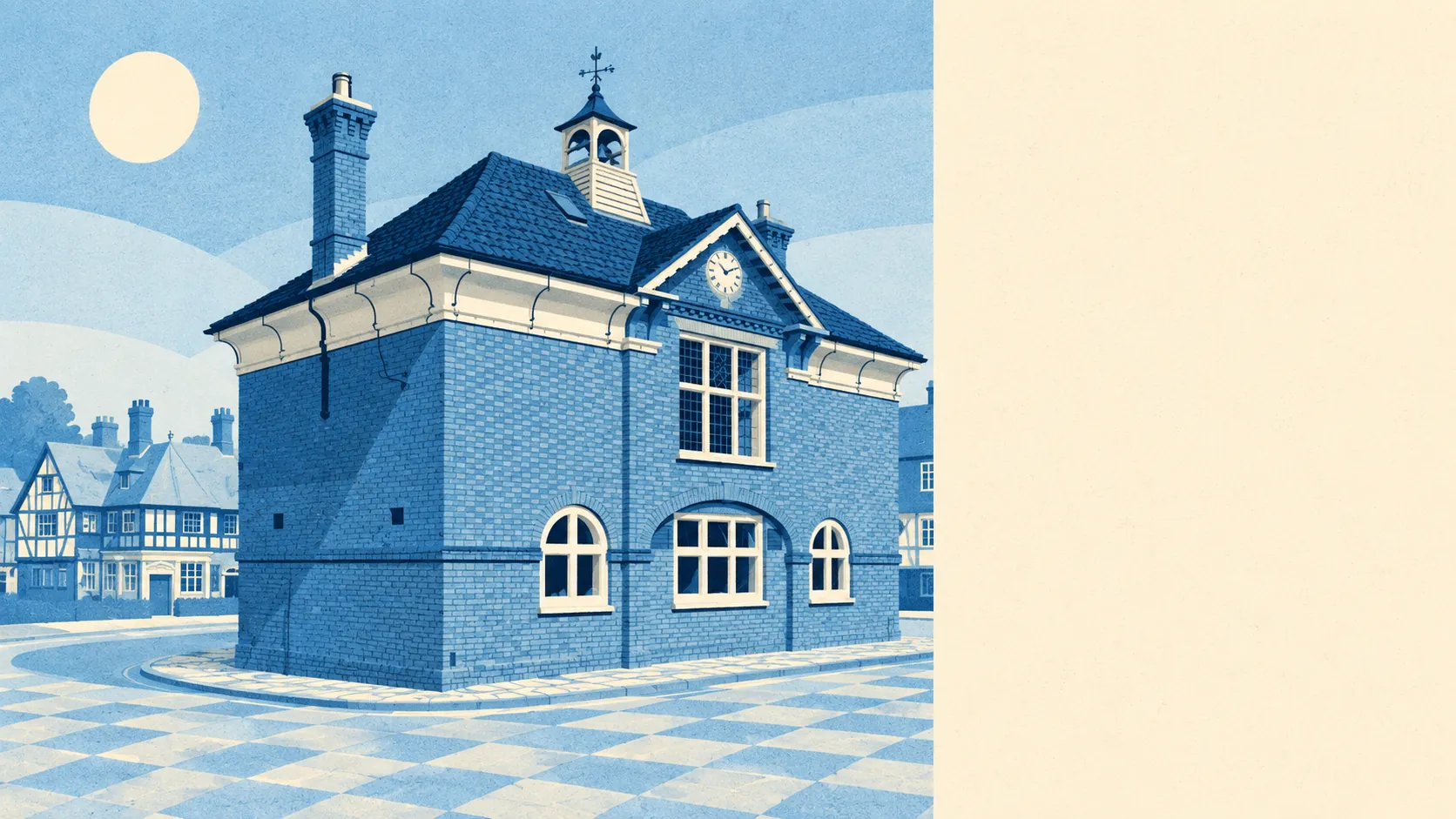
Haslemere is a commuter town where half the commuters stopped going. Seven in ten own their home. Half work from home. The typical house sells for well over half a million. Not a dormitory, then. A home office with hills round it.
The housing is a detached-house town that let some flats in. Across every dwelling on the council-tax list, detached houses make up 34%, flats 22%, semis 19%, terraces 15% and bungalows 9%. About 29% of the stock was built before 1930, so the period house exists here, but it's outnumbered by the sort of solid mid-century place estate agents describe as "offering scope". On energy performance certificates, half the certificated homes rate C or better, 38% sit on D and 13% are E or worse. Three quarters of homes run on mains gas and 8% heat by electricity alone. If the one you like is an older house on electric heating, ask for the bills before the second viewing, not after completion.
The Land Registry's last twelve months, to late May 2026, put the typical sale at about £575,000 across 155 sales. That figure splits hard by type. Detached houses went for around £887,500, semis for around £642,500, terraces for around £385,000 and flats for around £247,500. The typical terrace costs less than half the typical detached house, which is the whole Haslemere housing market in one line: the town has a cheaper way in, and most people are too busy looking at the big houses to notice it. For council tax, Band D is the most common band and only about 13% of homes sit in Bands A or B. Cheap council tax is not on the menu.
Renting runs at about £1,440 a month, which is the typical private rent across the Waverley area as of April 2026, not a Haslemere-only figure. The town sits at the pricier end of a pricey borough, so treat that as a floor for the good stuff rather than a promise.
Safety is ordinary, which in this postcode reads as a mild scandal. Police records for June 2025 to May 2026 put the crime rate at about 49 per 1,000 residents, roughly 6% above the Waverley average. Nothing in the mix screams trouble. Shoplifting makes up 13% of recorded crime against 8% across England and Wales, and public order offences 9% against 7%. The shops in town are worth pinching from, and the numbers say so.
Getting about depends on whether you still go anywhere. Only about 3% of workers took the train in the last census and 35% drove, while 50% worked from home. For those who do travel, Haslemere Rail Station is in town, with Witley and Liphook stations nearby, and trains run to London Waterloo and to Portsmouth Harbour. There are 95 bus stops across the area. Broadband matters more here than in most places, given who's using it: superfast broadband reaches about 97% of premises but gigabit only about 59%, so check the exact address before you promise your employer a steady video feed. Mobile is better, with 4G or 5G from all operators across about 97% of the area. The hospital is the weak link. Department for Transport modelling from 2019 puts it about half an hour away by car and about an hour by public transport.
The surroundings are the part nobody argues about. The average home is about 220 metres from green space, with around 15 green spaces within a kilometre, and part of the area falls inside the Surrey Hills National Landscape. Flood risk is low on the Environment Agency's river-and-sea flood zones, with under 1% of the area in the highest zone. On the wider postcode measure, which counts any flood indicator including surface water, about 6% of postcodes carry a high risk on at least one indicator and about 12% a medium one. That surface water is what a steep town on sandy ground does after a wet week. Check the specific street.
The catch comes when you want to change anything. The area holds 174 listed buildings, 10 of them Grade II* and 164 Grade II, and there are 8 conservation areas, including Haslemere itself, Grayshott, Camelsdale and Hammer and the River Wey. Inside those, new windows, a bigger extension or a different roof all go through the planning system first, and the answer is often a polite no. People buy here for how the town looks, then find out the town has already decided how their house looks too.
The neighbourhood is settled and comfortable. About 71% of households own their home and the median resident is 46. Average gross household income was about £72,600 in the financial year to March 2023. The high street trade reflects the income: of the 81 food outlets with a hygiene rating, about 88% hold the top score. The standards are high and so is the scrutiny.
Haslemere suits a household that works from home most of the week and wants proper countryside ten minutes from the front door. Families do well too. Ofsted has graded 159 settings across Surrey's wider area and 147 of them are good or outstanding, and Woolmer Hill School, St Bartholomew's and the Shottermill infant and junior schools are all local. The occasional London day is fine. The daily one gets old fast.
It suits the buyer who wants to gut a period house and put a glass box on the back much less well. It suits anyone who needs a hospital close by less well, and it isn't the answer for anyone trying to buy a house cheaply. The terraces and flats are the way in. Nobody finds a bargain detached house in Haslemere, because someone with a pension pot got there in 1998.
Wealthy people have been hiding in Haslemere for centuries. James Oglethorpe founded the Colony of Georgia and still found time to live at Town House on the High Street as MP for Haslemere from 1722 to 1754. The artist Josiah Wood Whymper later lived in the same house. George Eliot wrote much of Middlemarch while living in Shottermill, and the scientist Francis Galton and the geologist Archibald Geikie both lived in the area too. The town has had a market since 1221, and it still holds the Charter Fair on the High Street every other year to prove it.
Haslemere is a good place to live, and an above-average one overall. Its real strength is the local community: settled, well-off, healthy and heavily invested in keeping the place as it is. The weak spot is the other side of that: the freedom to extend or alter a home is tighter here than almost anywhere, because everybody else is invested in keeping your place as it is too.