Hampton is surrounded by park, river and very little else. Bushy Park takes up the east side. The Thames runs along the south. Green belt starts at the western edge. Despite being in London, it is the open space that sets the tone here.
Public green space is close to every home. The average home is about 120 metres from the nearest public green space and has around 26 green spaces within a kilometre. Most of the land to the east is Bushy Park, a Tudor hunting ground that is now open to the public. Nobody in Hampton needs a garden for kicking a ball about, though most of them have one anyway.
Water is about 400 metres from the average home, with around 30 rivers, ponds, reservoirs and other bodies of water within a kilometre. The Thames is the main one. Tagg's Island and Platt's Eyot sit in the river, and the Longford River, dug for Charles I, runs into the park. Few parts of outer London have as much water so close by.
The National Cycle Network is further off, about 1.4 kilometres from the average home, and only about 10% of homes are close to a route. There is no ancient woodland in the area at all. Most of the space to explore is landscaped parkland, the towpath and the riverbank.
The shops and pubs are local in scale. The rating records count 159 shops, 10 pubs and 14 restaurants. That is enough to cover the weekly essentials and a Friday night out, but not much more.
Air quality is measured for the council area as a whole. Richmond upon Thames recorded fine-particle pollution of about 8 micrograms per cubic metre in 2024. That figure covers the entire borough, so it does not tell you about any one street in Hampton.
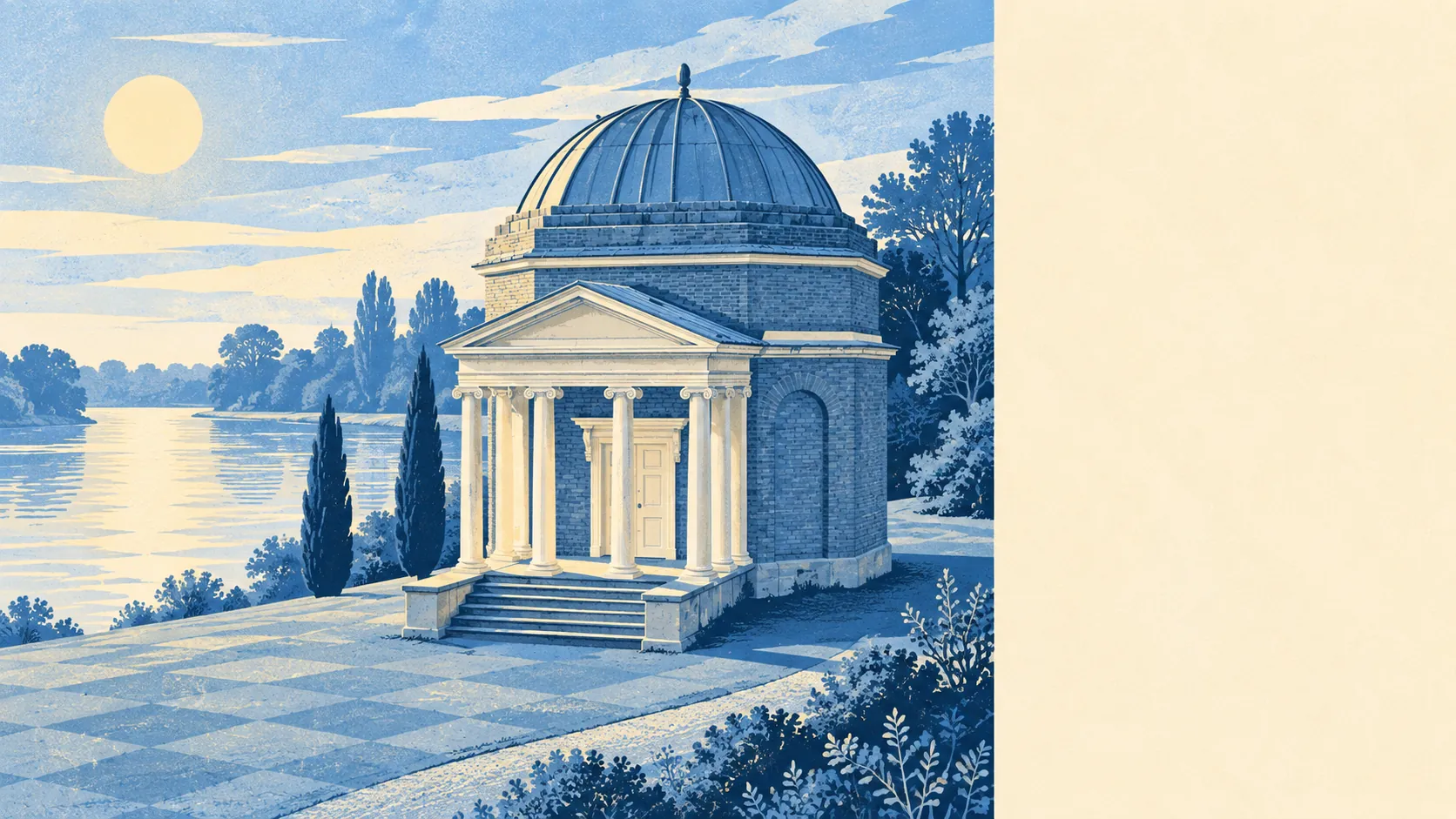
The character comes from the grand estates along the edge of Hampton. Hampton Court Palace and its grounds lie just to the south-east, and Garrick's Villa and Garrick's Shakespeare Temple face the river. Kempton Park is just across the boundary to the west. Even the waterworks along the riverbank are older than most of the town's houses. Hampton is a London suburb with royal and aristocratic estates on all sides.
Private gardens are generous too. Across Hampton there are about 77,000 square metres of private garden for every 1,000 residents. That is real outdoor space, and it shows on the streets of semis and detached houses, where gardens run back much further than in inner London.
The valuation list records 517 rateable business premises in Hampton. Shops are the largest category and offices come next. These are premises on the council's list, not a count of businesses open today, and some will be empty or have changed use since they were rated. Hampton has its own high street, and residents do not have to travel elsewhere for everyday shopping.
Of 110 rated food premises, about 70% have the top hygiene score and about 3% are at the bottom of the scale. In a place with only 14 restaurants, a few premises either way move those percentages a lot.
No protected landscape overlaps Hampton. There is no Area of Outstanding Natural Beauty, no Site of Special Scientific Interest and no ancient woodland. Its open space is designed parkland, managed rather than wild, and its protection comes from royal and heritage status.
The surroundings are Hampton's greatest strength. Parkland, river and green belt hem it in on three sides, so the countryside starts close to every front door.