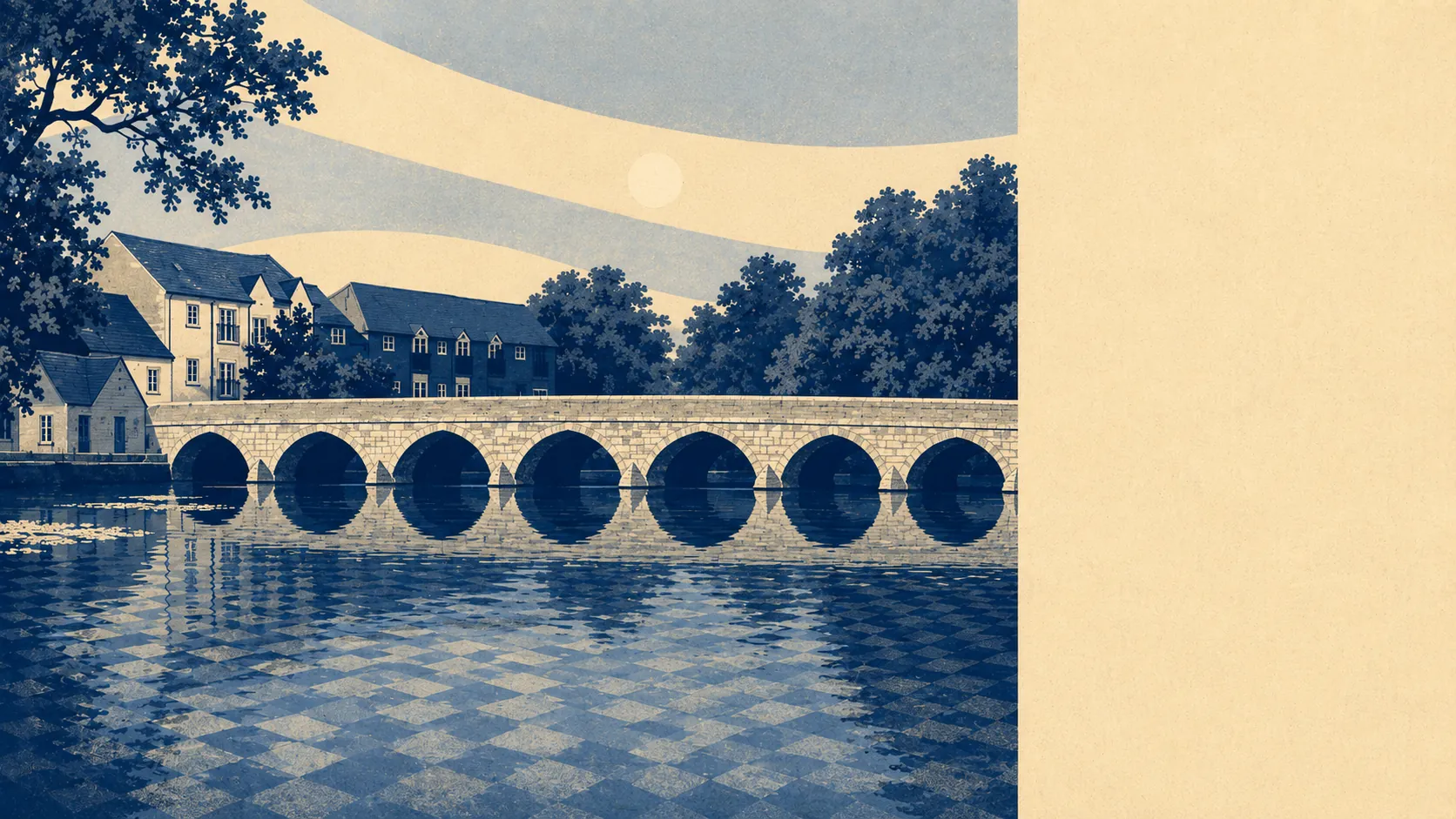
Yes, if you have made peace with the car. Fordingbridge is a town that stopped being on the way to anywhere the day the railway shut and quietly decided this was fine. The green space is on the doorstep. The bridge is medieval. The buses exist in the way that a fire extinguisher exists, which is to say technically and rarely. It is a good place to live for people who wanted the New Forest without the New Forest's price tag, and who will not be asking where the station is.
The housing stock is the first thing to understand, because it shapes everything else. On the council-tax valuation list, which covers every dwelling rather than only the ones with a recent energy certificate, detached houses run to about 28% and semis to roughly 23%, with bungalows at around 18% and terraces at about 14%. Flats make up around 17%. That bungalow share is not a rounding error, it is a statement about who has been buying here for decades. Roughly 24% of the stock predates 1930, so the town is a working mix of old and post-war rather than a heritage set-piece. Heating is mostly conventional: about 73% of households are on mains gas, with around 12% running on electricity alone. That last group is the one worth checking before you fall in love with a cottage, because electric-only heating in a pre-war building is a running-cost decision rather than a detail.
On price, the Land Registry's last twelve months put the typical Fordingbridge sale at around £332,500 across 74 transactions. The spread by type is wide enough to matter. Detached houses came in at a median of roughly £415,000, semis at about £341,500, terraces at around £303,000, and flats at roughly £161,250. That flat figure is the entry ticket to the town, and it is a genuinely different market from the one the detached buyers are in. Council tax sits mostly in band C, which is the modal band here, with about 21% of dwellings in bands A and B combined. Nobody in Fordingbridge is in band H at all, which tells you something about the ceiling on the place.
Renting is the harder ask. The typical private rent across the New Forest area runs at about £1,240 a month, which is a local-authority figure covering a much wider spread of villages and coastal towns than Fordingbridge itself. Treat it as the shape of the market rather than the price of a specific front door.
On safety, the published crime rate for the area is around 65 recorded crimes per thousand residents over the twelve months to May 2026, which sits roughly 12% above the New Forest average. That is a real gap and it deserves stating plainly rather than being buried. It is also the sort of gap that a market town with a high street and a night-time economy generates against a district full of villages that have neither. Hampshire Constabulary charges in about 9% of cases against a national rate of around 12%. Violence and sexual offences make up about 40% of the recorded mix, which is a broad statutory grouping that includes assault without injury, and the totals here are low enough that a handful of incidents shifts a share by several points. Read it as a market town, not as a warning.
Schools are the strongest thing on this page after the countryside. Hampshire's Ofsted picture is 185 settings graded good or better out of 211 with a published grade, including 27 rated outstanding. Locally, Key Stage 2 maths averages a score of 104 across four schools in the postal district, and the single secondary reporting a Key Stage 4 result posts an Attainment 8 score of around 47. The Burgate School and Sixth Form is the secondary option, with Fordingbridge Infant School and Fordingbridge Junior School covering the town's primary years, and Breamore, Hale, Hyde and Western Downland Church of England Aided Primary School spread through the surrounding parishes. Forres Sandle Manor covers the independent sector for anyone paying twice.
Connectivity is the weak point and there is no polishing it. About 54% of working residents drive to work and around 29% work from home, while trains account for 0.2% and buses 0.6%. Those two figures are not typos, they are the whole story: the railway station closed in 1964 and what stands on the site now is a mill and an industrial estate. The 20 bus stops in the town average around 20 scheduled weekday departures each, with roughly 63% seeing any weekend service at all. Broadband is the compensation and it is a good one: gigabit-capable connections reach about 82% of premises and superfast about 98%, with none below the universal service obligation. Hospital access runs to about 26 minutes by car under Department for Transport modelling, and about 46 by public transport, which is the kind of gap that decides where people who cannot drive end up living.
The environment is where the town earns its keep. Green space averages around 143 metres from the front door with roughly 15 sites within a kilometre, and water is closer still at about 176 metres. Flood risk is the counterweight. Around 13% of postcodes carry a high rating on at least one flood indicator including surface water, with about 9% at medium. On the Environment Agency's river-and-sea zones specifically, roughly 3% of the area sits in flood zone 3 and about 6% in zone 2, rising to around 27% under the climate-change allowance. The River Avon runs through the middle of town, so this is geography rather than bad luck. One flood is formally on record, in January 1959, from a main river exceeding channel capacity with no raised defences present.
Heritage is a live constraint on a small number of properties rather than the whole town. There are 65 listed buildings in the area, one at Grade I and three at Grade II star, and a single conservation area covering Fordingbridge itself. Own inside it and window replacements, solar panels and extensions become a conversation with the planning department rather than a weekend decision. Own outside it and none of this touches you, which is most people.
Character-wise, about 68% own their homes, the median resident is 50, and typical household income runs to around £61,000 a year before tax. That is a settled, middle-aged, owner-occupied town rather than a churning one, and the people who move here mostly stay. This page also covers Martin and Rockbourne, the outlying parishes to the north and west, which are villages by any reasonable definition and priced accordingly.
It suits families who want good schools and a garden and have two cars or the confidence to buy a second, along with retirees and downsizers who have spotted the bungalow share and understood what it means. It suits people who can work from home, which is a large slice of the town already.
It does not suit anyone who needs a train, anyone whose plan involves the bus, or anyone buying a first flat while assuming the town will accelerate around them. Fordingbridge is not up-and-coming and has never claimed to be.
The town has form on interesting residents. Charles Chubb, of the locks, was born here. Augustus John lived at Fryern Court, Terry Pratchett's illustrator Paul Kidby is a local, and the churchyard at St Mary's holds James Alexander Seton, the last British person killed in a duel in Britain, which is a distinction Fordingbridge is unlikely to lose.
So: a good place to live, with the trade named honestly. Its real strength is the surroundings, the green space and water within a few minutes' walk and a market town that has kept its schools and its bridge. The weak spot is transport, and it is not marginal. Buy here for the country and the primary schools, not for the commute, and you will be one of the people who stays.