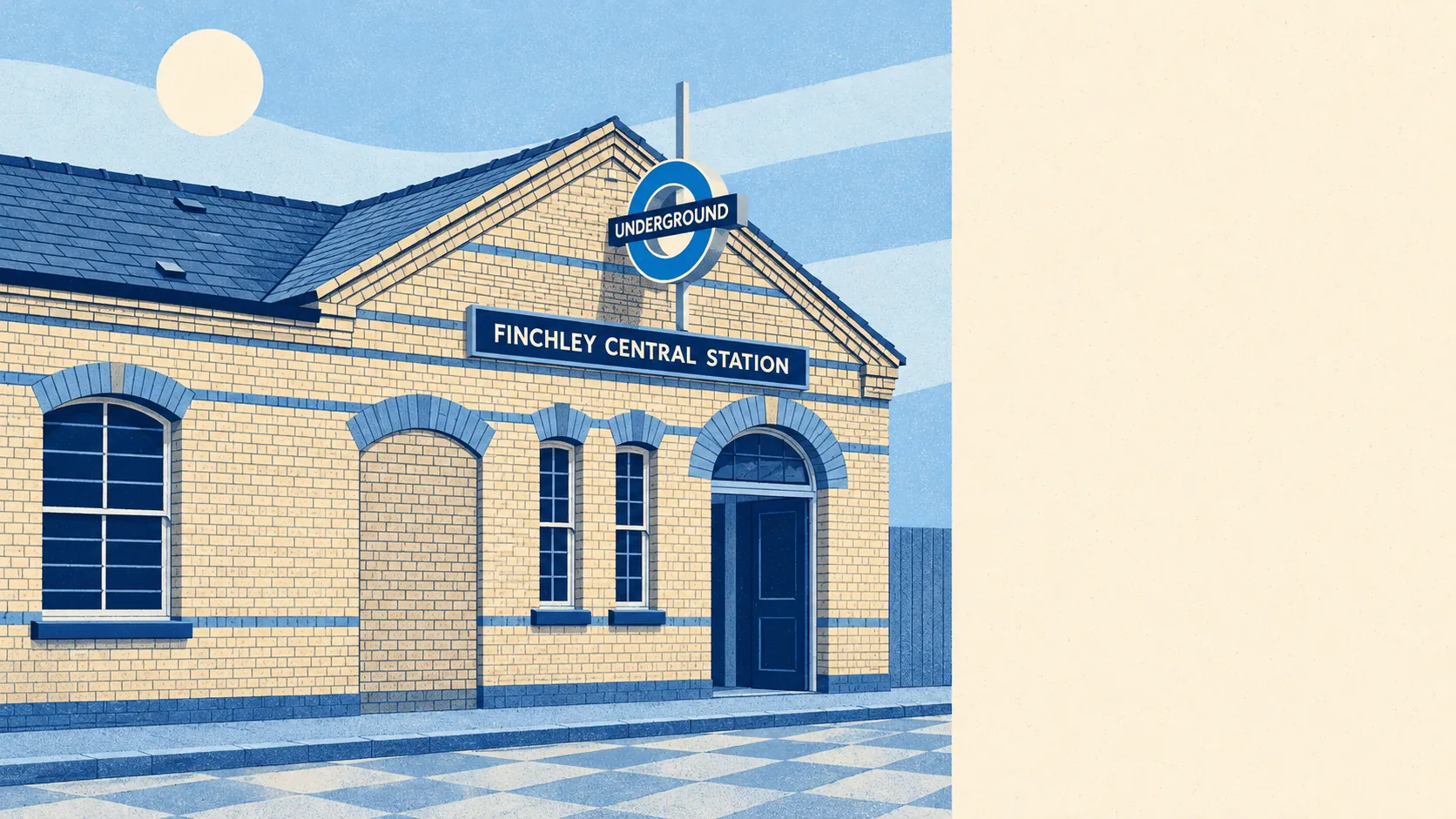
The area around Finchley is greener than a district this built-up has any right to be. A park is a couple of minutes from most front doors. Brooks run along two of its edges. Three pubs serve the whole lot. Finchley spends its energy outdoors and keeps its evenings modest.
The average home in Finchley is about 170 metres from public green space, with about 30 green spaces inside a kilometre. One of them is Avenue House Grounds in Church End, and College Farm, the last farm in Finchley, is another. Very few people here need a car to walk a dog.
Water is close too. The average home is about 380 metres from blue space, with about 22 stretches of water within a kilometre. Dollis Brook marks Finchley's western boundary and Mutton Brook its southern one, and the two join to become the River Brent. Few London suburbs can say two of their borders are streams.
The National Cycle Network is further off, about 7.7 kilometres from the average home, and no postcode in Finchley is close to it. Cyclists who want a signed long-distance route have a ride to reach the start.
The rated-premises records count 273 shops in Finchley, 20 restaurants and three pubs. That high street is built for errands, and the nights out end early. The 171 food outlets with a hygiene rating are covered further down.
Barnet's fine-particle pollution level for 2024 was about 8.5 micrograms per cubic metre, a figure that covers the whole borough.
Finchley has two kinds of street. Church End, the old village that grew into the centre, keeps the parish church of St Mary's and the conservation areas around it. Long Lane runs between East Finchley and the centre, with small shopping parades along its length. In between are long residential roads lined with flats and semis, and parks reached through gaps in the houses. Finchley is on a plateau, so its edges drop away towards the brooks, and the walking gets better the further you go from the main roads.
Private gardens are also generous. Finchley has about 59,000 square metres of garden for every 1,000 residents. That figure averages houses with long gardens together with flats that have none, so check the title plan or lease to see whether a particular flat comes with its own garden, shared access, or nothing beyond the window box.
The business rates valuation list records 822 rateable premises in Finchley. Offices are the biggest category at 324, with shops close behind. Those are premises on a valuation list, and an entry does not mean anyone is trading there today. Finchley is a place where a lot of people work in small offices above the shops, then walk home past the park.
About 57% of the 171 food premises with a hygiene rating hold the top score of five, and about 8% sit at the low end of the scale. On those numbers most places are fine to eat in, and a few are worth checking first.
No protected landscape designation overlaps Finchley. It has no area of outstanding natural beauty, no site of special scientific interest and no ancient woodland. Finchley's green space is the everyday kind, made up of parks, brooks and a farm, so the most special-looking thing about it is how often it turns up.
The surroundings are Finchley's real strength. Green space and water are a short walk from almost every door, and that matters more day to day than any designation a map could add.