Yes, if your idea of a good evening involves being indoors by nine. Around eight in ten households own their home outright or on a mortgage. The typical resident is closer to sixty than forty. Roughly one household in three works from home. Ferndown is not a town that is going anywhere, and that is precisely what its residents paid for.
The housing stock explains most of the town's personality before anyone opens their mouth. Bungalows are the single largest category on the council-tax valuation list at around 40% of every dwelling, with detached houses at roughly 27% and flats at about 19%. Terraces and semis together make up barely a tenth of the place, which tells you the town was laid out by people who wanted space between themselves and the neighbours and got it. Only about 4% of dwellings date from before 1930, so the Victorian-terrace fantasy is not on offer here: this is a post-war town, built out in the two or three decades after the Stewart family opened one of Britain's first garden centres in 1955, when Ferndown was still described as a village with a gravel road and a scattering of shops. Energy performance certificates put around 41% of certificated stock in band D and roughly 50% in bands A to C, which is the usual mid-century picture of solid walls, retrofitted insulation and a boiler that was modern once. About 79% of homes run on mains gas, and around 9% are on electric-only heating. That second figure matters more than it looks. An electrically heated bungalow with band D insulation is a running-cost decision, not a decorating one, and it is worth knowing which one you are viewing before you fall for the conservatory.
On price, the Land Registry's last twelve months put the median sale at around £410,000 across 238 transactions, which for Dorset is neither a bargain nor a punishment. The spread by type is where the real information sits. Detached houses ran to a median of about £505,000 across 147 sales, semis around £337,000, terraces roughly £310,000, and flats about £210,000 across 55 sales. Detached property is not one option among several here, it is the market. Council tax lands mostly in band E, which is the modal band, and only around 11% of dwellings sit in bands A or B combined. Band D bills for the area run to roughly £2,765 a year. Nobody moves to Ferndown to dodge the council.
Renting is a smaller world. Typical private rent across the Dorset area is about £1,040 a month, and that is a local-authority average from the Office for National Statistics price index rather than a Ferndown figure, so treat it as the regional weather rather than the forecast for your street. By size across the same area, one-beds average around £720 a month, two-beds about £950, three-beds roughly £1,170.
Safety is where Ferndown quietly outperforms. The recorded crime rate is about 43 offences per thousand residents in the year to May 2026, which sits below the Dorset average of around 55. That is a published rate calculated on its own population base, not something arrived at with a calculator. Anti-social behaviour makes up around 30% of the local mix against roughly 16% nationally, which sounds alarming until you work out that in a town this quiet, a bit of shouting outside the shops is a larger share of not very much. Dorset Police charge in about 14% of cases against roughly 12% nationally, which is a force statistic rather than a Ferndown one.
Connectivity is the town's weak point and it is not close. Around 55% of residents drive to work, roughly 33% work from home, and the share commuting by train is 0.1%, which is a rounding artefact wearing a percentage sign. There is no station in Ferndown: the nearest is Branksome, about eleven kilometres away. Buses exist and are better than the doom suggests, with 68 stops in the area, an average of around 31 scheduled weekday services per stop, and roughly 92% of stops keeping some weekend service. Broadband is the compensation. Gigabit-capable connections reach about 69% of premises, superfast around 96%, and only about 0.4% fall below the universal service obligation. Every premises has four or five gee coverage from at least one operator and around 97% from all of them. You can work from Ferndown very comfortably. Getting out of it is the problem.
On flooding, around 10% of postcodes carry a high rating on at least one flood indicator, including surface water, and roughly 14% a medium rating on the same basis. Separately, the Environment Agency's river-and-sea flood zones cover 0% of the place. Those two measures answer different questions, and the second is the one insurers care about most. Surface water is the live issue here, not the River Stour. Green space is genuinely good: an average of around 350 metres to the nearest green space, with roughly seven within a kilometre, and water at about 480 metres. Gardens make up around 36% of the total area. Shrink-swell clay is classed at the moderate-to-significant level across roughly 81% of the area, which is a subsidence-and-extension-foundations conversation, not a reason to walk away. Radon sits in the lowest band.
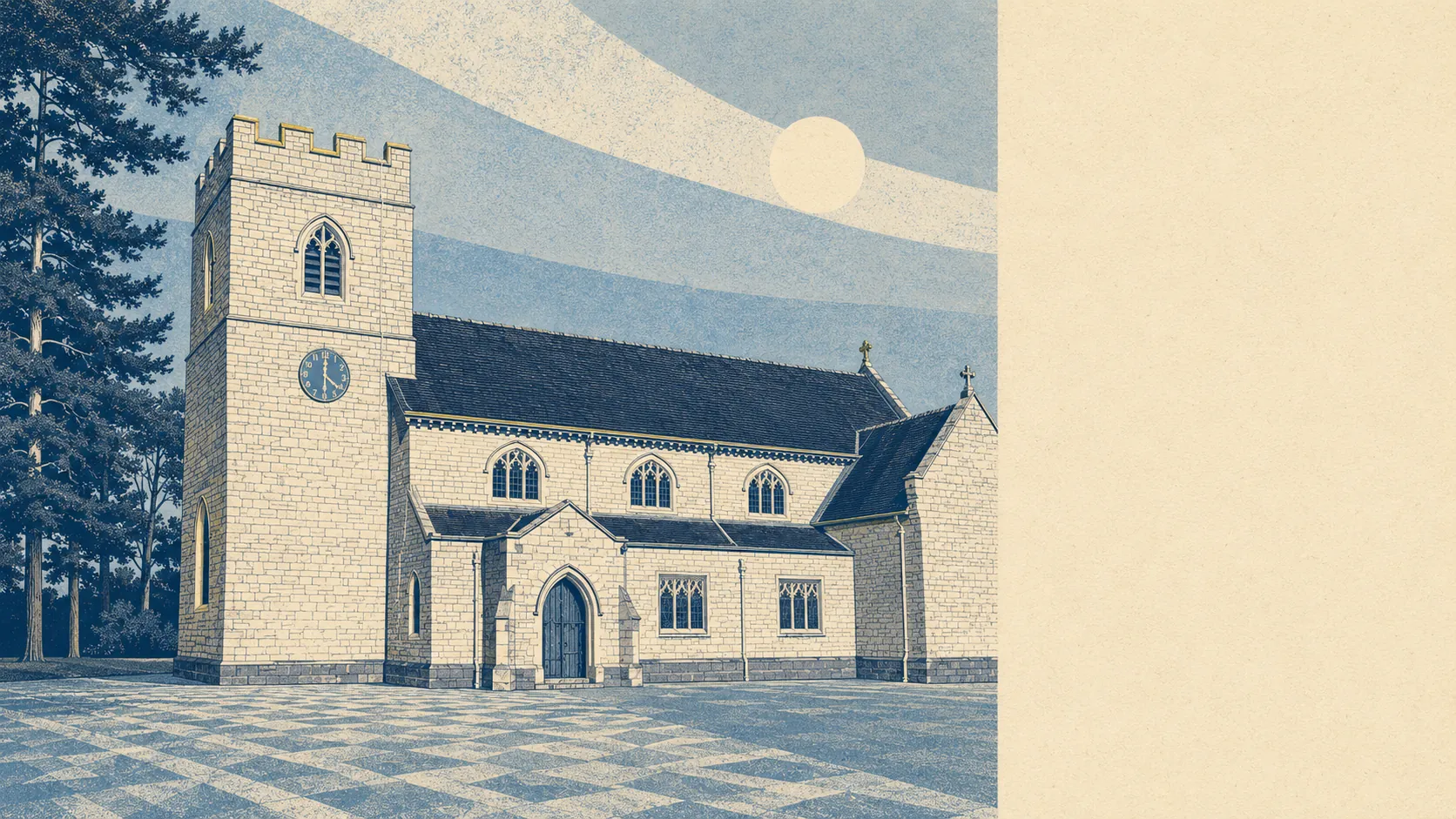
Heritage constraints are close to nonexistent. Nine listed buildings in total, two at grade two star and seven at grade two, and one conservation area at Hampreston. Unless you are buying the fourteenth-century Church of All Saints, you can extend, glaze and render without a heritage officer forming a view. In a county thick with conservation areas, that is a quiet advantage nobody advertises.
The neighbourhood character is exactly what those numbers add up to. About 84% of homes are owner-occupied, the median age is around 59, and median household income runs to roughly £52,300 a year gross, with about £38,800 net. Roughly 32% of households are one person living alone, and around 23% are a single pensioner.
Ferndown suits downsizers, retirees, and remote workers who want a detached house with a garden and a supermarket run measured in minutes rather than a fight. It suits families willing to work with Dorset's three-tier first, middle and upper school system, where Ofsted has graded 68 of 86 settings in the authority good or better with two outstanding.
It does not suit anyone who needs a train, anyone under thirty-five hoping to find their own kind, or anyone who thinks a town should still be doing something at ten on a Tuesday. The people who last here are the ones who checked that first.
Ferndown is a good place to live for the people it was built for, and a slow puncture for everyone else. Its real strength is safety, and the numbers are not a fluke of a quiet quarter. The weak spot is transport and connectivity, and no amount of gigabit broadband fixes the fact that the nearest platform is in another town. Buy the bungalow, keep the car, and stop pretending you were ever going to commute.