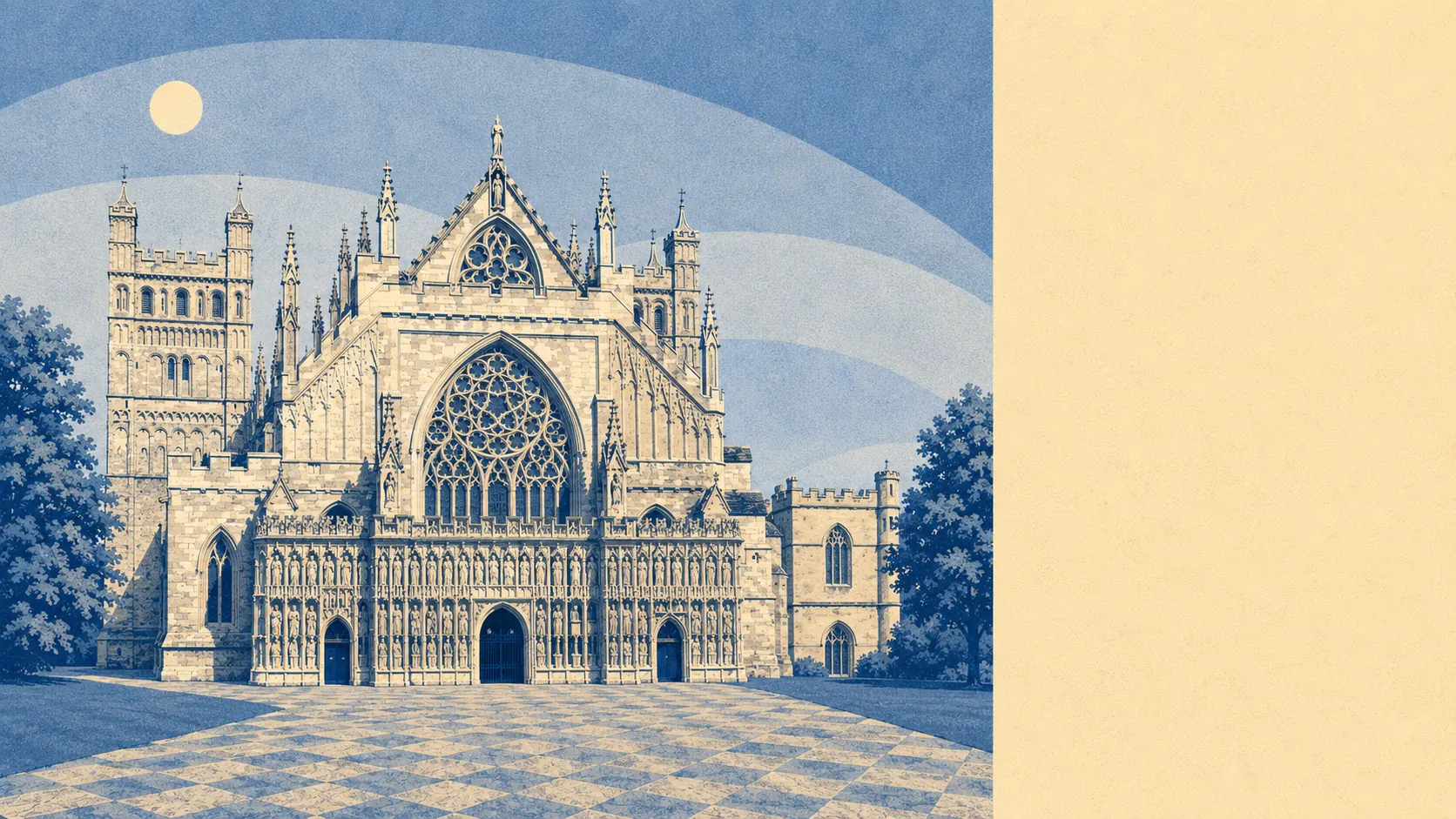
Yes, if you can live with a city that owns the county and behaves like a village. Two in five households rent. About a quarter get by without a car. Nearly a third of homes contain one person. That is not a sleepy Devon town with a cathedral bolted on. That is a small city running at a proper city's metabolism, with fields starting about ten minutes past the ring road.
The housing stock is more ordinary than the cathedral leads you to expect. Across every dwelling on the council-tax valuation list, terraces are the single biggest group at around 32%, with flats close behind on roughly 31%, semis at about 19%, detached houses at just over 11% and bungalows at around 6%. Fewer than a quarter, about 22%, were built before 1930, which means the postcard version of Exeter is a minority interest and most people live in something put up after the war. On energy, roughly 59% of certificated homes sit in bands A to C, about a third are band D, and around 9% are band E or worse. Three quarters run on mains gas. Around 12% are heated by electricity alone, which is a running-cost fact worth knowing before the viewing rather than after the first winter bill lands, particularly in the older converted flats where it turns up most.
On price, the Land Registry's last twelve months to late May 2026 put the typical Exeter sale at £292,000 across 1,080 transactions. The type split is where the real spread lives: flats around £173,000, terraces about £275,000, semis roughly £330,000, and detached houses at around £437,500. That is a genuine ladder rather than a market with one rung, which is unusual for a city this size. Council tax lands softly by national standards, with band B the most common and roughly 46% of dwellings in bands A or B combined. The band A annual bill runs to about £1,660 and band D to roughly £2,500.
Renting is a different conversation. Typical private rent across the Exeter area, as measured by the Office for National Statistics price index in April 2026, is about £1,310 a month, up around 2% on the year. That is an area-wide average covering the whole local authority rather than a figure for any one street, and the bedroom split underneath it does more work: about £910 for a one-bedroom, roughly £1,130 for two, around £1,360 for three. A student city with a large teaching hospital and a national weather service does not produce a gentle rental market, whatever the estate agent's window suggests.
Crime is the most misread number in Exeter, largely because a city centre absorbs the trade of everywhere around it. The published rate is about 116 recorded crimes per thousand residents over the twelve months to May 2026, which sits essentially level with the Exeter local-authority average. Violence and sexual offences make up about 40% of the recorded mix against roughly 35% across England and Wales, though that category is a broad statutory grouping that includes assault without injury and tops the table almost everywhere. Shoplifting runs at about 10% against roughly 8% nationally, which is what happens when a High Street serves three neighbouring districts and a motorway junction.
Schools are the quiet strength. Ofsted has graded 172 settings across the Devon authority, of which 138 are good or better and 3 outstanding, with 31 requiring improvement and 3 inadequate. At key stage two, the average maths score across the 27 schools in these postcodes is about 104, sitting a shade above the expected standard. At key stage four, the six secondary schools average an attainment score of roughly 48. Isca Academy, West Exe School, St Luke's Church of England School and St Peter's Church of England Aided School carry most of the city's secondary intake, with Exeter Mathematics School operating as a specialist sixth form. Journey times are short in a way that matters daily: about nine minutes' walk to a primary, roughly 21 minutes to a secondary.
Connectivity is where Exeter quietly outperforms its size. Exeter St Davids, Exeter Central and Exeter St Thomas sit inside the city, with Polsloe Bridge, St James Park, Pinhoe, Digby and Sowton, Newcourt, Marsh Barton and Topsham serving the suburbs. Almost nobody uses them to commute, at about 1% by train, because roughly 31% work from home and about 37% drive. There are 664 bus stops in the area, and 626 of them carry service data averaging 122 weekday departures, with about 98% seeing weekend service. On broadband, gigabit-capable connections reach about 88% of premises and superfast around 96%, with no premises below the universal service obligation. Every operator offers fourth or fifth generation mobile coverage across the area.
The water is the thing to check. On the postcode indicators, which include surface water and count any flood risk at all, about 11% of Exeter postcodes carry a high indicator and roughly 13% a medium one. On the Environment Agency's river-and-sea zones, around 11% of the area sits in zone 3 and about 3% in zone 2, rising to roughly 13% once climate allowances are applied. Around 14% has a recorded historic flood. The city was founded at the lowest bridging point of a tidal river that floods its plain, and pretending otherwise is a poor negotiating position. Against that, green space is genuinely excellent: the average postcode sits about 150 metres from open green space with around 24 spaces inside a kilometre, and water is roughly 440 metres away. Air quality is clean, at around 5.5 micrograms of fine particulates per cubic metre.
Heritage is the constraint nobody mentions until the planning refusal arrives. There are 808 listed buildings in the area, 22 of them grade one and 71 grade two star, alongside 20 conservation areas and 20 scheduled monuments. Southernhay, Princes Square, St Leonard's, Pennsylvania, Heavitree, Exwick and Riverside all carry designations. What that means practically is that in large parts of central and inner Exeter, window replacements, solar panels, extensions and even paint colours become a conversation with the council rather than a decision you make on a Saturday. The city walls are Roman on their course and the underground passages are medieval, which is charming right up to the point where you want a rear extension.
The character underneath the numbers is a city of settled owners and a large transient population living on top of each other. Around 57% own their homes, the median resident is 35, and typical household income before tax runs to roughly £53,900, with net household income after tax around £40,500. About 34% hold a degree, which is what a university and the Met Office do to a labour market. Roughly 32% of households are a single person and about 17% are a couple with children.
This page covers a wide spread of the surrounding area, which is where much of the appeal actually sits. Topsham keeps its own identity as an estuary port with a royal charter older than most of Exeter's buildings. Heavitree, Pinhoe, St Thomas, Exwick, Newtown, Pennsylvania and Countess Wear are the established city neighbourhoods, each with its own price logic. Beyond them, Exminster, Woodbury, Exton, Clyst St George, Clyst St Mary, Clyst Honiton, West Clyst, Silverton, Newton St Cyres, Whitestone, Kennford, Cheriton Bishop, Christow and Dunsford give you the village version at commuting distance, some of them inside Dartmoor National Park.
It suits anyone who wants a city's services without a city's scale, and particularly anyone working from home who values a fifteen-minute walk to everything over a garage. It suits families, given the school picture and how short the journeys are. It suits people who want the moor and the estuary reachable on a weekday evening rather than as an annual holiday.
It suits you less if your plan involves buying a period house and reshaping it. It suits you less if you need a fast train commute, because the trains exist but almost nobody here uses them that way. And it suits you less if you want the flood question to have a simple answer, because on a tidal river with a flood plain it never will.
Exeter is a good place to live, and the reasons have almost nothing to do with what the tourist board sells. Its real strength is the surrounding area and the green space, with open ground close to nearly every postcode and Dartmoor, the estuary and the coast all inside an evening's reach. The weak spot is the freedom to extend or alter a home, because a city with this much protected fabric hands you a planning officer along with the keys. Buy the location, not the renovation project.