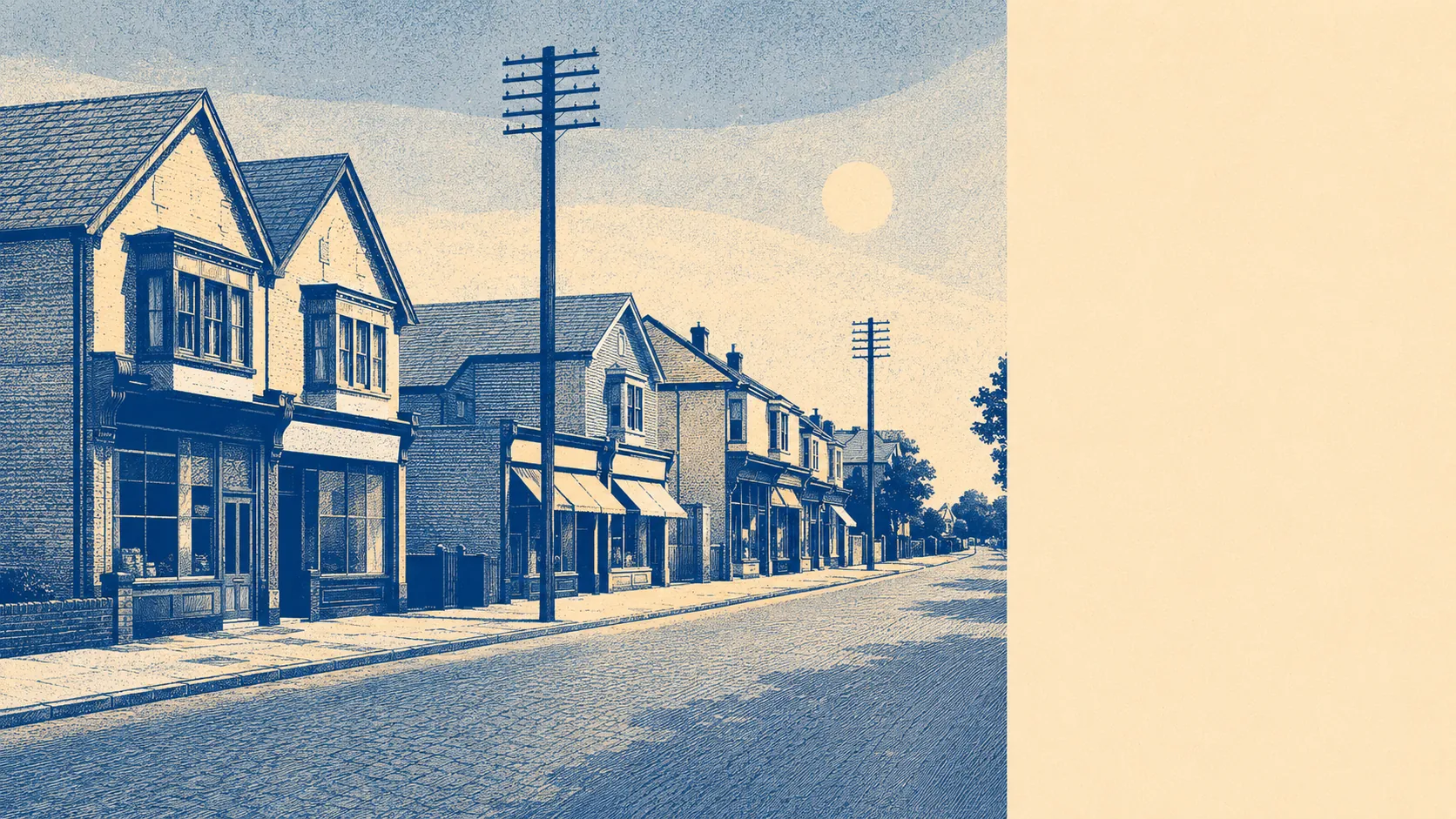
Yes, if you can live with being the part of Portsmouth that goes to bed early. This is the mainland side, under Portsdown Hill, where the city stops behaving like a city. Four in five households own their homes. Half of them keep more than one car. Nothing about that is glamorous, and nobody living here has ever pretended otherwise.
The stock is the giveaway. Portsmouth's council tax valuation list, which covers every dwelling rather than just the ones sold recently, puts semi-detached houses at around 41% of the place, terraces at about 21%, detached at roughly 15%, with bungalows and flats each making up around 12%. Only about 18% of it predates 1930, which tells you the shape of the place: this was farmland and a hamlet that got built over in the middle of the last century and has been quietly maintaining itself ever since. Energy certificates put around 41% of the assessed stock in band D and about 46% in bands A to C, which is the profile of solid post-war building that has had the loft done and the windows replaced but was never designed with insulation in mind. Roughly 82% run on mains gas. About 7% are electric-only, and if the property you are viewing is one of them, ask what the winter bills actually look like before you fall in love with the garden.
On price, the Land Registry's last twelve months to May 2026 put the typical Drayton sale at £370,000 across 138 transactions. The spread by type is wide and worth knowing before you start booking viewings: flats at a median of £175,000, terraces at £339,000, semis at £390,000, detached houses at £584,000. Band C is the most common council tax band, and only around 14% of dwellings sit in bands A or B combined, so the cheap-end cushion that exists in much of Portsmouth is not really here. This is a place that prices like what it is.
Renting is a different question, and the honest answer is that the neighbourhood-level figure does not exist. The typical private rent across the Portsmouth area runs at about £1,360 a month, up around 3% over the year to April 2026. That is a whole-city average covering everything from seafront studios to family houses on the mainland, so treat it as a direction of travel rather than a quote.
Safety is where Drayton does its quiet showing-off. The published crime rate here is around 46 recorded crimes per thousand residents over the twelve months to May 2026, which sits roughly 64% below the Portsmouth local authority average. That is not a rounding difference. That is a genuinely different experience of the same city, and it is the single loudest thing the numbers say about this place.
Schools are the other strength. Ofsted has graded 22 settings across the wider Portsmouth authority as good or better in 20 cases, with two rated outstanding. Locally, Key Stage 2 maths across the eight primaries in these postcode districts averages around 103, which is just above the national benchmark of 100. At Key Stage 4, the attainment measure across the three secondaries in the districts runs at about 43. The primary options include Court Lane Infant Academy and Court Lane Junior Academy, Solent Infant School and Solent Junior School, and Springwood Infant School and Springwood Junior School. Secondary choice pulls toward Castle View Academy, Springfield School and, further up the road, Crookhorn College and Purbrook Park School. Typical journey time to a primary is around 11 minutes on foot and 7 by car; a secondary runs about 16 minutes walking.
Connectivity is where the shine comes off. Drayton has no station of its own. Cosham Rail Station is the working answer, with Hilsea and Havant also in range, and under 1% of residents commute by train. Around 2% take the bus, despite 63 bus stops in the area running an average of 314 scheduled weekday services each and weekend service at every one of them. What people actually do is drive: about 51% commute by car, and roughly 32% work from home. Journey time to the nearest town centre runs about 9 minutes by car and 18 by public transport, which tells you which one people pick. Broadband is the compensation prize, with gigabit-capable service available to around 98% of premises and nothing sitting below the universal service obligation.
Flood risk is mixed and worth reading carefully. Around 6% of postcodes carry a high rating on at least one flood indicator, including surface water, with about 12% at medium. On the Environment Agency's river-and-sea flood zone mapping, roughly 7% of the area falls inside zone 3. Those are two different measures of two different things, and the honest summary is that most of Drayton is fine and a minority of it is not. Nothing here has a recorded historic flood. Green space is genuinely good: the average postcode sits around 190 metres from open green space with roughly 15 separate spaces within a kilometre, and gardens account for around 36% of the area.
Heritage constraints are light. There are 17 listed buildings in the area, two of them grade two star and the rest grade two, plus a single conservation area at Hilsea Lines and two scheduled monuments. The New Inn is grade two listed and still standing. For most buyers this means very little: unless you are buying one of those seventeen, your permitted development rights are intact and your rear extension is a form-filling exercise rather than a negotiation.
The character follows from all of it. Around 83% of homes are owner-occupied, the typical resident is 45, and household income across the area runs at about £64,700 gross before tax in the financial year to March 2023. This page also covers Farlington, which shares the same ward and the same profile so completely that treating them as separate places is an administrative fiction.
Who it is for: buyers who want a garden, a driveway, a school they can walk to, and a Saturday night that involves nothing. Families trading up out of the island. Anyone who has done the city-centre thing and found that the thing they actually wanted was space and quiet at a Portsmouth price rather than a Hampshire village one.
Who it is not for: anyone who needs a train from their own postcode, anyone who wants somewhere to walk to on a Friday evening, and anyone who thinks a place should have opinions. If you want the scruffier, cheaper, more convenient version of the same idea, Cosham is next door and has the station. If you want the same suburban proposition with more of it and less pretence, Waterlooville is up the road doing exactly what its name suggests. Drayton is the middle option, and it knows it.
The verdict is a solid yes with a caveat you can see coming. Its real strength is the settled, owner-occupied, low-crime community with schools that work, and that is not a small thing to buy into. The weak spot is transport and connectivity: no station, a bus network almost nobody uses, and a car in the driveway doing all the heavy work. Buy here if the car is a feature rather than a compromise. If you wanted Emsworth you would have bought Emsworth, and this is the sensible cousin who never needed to prove it.