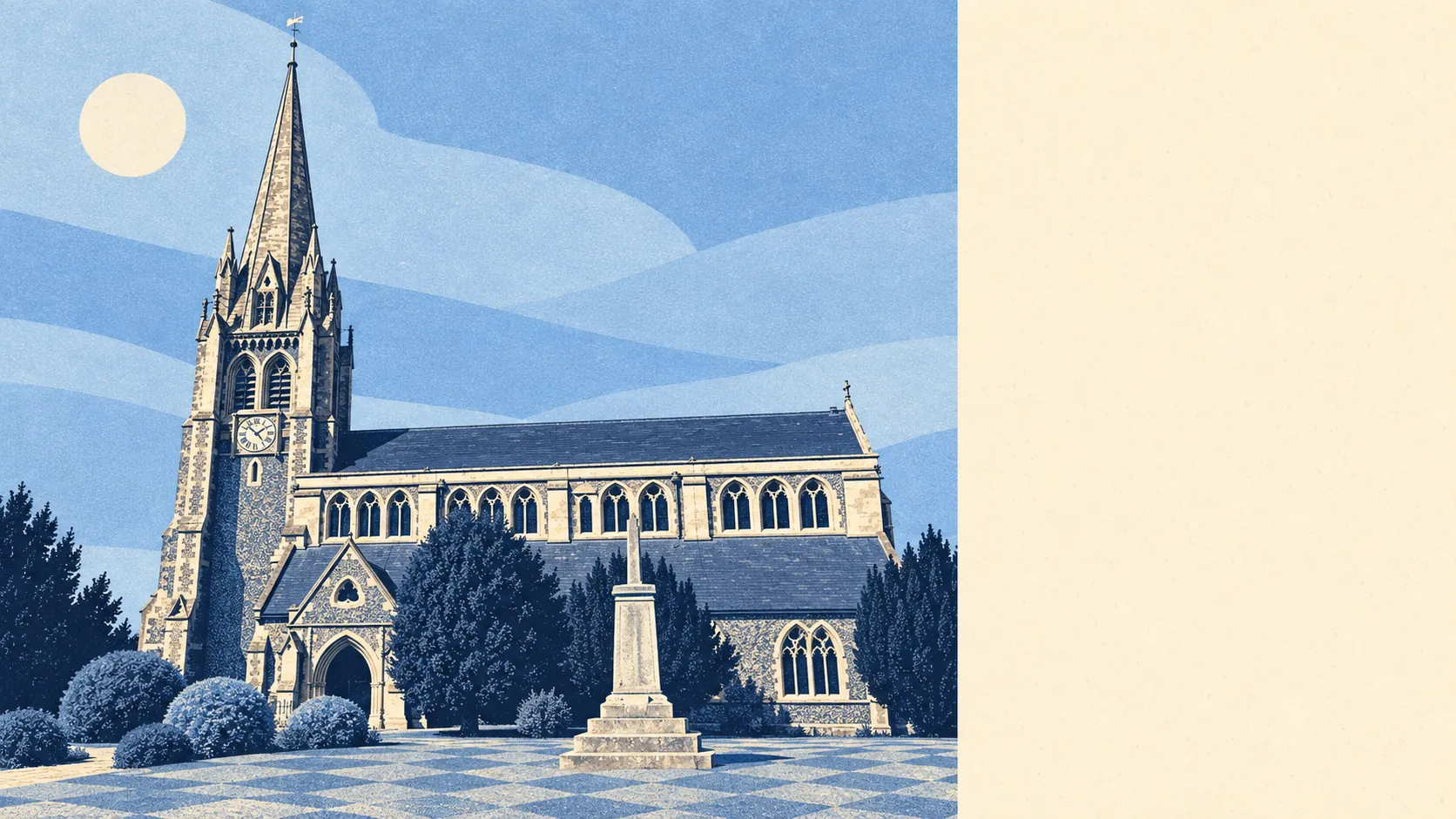
Dorking is a commuter town that has mostly stopped commuting. Nearly half the working residents work from home. Hardly anyone takes the train to work. The hills start where the streets stop. It's less a dormitory than a very expensive home office with Box Hill out of the window.
The housing is more mixed than the postcard suggests. On the council-tax valuation list, which covers every home, flats make up about 29% of the town, terraces 22%, semis 23% and detached houses 19%, with bungalows at about 5%. About a third of homes were built before 1930, so buyers tend to find the period features first and the draughts later. On energy performance certificates, about 49% of rated homes reach band C or better, 37% sit in band D and 15% are band E or worse. About 77% of homes are on mains gas, and about 10% rely on electric-only heating, which is worth checking before you fall for a cottage and not after the first winter bill.
Prices are high, which will surprise nobody who has driven down the High Street. The typical sale price in the Land Registry's year to mid-May 2026 was about £455,000, over 190 sales. By type, flats went for a median of about £277,000, terraces about £439,000, semis about £568,000 and detached houses about £883,000. That last number is what a garden and a view of the Downs costs in this part of Surrey. The most common council-tax band is D, which runs about £2,520 a year here, and only about 15% of homes are in bands A or B. The town has almost no cheap end, and a buyer hunting for one is hoping, not searching.
Renting doesn't get you out of it. The typical private rent across Mole Valley was about £1,550 a month as of April 2026. That is a district-wide average, not Dorking's own figure, and it spans everything from a one-bed at about £1,140 to a four-bed at about £2,570. Landlords have noticed the view as well.
Safety is where the town looks less comfortable than it thinks it is. Police figures for June 2025 to May 2026 put Dorking's crime rate at about 80 per 1,000 residents, roughly 20% above the Mole Valley average. That is partly what happens when you put the district's only proper town centre inside a district made mostly of villages. The mix leans away from the county stereotype: burglary was about 7% of recorded crime against a national share of about 4%, and anti-social behaviour about 19% against 16%. None of this makes Dorking rough. It makes it a town, and the villages around it flatter the comparison.
Schools are the strongest argument for staying put. Ofsted has graded 147 of 159 settings across Surrey good or outstanding, 30 of them outstanding. Locally, the eight primaries in the area's postcode districts average about 105 in end-of-primary maths, where 100 is the expected standard, and the two secondaries average about 52 on the government's Attainment 8 measure. The Ashcombe School and The Priory Church of England School cover the secondary years. Primaries include Powell Corderoy Primary School, which traces itself back to 1816, St Martin's CofE, St Paul's CofE and St Joseph's Catholic. Parents here tend to pick the house for the catchment and then pretend it was the vineyard.
Getting around is better on paper than in practice, because hardly anyone uses the paper. Dorking has three stations: Dorking for London Victoria, London Waterloo and Horsham, and Dorking Deepdene and Dorking West on the Reading to Gatwick line. Only about 3% of working residents take the train to work, while about 38% drive and about 44% work from home. There are 78 bus stops, averaging about 43 weekday departures each. Broadband is the quiet winner: about 88% of premises can get gigabit speeds and every one can get superfast, which is what a town of home offices needed.
The surroundings are the whole point. The average home is about 145 metres from the nearest green space, with around 17 within a kilometre, and the Surrey Hills National Landscape wraps the town on three sides. Flooding needs a clear label. Of the town's postcodes, about 14% carry a high rating on at least one flood indicator, surface water included, which usually means the Pipp Brook and heavy rain rather than rising seas. In the Environment Agency's river-and-sea flood zones the figures are small: about 2% of the area in zone 3 and about 1% in zone 2. The last recorded flood, in January 2014, came from an ordinary watercourse overflowing its channel. Check the specific street.
Heritage will have opinions about your extension. There are 157 listed buildings in the area, five of them Grade II* and the rest Grade II, and three conservation areas: Dorking itself, Dorking Pixham Lane and Milton Street. There are also three scheduled monuments, including a Bronze Age bowl barrow in The Glory Wood. If your plan involves plastic windows on the High Street, the planning officer got there first.
The people are settled and well paid. About 66% own their homes, the median age is 45, and average gross household income, as modelled by the Office for National Statistics for the financial year to March 2023, was about £70,800. That's a town that arrived rather than one still arriving. The same page covers the villages around it, from Westcott and Westhumble on the doorstep to Mickleham under Box Hill, Betchworth to the east, and Holmbury St Mary and Peaslake up in the hills, where the property prices climb along with the lanes.
Dorking suits buyers who work from home, walk at weekends and want good schools without a long drive. It suits families who can afford a semi and would rather pay for it than for a commute. It also suits anyone who wants a proper High Street within reach of Leith Hill, and is happy to pay a premium for having both.
It doesn't suit buyers who need a cheap first rung, because the flats are the only affordable stock and they aren't cheap. Nor does it suit anyone who wants nightlife, or who expects a quiet market town to have a village's crime numbers. If you commute to London every day, the trains will get you there, but most of your neighbours stopped doing it for a reason.
Dorking has had some good residents. Daniel Defoe, Laurence Olivier and Ralph Vaughan Williams, whose The Lark Ascending suits the view, all have their names attached to the place. Rob Walker's racing team ran out of Pippbrook Garage on London Road with Stirling Moss driving, which is about as fast as anything in Dorking has moved since.
Dorking is a good place to live if you can pay for it. Its real strength is the country around it, with green space at the end of most streets and the Surrey Hills on three sides. The weak spot is safety, where a busy town centre pushes crime above a district that is mostly villages. The rest is a trade: you pay London-adjacent prices, keep a train line you'll rarely use, and get to stay home and look at the hills.