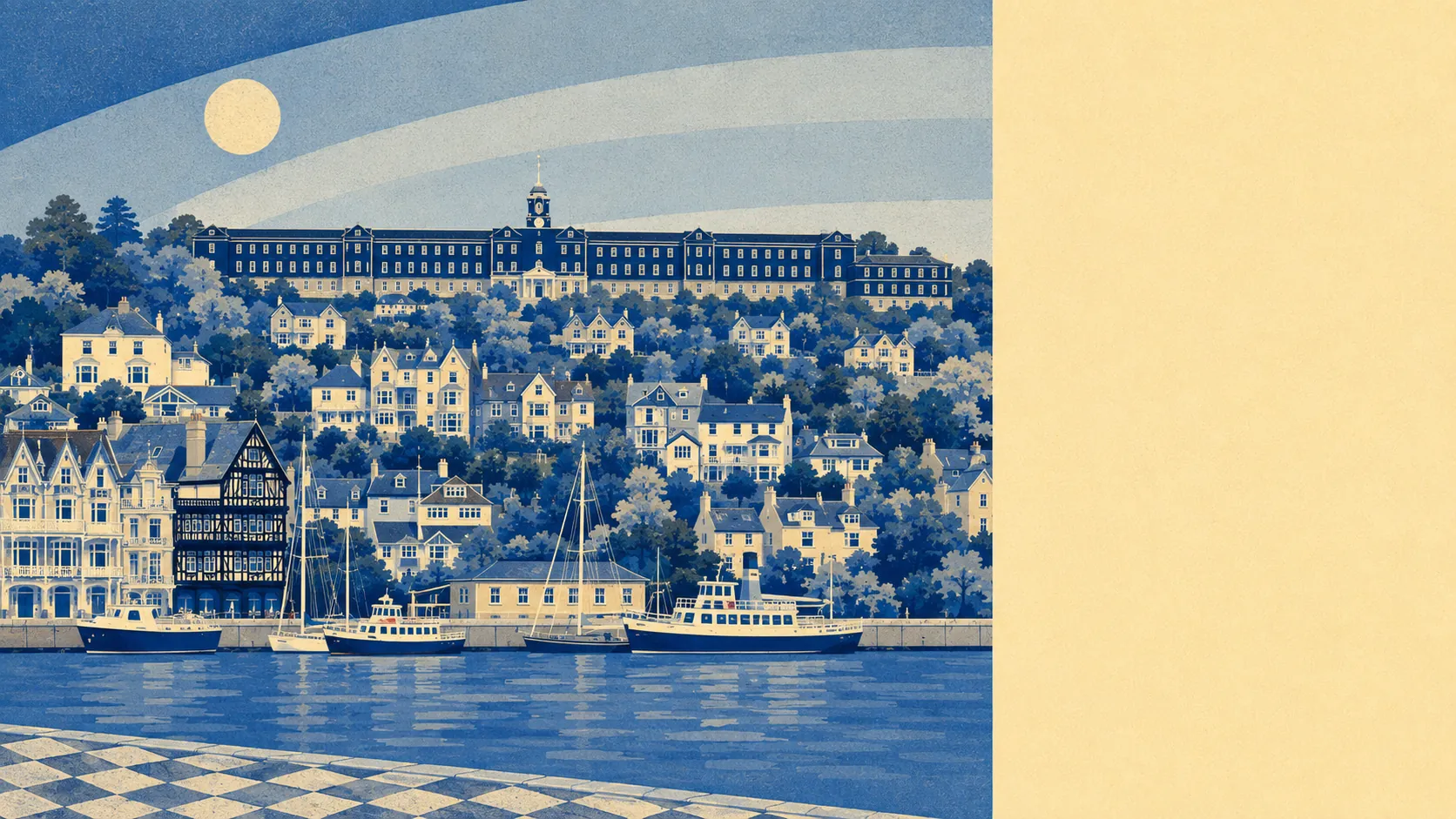
Older, settled and comfortable rather than rich, which is not the crowd the harbour photography implies. Six in ten own their homes. The typical resident is in their mid fifties. More than a third of households are one person living alone. Whatever the brochures suggest, this is not a town filling up with young families and a dinghy.
On tenure, the Census 2021 counts, which are the source for every population figure here, put owner-occupation at about 60%. Private renting accounts for roughly 18% and social renting for about 21%, which is the number that quietly contradicts the yacht-and-gin version of Dartmouth. This is a working town with a very expensive front row, not a resort with staff quarters.
The age profile is the headline. The median resident is about 54, and the 25 to 44 bracket, the years when people typically buy a first home and have children in it, accounts for roughly 18% of the population. Anyone moving here in their thirties should expect to be the youngest person in most rooms that are not a school gate or a pub.
Income sits in unremarkable territory. Modelled household income for the area was around £47,000 gross, before tax, in the financial year to March 2023, or roughly £39,000 after tax. That is a historic modelled figure rather than a current one, and it is worth holding in mind next to what property costs here, because the two are not obviously in the same conversation.
Household composition follows directly from the age profile. About 36% of households are a single person, and around 20% are pensioners living alone, that second group being part of the first rather than an addition to it. Couples with dependent children make up roughly 12% of households and lone parents about 8%. Put plainly, one-person households outnumber families with children by a wide margin, which shapes everything from what the shops stock to how quiet the town is in February.
Education levels split the town in two directions at once. Roughly 33% of residents hold a degree-level qualification and about 17% hold none at all. Full-time students account for around 2%. That combination is typical of a place where a professional incomer population has settled alongside an established local one, and it means the town has both a book group and a functioning trade base.
One structural note that changes how the rest reads: of about 5,588 residents, roughly 5,376 live in private households and 212 live in communal establishments. The area contains 3 care homes, all currently rated good or better by the Care Quality Commission, which accounts for part of that count and reinforces the older skew already visible in the age data.
The people here are middling in the most literal sense: mid-range incomes, mid-range qualifications, a solidly mixed tenure base, and an age profile tilted firmly toward people who have already done their striving somewhere else. Dartmouth is not where careers are made. It is where they are politely concluded.