The area around Cookham is river, common land and very little in between. Green space is a short walk from almost every door. The Thames and two brooks are close by. The local high street relies heavily on its pubs. Most of the surroundings look like a calendar page, and a fair amount of effort has gone into keeping them that way.
On average, the nearest green space is about 150 metres from a Cookham home, and there are about nine within a kilometre. Cookham Dean Common and Cock Marsh are both common land, part of the large stretch of commons that still survives in the parish. Cookham has more commons than most towns have parks, which is one benefit of being old and stubborn.
Water is close too. The nearest river, brook or lake averages about 540 metres away, with about 22 within a kilometre. The Thames runs past between Marlow and Taplow, and the Lulle Brook and the White Brook flow through the parish to join it. The brooks get on with the work while the Thames gets the photographs.
The National Cycle Network is about a kilometre from the average home, and about 21% of postcodes are close to it. There is no ancient woodland within the area itself.
On the rating records for the wider postcode districts around Cookham, there are 625 shops, 82 pubs and 49 restaurants. That area is much larger than the village, so these counts describe the surrounding district, not Cookham's own high street. The area has a lot more pubs than restaurants.
Fine-particle air pollution across Windsor and Maidenhead averaged about 7 micrograms per cubic metre in 2024. That is a figure for the whole council area, and it doesn't measure any single street.
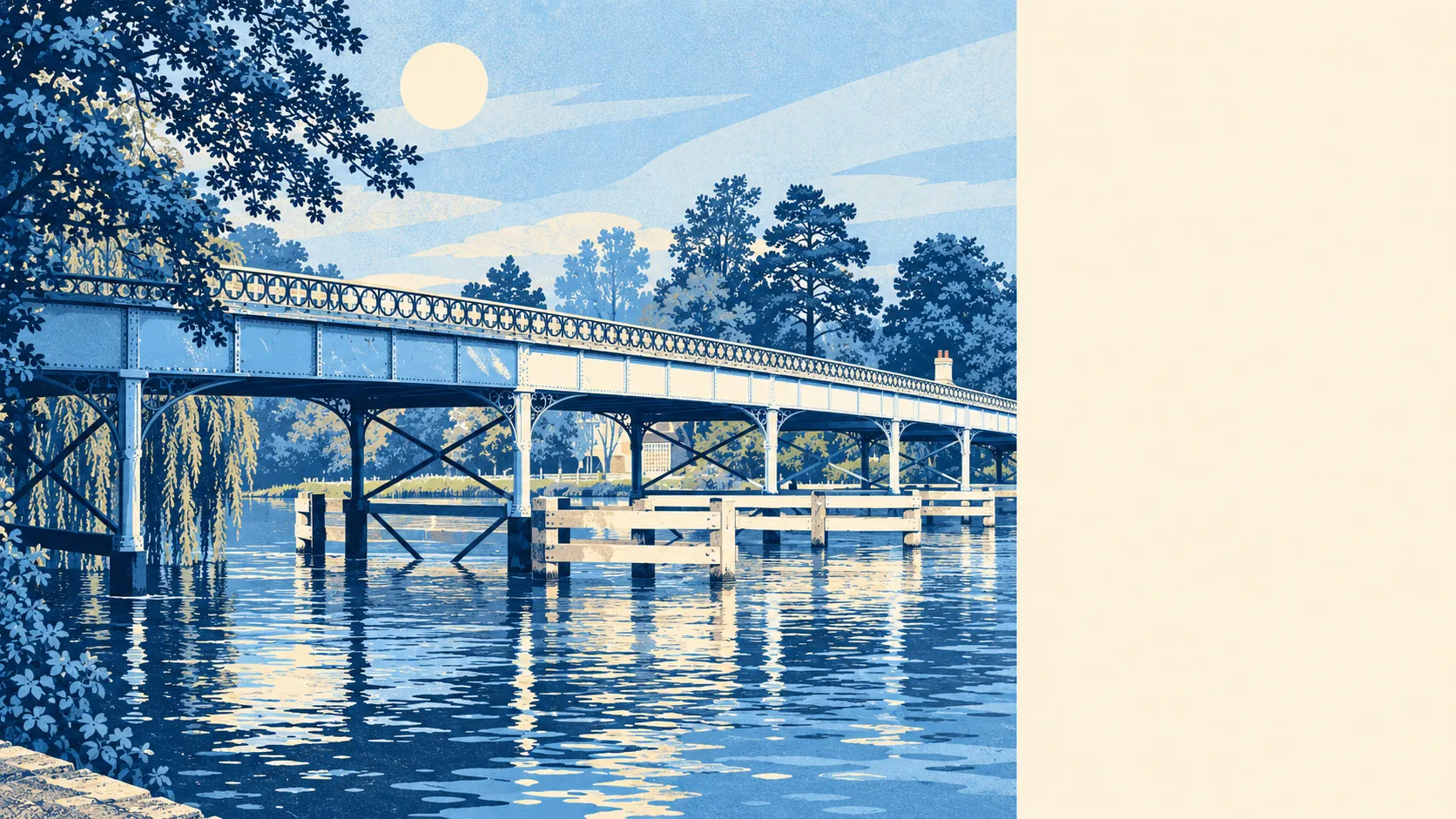
The setting has real character. Odney Island, Formosa Island and Sashes Island sit in the river, with long moorings above Cookham Bridge. Winter Hill looks out over the Thames Valley and the Chiltern Hills. Bourne End is across the water, with Marlow and Bisham to the west and Taplow to the east. The round barrow cemetery on Cock Marsh is a scheduled monument, as is Robin Hood's Arbour on Maidenhead Thicket. The prehistoric burial mounds on Cock Marsh mean Cookham's oldest residents still have the best view of the river.
Homes have plenty of private outdoor space as well. Across Cookham there are about 313,000 square metres of garden for every 1,000 residents, which puts it firmly in lawn country, with very few people relying on a balcony.
The council's valuation list has 178 rateable business premises in the area, the largest groups being 54 shops and 26 offices. These are premises on a list. Some may be empty or used for something else, so the count doesn't tell you how many shops are trading on a given morning.
The Food Standards Agency has rated 48 food premises in the area. About 85% have the top hygiene score, and none are in the lowest bands. For a village where eating out mostly means the pub, that is a very good record.
No protected landscape designation overlaps the area itself: no area of outstanding natural beauty, no site of special scientific interest and no ancient woodland. Cock Marsh, just to the north of the village, is a site of special scientific interest. The protected countryside is next door, and the village has to be attractive without the official designation.
Cookham's surroundings are one of its real strengths: common land on the doorstep, the Thames within a short walk, and a long history that hasn't been built over.