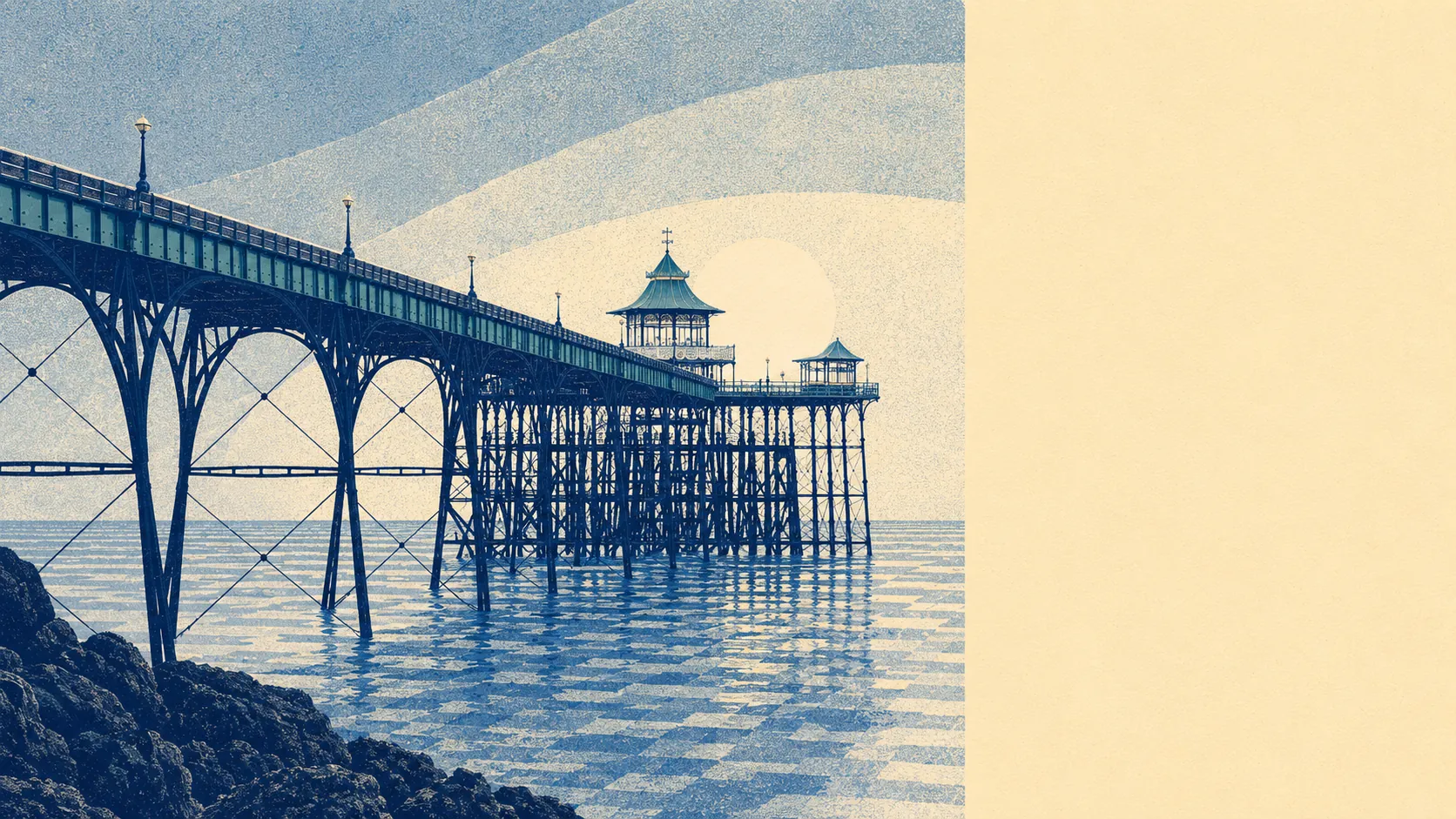
Clevedon is a Victorian seaside resort that quietly gave up on tourists and became Bristol's dormitory by the sea. The median resident is 49. About three-quarters of homes are owner-occupied. The typical sale runs to around £345,000. Not a resort anymore. A retirement plan with a Grade I pier.
Six in ten homes here are houses, and getting on for three in ten are flats, which is more flats than a town this genteel likes to admit. The building stock skews post-war, mostly put up between 1950 and 1982, with about a quarter dating from before 1930 when the place still thought of itself as a resort. Energy efficiency splits down the middle: roughly four in ten homes reach band C or better, another four in ten sit at band D, and nearly one in five limp in at band E or worse. The Victorian villas that look best from Poets' Walk are the ones that cost the most to heat.
A typical sale over the past year landed at about £345,000 across roughly 300 transactions. A flat goes for around £265,000, a terrace about £292,000, a semi around £371,000, and a detached house around £465,000, which is the price of admission to the bit with the views. Council tax mostly lands in band C, and about a third of homes sit in band A or B, so the bills come in gentler than the postcard suggests.
Renting is the minority sport, with about a quarter of households in rented homes. Across the wider North Somerset area, a typical private rent runs to about £1,200 a month, so anyone hoping the sea knocks money off the rent has misread the market.
The published crime rate is about 51 crimes per thousand residents a year, which runs roughly 43% below the North Somerset average. For a town with a seafront and its share of pubs, that is low. This is not a place where much happens after the tide goes out, and the numbers back that up rather than contradict it.
Clevedon lost its own railway in the 1960s and never got it back. The nearest trains sit at Yatton, and barely anyone bothers: fewer than one in a hundred commute by rail, while about half drive and more than a third work from home. What the town does have is broadband, with gigabit-capable lines reaching around nine in ten homes and superfast coverage close to universal. The internet arrived more reliably than the trains ever did.
The Severn estuary gives Clevedon both its views and its main liability. Nearly two-thirds of the area falls inside the Environment Agency's highest tidal flood zone, a function of a tidal range that ranks among the largest anywhere in the world. Surface-water risk is narrower: around one in twenty postcodes carry a high risk and about one in nine a medium one. Anyone buying near the front should read the flood report before the estate agent's brochure. Away from the water it is a different story, with green space almost everywhere, the nearest patch typically under 200 metres from the door and roughly twenty within a kilometre.
The town carries about 125 listed buildings and a pair of conservation areas, including the Triangle, where the old light railway once crossed the road behind a man waving red and green flags. Owning inside those boundaries means asking permission for the kind of changes that are nobody's business anywhere else, from the windows to the front door. It keeps the place looking the way people move here for, and it keeps the paperwork thick.
About three-quarters of households own their homes, the median age is 49, and the typical household income sits around £56,000. This is a town of settled, comfortable, middle-aged owners, which explains both the low crime and the strength of local feeling about parking.
It suits people who want the sea without the arcades, who plan to stay put, and who would rather commute to Bristol than live in it. Retirees land well here. So do families who can stretch to a semi and value green space over nightlife.
It suits nobody who needs a train, wants a bargain, or expects the place to entertain them after nine. If you are 25 and renting, Clevedon will feel like a waiting room with a good view. If you want Weston-super-Mare's prices, go to Weston-super-Mare and take what comes attached to them.
The literary credentials are genuine. Samuel Taylor Coleridge spent his honeymoon here in 1795. Arthur Hallam, the friend whose death gave Tennyson his elegy In Memoriam, is buried locally, and Poets' Walk around Wain's Hill is named for the visitors who came to be mournful about it. The Curzon cinema has been running since 1912, which makes it one of the oldest continuously operating cinemas anywhere. The first large-scale batch of penicillin was grown in the town in 1938. Not bad for a place most people drive past on the way to somewhere louder.
The verdict comes out above average, and the reasons are not subtle. The surroundings and green space are as good as anything on this stretch of coast, the crime figures are honestly low, and the town has kept its character without pickling it into a museum. The flood risk is the single line that scores badly, and it is the one worth taking seriously rather than shrugging off. Buy on the higher ground, read the flood report, and Clevedon is one of the better bets on the Severn. Buy blind near the water, and the estuary will eventually remind you it was here first.