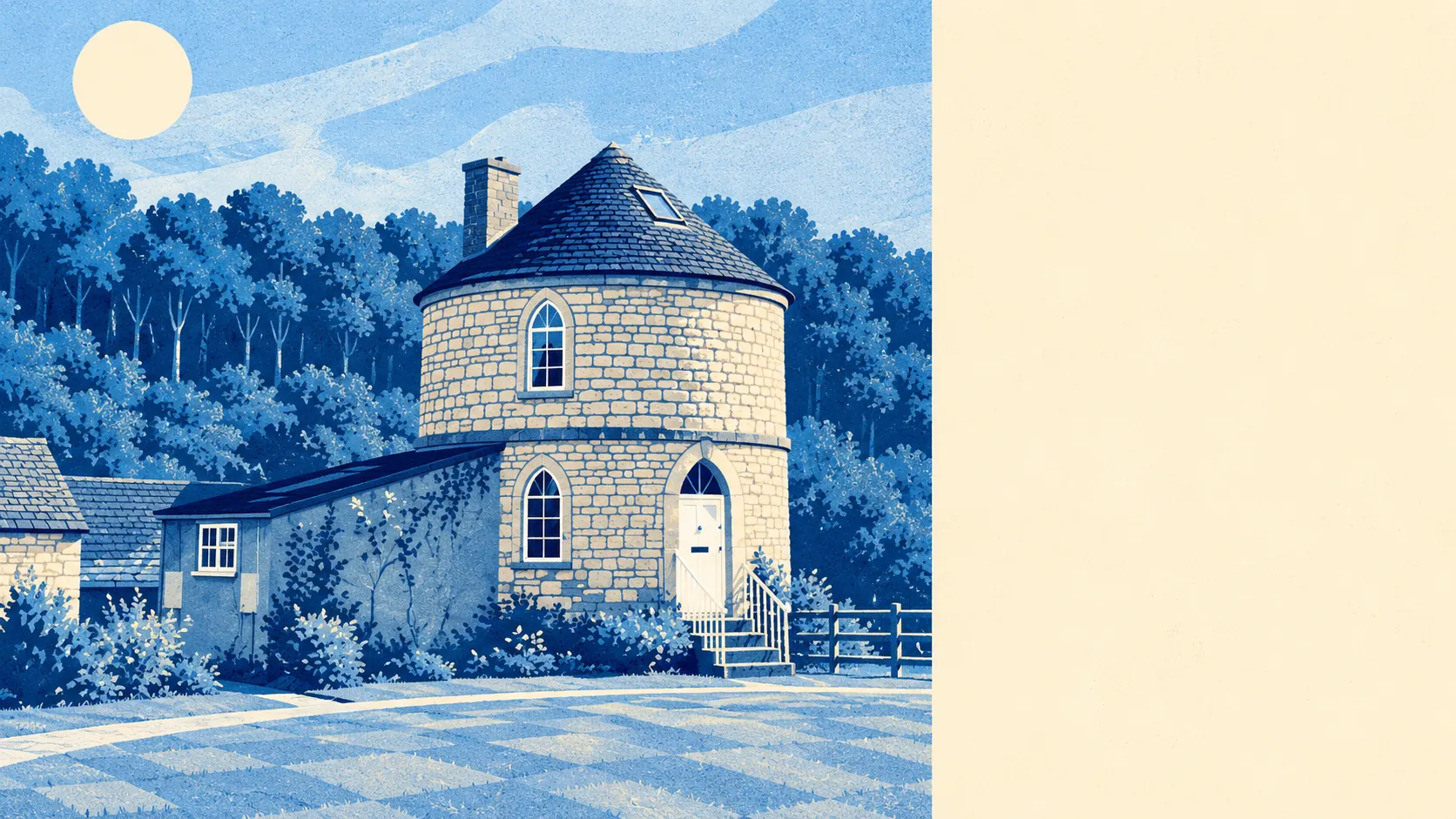
You can extend a house in Chalford, but expect to ask permission for more than you'd like. The village and its surroundings carry plenty of listed buildings. There are six conservation areas. The whole place lies in a protected Cotswold landscape. The hillside itself is often more of a constraint than the planners.
Within the area around Chalford, the national heritage list records 135 listed buildings: none at Grade I, 4 at Grade II* and 131 at Grade II. Listing covers the whole building, inside and out, so a new window, an internal wall or a change of roof covering can need listed building consent as well as planning permission. A Grade II cottage gives you the same lack of freedom as a grand house, only on a smaller footprint.
Six conservation areas cover the place: Chalford Vale, Chalford Hill, France Lynch, Eastcombe, Bussage and Brownshill, and St Mary's and Belvedere. Inside them, works that would go ahead without an application elsewhere can need one, and the council looks closely at anything visible from the street or across the valley. Chalford Hill was originally called Chalford Lynch, after the terraces cut along the hillside, and many houses still sit on those narrow shelves. On a site like that the sensible extension is often impossible before anyone at the council has looked at the drawings.
There are 5 scheduled monuments in the area, the strictest tier of heritage protection, and that tier matters mainly for land next to one. The list nearby includes Lillyhorn Roman villa at Bournes Green, a reminder that the Romans built here first.
People still apply. Stroud District Council's planning register logged 1,339 applications across the area between April 2024 and June 2026, and 577 of them in the last twelve months. That is a lot of paperwork for a parish of terraced hillsides, and it shows that owners here keep asking and keep changing their houses, one application at a time.
One listed building in the area is on Historic England's Heritage at Risk register. That means the building is in poor condition, and its repair is likely to come with grant interest and close official attention. For the owner of an ordinary house down the lane it changes nothing.
In practice, assume nothing is automatic. Permitted development rights, which let homeowners carry out some extensions without a full application, are cut back on listed buildings and narrowed in conservation areas. Ask Stroud District Council for the house's listing status, its conservation-area status and its planning history while you are still deciding on an offer. Any refused application on that file tells you what the next owner shouldn't bother asking for.
Freedom to change a house in Chalford is poor. If you want a home you can reshape, buy one somewhere else. If you're happy with the house and the slope as they are, the rules rarely get in your way.