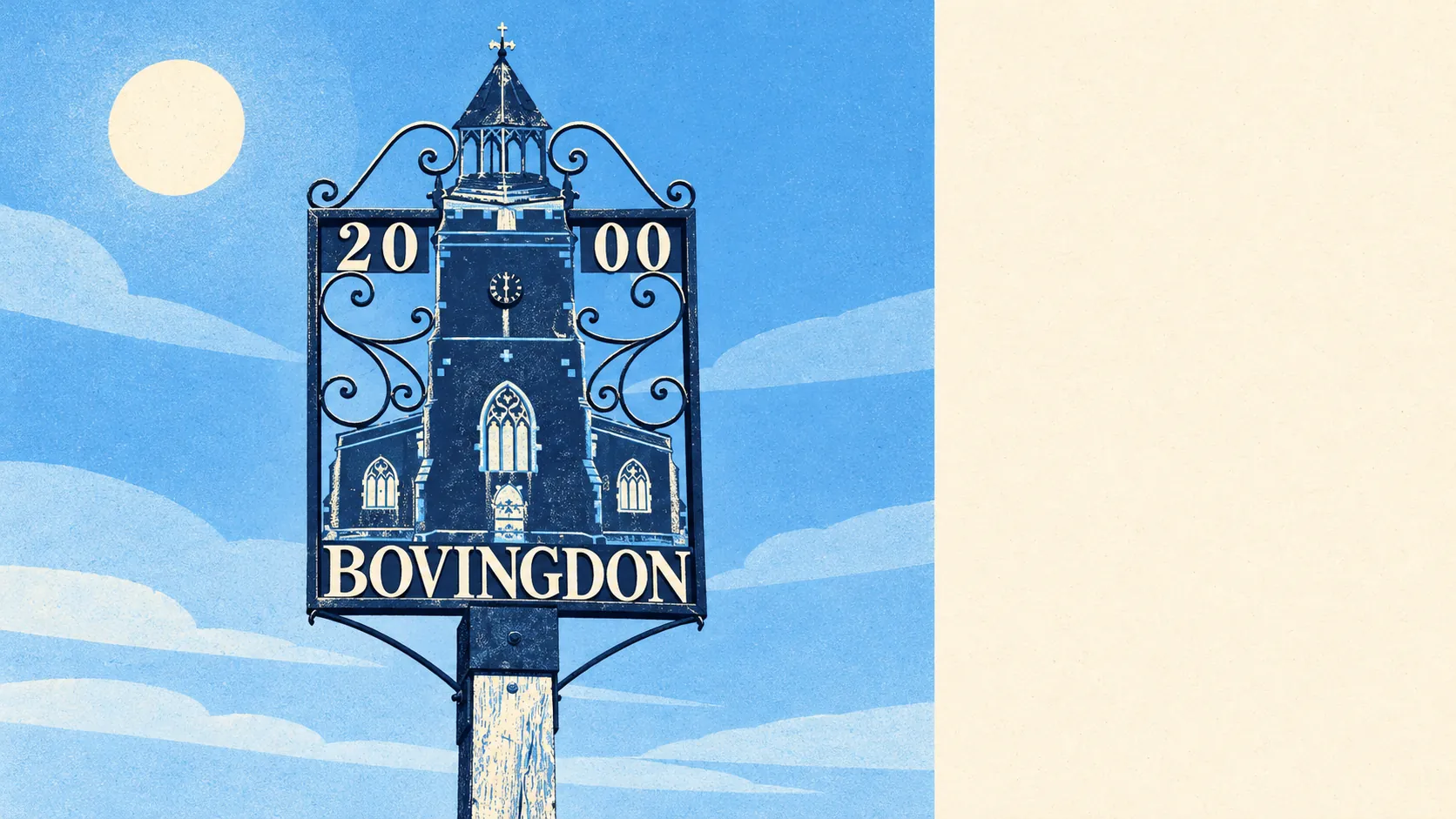
Bovingdon is a village of owners who plan to stay, and that is the best thing a buyer gets for the money. Three households in four own their home. Most residents report good health. Household incomes run comfortably high. Neighbours who intend to be around in twenty years tend to look after the place, and the price of joining them is where the wincing starts.
Owner-occupiers make up about 75% of Bovingdon's households, and the modelled gross household income for the wider area was about £69,000 in the financial year to March 2023, an average the Office for National Statistics spreads across a block of neighbourhoods. The census puts the median age at 42, though that figure needs handling with care. The Mount Prison was built on part of the old airfield in the 1980s and sits inside the village boundary, so of 5,609 residents, 985 live in communal establishments and 4,624 in ordinary households. Every census average for Bovingdon includes a few hundred people who had no say in the postcode.
Hertfordshire Constabulary's published rate for Bovingdon is about 58 crimes per 1,000 people over the year to May 2026, roughly 36% below the Dacorum average. Buyers who hear "prison" and expect the worst will find the village reads lower than the borough around it, though the totals are small enough that a few incidents shift the mix noticeably from one year to the next.
The money is the hard part. The Land Registry's median sale price for the year to March 2026 was about £500,000 across 62 sales. Detached houses went for a median £850,000 on 15 sales, semis about £528,000 on 27, terraces about £438,000 on 12, and flats £280,000 on 8. Band D is the most common council-tax band, and bands A and B together cover only about 10% of homes. For a first-time buyer, the cheap end of Bovingdon is eight flats a year and a short list of terraces. Renting, at least on paper, is gentler: Dacorum's typical private rent is about £1,580 a month as of April 2026, a borough-wide figure that averages Hemel Hempstead's flats in with this village's semis.
The housing is a fairly even split. On the council-tax valuation list, about 25% of homes are semis, 23% detached, 23% terraced, 16% flats and 9% bungalows, and only about 18% were built before 1930. The bulk went up in the post-war decades, a good share of it while American bombers were still flying out of the airfield next door until 1962. About 79% of homes heat with mains gas and about 6% with electricity alone. Around half the homes with an energy certificate rate in bands A to C, respectable for stock of that age.
On the Environment Agency's mapping, none of Bovingdon falls in the river-and-sea flood zones. On the wider postcode measure, which includes surface water, about 9% of postcodes are flagged at high risk on at least one indicator. Flaunden, the smaller village this page also covers, kept flooding on the banks of the River Chess and moved itself up the hill in the eighteenth and early nineteenth centuries, which remains the most decisive flood scheme anywhere near here.
Green space is about 200 metres from the average front door, and some kind of water about 400 metres. The countryside starts at the end of most roads, and the airfield's remainder hosts a Saturday market and a banger-racing circuit that has not run regular races since 2008.
Getting anywhere means driving. At the 2021 census about 46% of working residents drove to work, about 40% worked from home, and about 2% took the train. The nearest stations are elsewhere: Hemel Hempstead, Apsley and Berkhamsted on one side, Amersham and Chalfont & Latimer on the other. The village has 31 bus stops averaging 16 weekday services each, and at peak hour the average stop sees half a bus, a timetable that rewards optimism. Superfast broadband reaches about 97% of premises and gigabit about 60%, which explains how so many people stopped commuting at all.
Heritage is real but light. Bovingdon has 40 listed buildings, two of them Grade II* and the rest Grade II, with the Church of St Lawrence among them, and one conservation area around the old village core. Inside that boundary, new windows and extensions go through the council first; outside it, the post-war streets are ordinary to alter.
Bovingdon Primary Academy is the village school, roughly a ten-minute walk on the Department for Transport's 2019 modelling. The two primary schools in the postal district averaged about 109 in Key Stage 2 maths. Secondary is a different story: the same 2019 model puts the nearest secondary about 15 minutes by car and well over an hour on foot, so Longdean School and the rest mean a daily lift or a bus pass. Across Hertfordshire, Ofsted grades 203 of 227 graded settings good or better, a county-wide count that says nothing about any one classroom.
The village's most famous moment came in 1964, when Tony Nash, son of the owner of the Bovingdon Country Club on Box Lane, won Olympic gold in the two-man bobsleigh at Innsbruck. The club renamed itself the Bobsleigh Inn in his honour, so Bovingdon's chief tribute to its greatest athlete was a pub sign. The footballer David Seaman and the artist David Tremlett are also among its names.
Bovingdon works for buyers who drive, work from home at least part of the week, and want neighbours who will still be there when the children leave primary school. It works badly for anyone counting on a station, a cheap first rung or a teenager who can get to school alone.
The community is the reason to come: owners who stay, look after the place and keep the crime rate well under the borough's. The cost is the reason to hesitate, with half a million as the starting point and little underneath it. On balance Bovingdon is a better-than-average village, for the people who can get in.