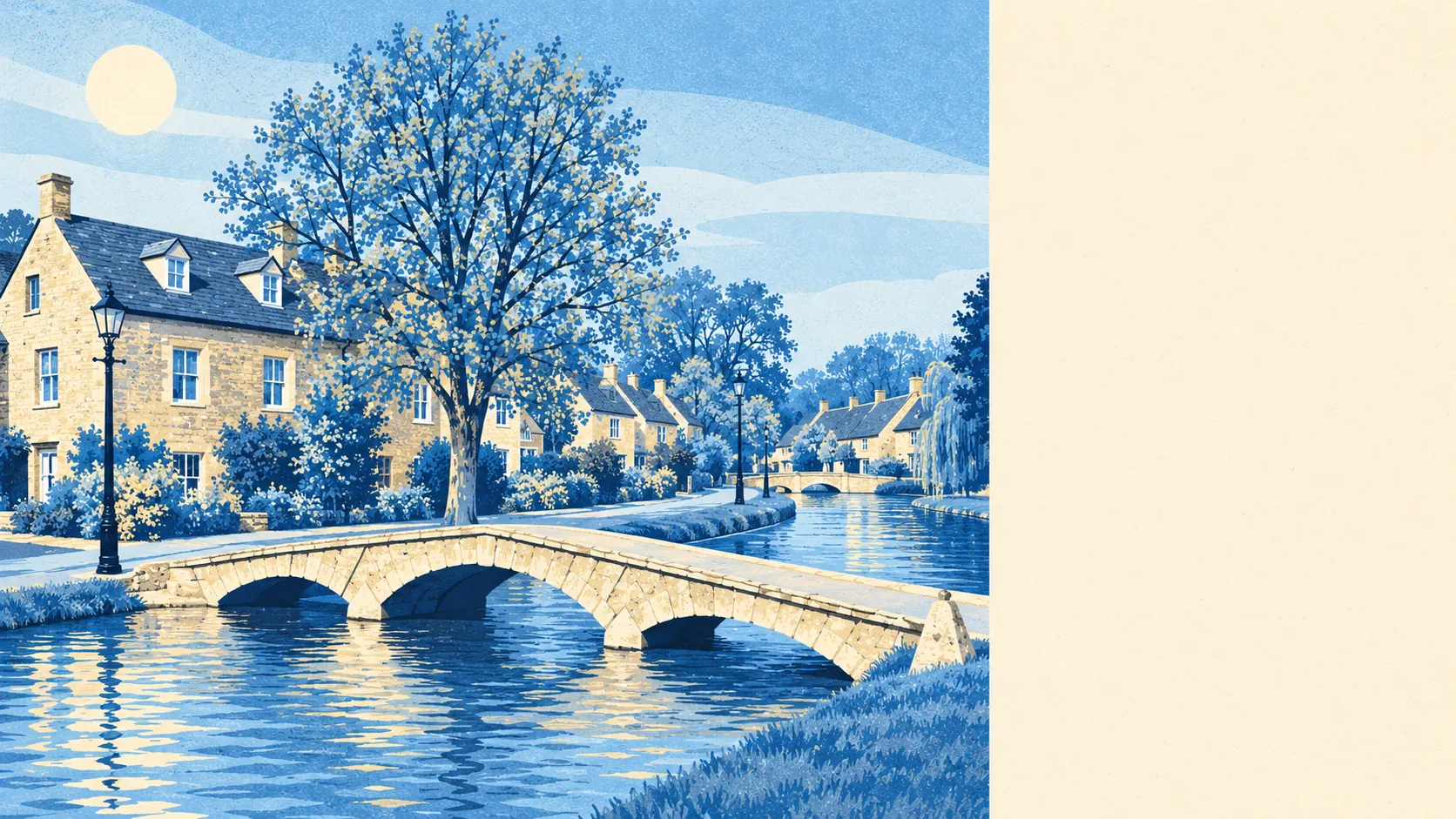
Yes, you can extend a house in Bourton-on-the-Water, though how much freedom you get depends heavily on where the house is. Most homes aren't listed. The old centre is a conservation area. The whole parish is protected countryside. On the newer streets an extension is routine paperwork, and in the stone core it means working to standards set centuries ago.
There are 114 listed buildings in and around Bourton: none at Grade I, 7 at Grade II* and 107 at Grade II. Listing covers the whole building, inside and out, so replacing windows, moving an internal wall or adding a rear extension all need listed building consent from Cotswold District Council as well as any planning permission. The village is built in yellow Cotswold limestone, with stone-mullioned windows, string-courses and hoodmoulds over the doors, and a new extension on a listed house is expected to match that standard in the same stone.
The area has one conservation area, covering much of the village centre. Inside it, the council takes an interest in things that would pass without comment elsewhere, such as demolishing a front wall, changing a roof, or anything visible from the street. Check with the council whether the house is inside the boundary and whether it is listed, because two cottages on the same lane can fall under different rules.
There are 2 scheduled monuments in the area, the strictest tier of protection. They matter mainly to anyone whose land runs up to one, where even digging foundations can need separate consent.
People here still alter their homes all the time. In the area covered here, 2,102 planning applications were made between April 2024 and June 2026, and 922 of them in the last twelve months. A village where the planners deal with an application roughly every working day is a village that is extending, not one that has given up.
In practice, the ordinary permitted development rights that let you build a modest rear extension or a loft conversion without full planning permission are more limited here. The whole parish lies inside the Cotswolds Area of Outstanding Natural Beauty, and the centre is a conservation area on top of that. Outside the centre, on the post-war and later streets, a conventional extension follows the usual route. In the old core, assume the extension needs consent and the building materials need approval too.
On freedom to extend, Bourton comes out middling. The newer streets let you get on with it, but in the centre an extension takes patience, local stone, and a lot of correspondence with the council.