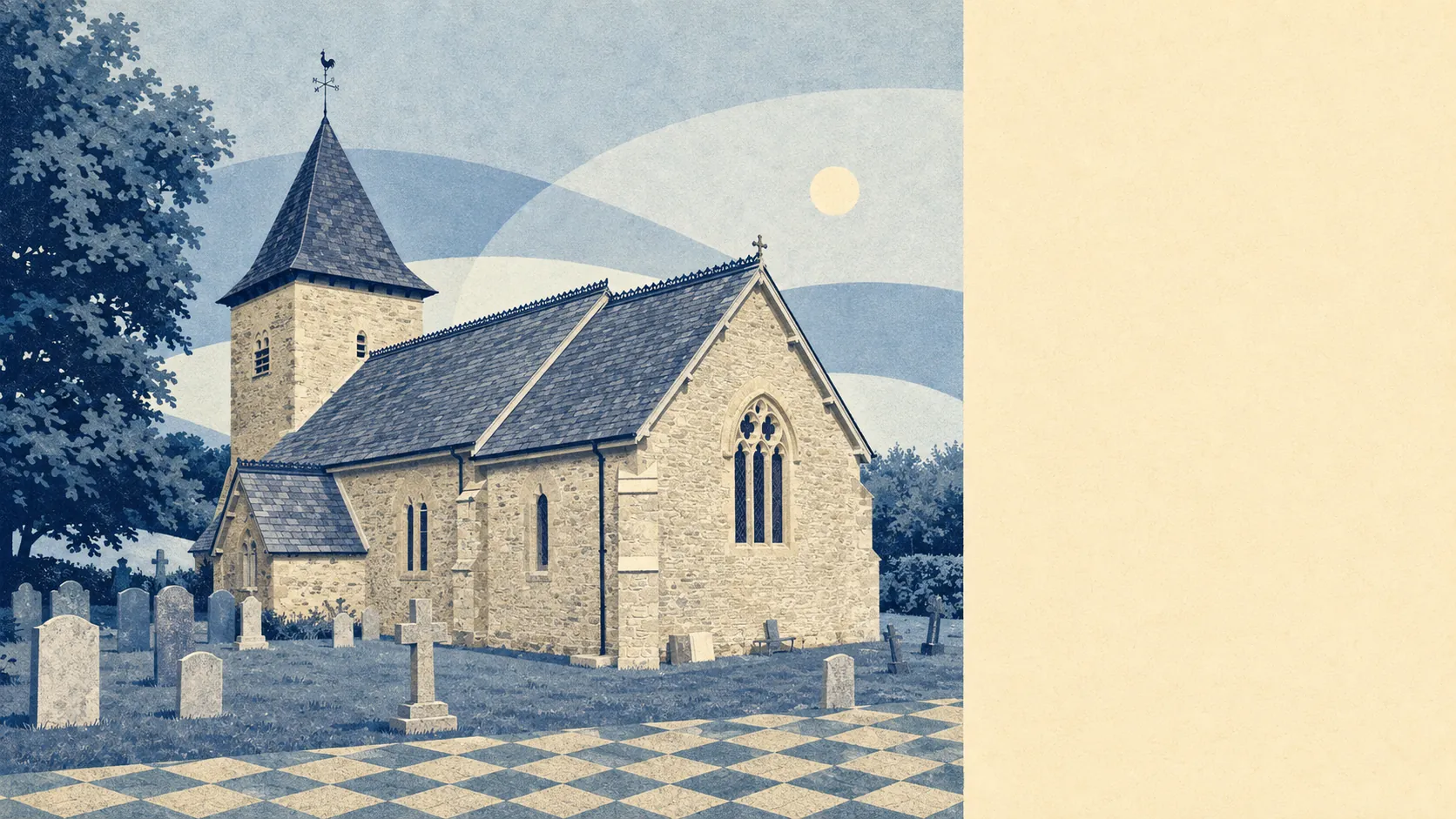
Yes, if you have already made your peace with the car. Four in five households own their home. The typical resident is in their mid fifties. Most households keep more than one car, and almost nobody here commutes by train. Beaworthy is not a place that rewards a trial run, and the people who stay worked that out before they signed anything.
The housing is mostly what a working farming district builds when nobody is watching. The council tax valuation list, which covers every dwelling rather than only those certificated since 2008, puts about 40% of homes as detached and another 25% as bungalows, with semis at around 17%, terraces at around 13%, and flats at about 3%. Roughly 44% of the stock predates 1930, and Victorian is the commonest single vintage. Energy certificates carry the running-cost half of that: around 31% sit at band D, about 42% at band E or worse, and only around 26% manage band C or better. Mains gas reaches about 7% of households, which means heating is a private arrangement for nearly everyone else, and roughly 8% run on electricity alone. Another 5% have no central heating at all. A thick-walled cottage looks wonderful in a June viewing and behaves differently in February, and the certificate is the only part of the transaction that will tell you so.
The Land Registry recorded 47 sales across the area in the year to April 2026, at a median of £325,000. Split by type, that median stops being much use: detached houses landed at around £380,000, semis at around £283,000, and terraces at around £181,000. Council tax runs the same shape, with band D the commonest and about 32% of dwellings in bands A and B. Buyers turn up quoting the middle figure and leave having discovered the middle figure does not buy the house in the photographs.
Renting is a thinner proposition. Typical private rent across the Torridge area was about £790 a month as of April 2026, measured by the official rent index rather than a sweep of listings, and that is a district figure covering a great deal more than Beaworthy. Only about 20% of households here rent at all, so the local market is small enough that a single landlord changing their mind counts as market movement.
Safety is where the area quietly outperforms. Recorded crime ran at about 36 offences per 1,000 residents in the twelve months to May 2026, against about 55 across Torridge as a whole, which puts the Beaworthy area roughly 35% below its own district average. That is a published neighbourhood rate, not a headcount divided by residents. Worth knowing alongside it: across Devon and Cornwall Police as a whole, 8% of recorded crimes ended in a charge over the same twelve months, against about 12% nationally. That is a force statistic rather than a Beaworthy one, and it matters more on the day something happens than the reassuring rate does on every other day.
Getting anywhere is the problem, and the countryside does not compensate for it on a Monday morning. About 39% of working residents mainly work from home and about 52% drive, while the share commuting by train rounds to nothing. Department for Transport modelling puts the nearest town centre at about 21 minutes by car and about 61 minutes by public transport, a doctor's surgery at about 18 minutes by car, and the nearest hospital at about 58 minutes by car. Those figures date from 2019, and the driving times have aged better than the bus ones. There are 108 bus stops in the area, averaging five weekday departures each, and about 47% see any weekend service at all. Five departures at the average stop is not a network, it is a gesture. Broadband is patchy in the same direction: superfast reaches about 48% of premises, gigabit about 15%, and roughly 6% sit below the universal minimum speed, which is the number to check against your own postcode before you promise anyone a video call. Modern mobile coverage from every operator reaches about 95% of the area, so the phone works even where the fibre does not.
Flooding is a small and specific worry rather than a general one. On the postcode indicators, which include surface water and not just rivers, about 5% of postcodes carry a high rating on at least one measure, about 3% a medium one and about 12% a low one. In the Environment Agency's river-and-sea flood zones proper, under 1% of the area falls in zone 2 and none in zone 3. One flood event is on the record, back in 1970, when a main river exceeded its channel capacity. Green space is close without being formally protected: a green space at about 850 metres on average with two within a kilometre, and water at about 500 metres with roughly seven within a kilometre. No national landscape designation, no protected sites, no ancient woodland. What surrounds you is working farmland, which is a different arrangement from scenery and behaves accordingly at harvest.
Heritage is dense enough to change what you can do with a house. There are 296 listed buildings in the area, three of them grade one and 23 grade two star, plus 35 scheduled monuments and five conservation areas at Eworthy, Germansweek, Sheepwash, Northlew and Bratton Clovelly. Seven listed entries sit on Historic England's at-risk register. Buy inside one of those boundaries and your windows stop being your decision, your extension acquires an opinion, and the timetable for both belongs to somebody at the council.
The social picture follows from all of that. Around 79% of households own, the median age is about 54, and modelled gross household income across the area ran at about £45,700 in the financial year to March 2023, before tax. That is a settled population rather than a churning one, and the under-forties who are here are outnumbered rather than absent. This page covers Hatherleigh as well, which sits in the same orbit, on the same roads, under the same assumption that you will drive.
It suits people who work from home or work land, who want space and a low crime rate more than they want choice, and who can look at a band E cottage and cost the winter honestly. It suits anyone whose social life happens indoors, at home, on a Tuesday.
It does not suit people who need a train, need a hospital in under half an hour, or need to be somewhere at nine in a place a bus actually goes. Wanting the isolation without the driving is the one demand this area cannot meet, and no postcode within it hides a shortcut.
Henry Courtney Selous, a London-born painter, illustrator and lithographer, died at Beaworthy in September 1890 after a career made in the Haymarket. A Victorian artist finishing up in the deep Devon interior is either a retirement or a vanishing act, and from the road the two are indistinguishable.
Beaworthy is an average place to live in the honest sense: genuinely good at some things, genuinely poor at others, and clear about which is which. Its real strength is safety, and the numbers back that up rather than the estate agent. The weak spot is transport and connectivity, which is not a detail to be worked around but the single fact that shapes every day here. Get that trade the right way round and the rest of it is a bargain.