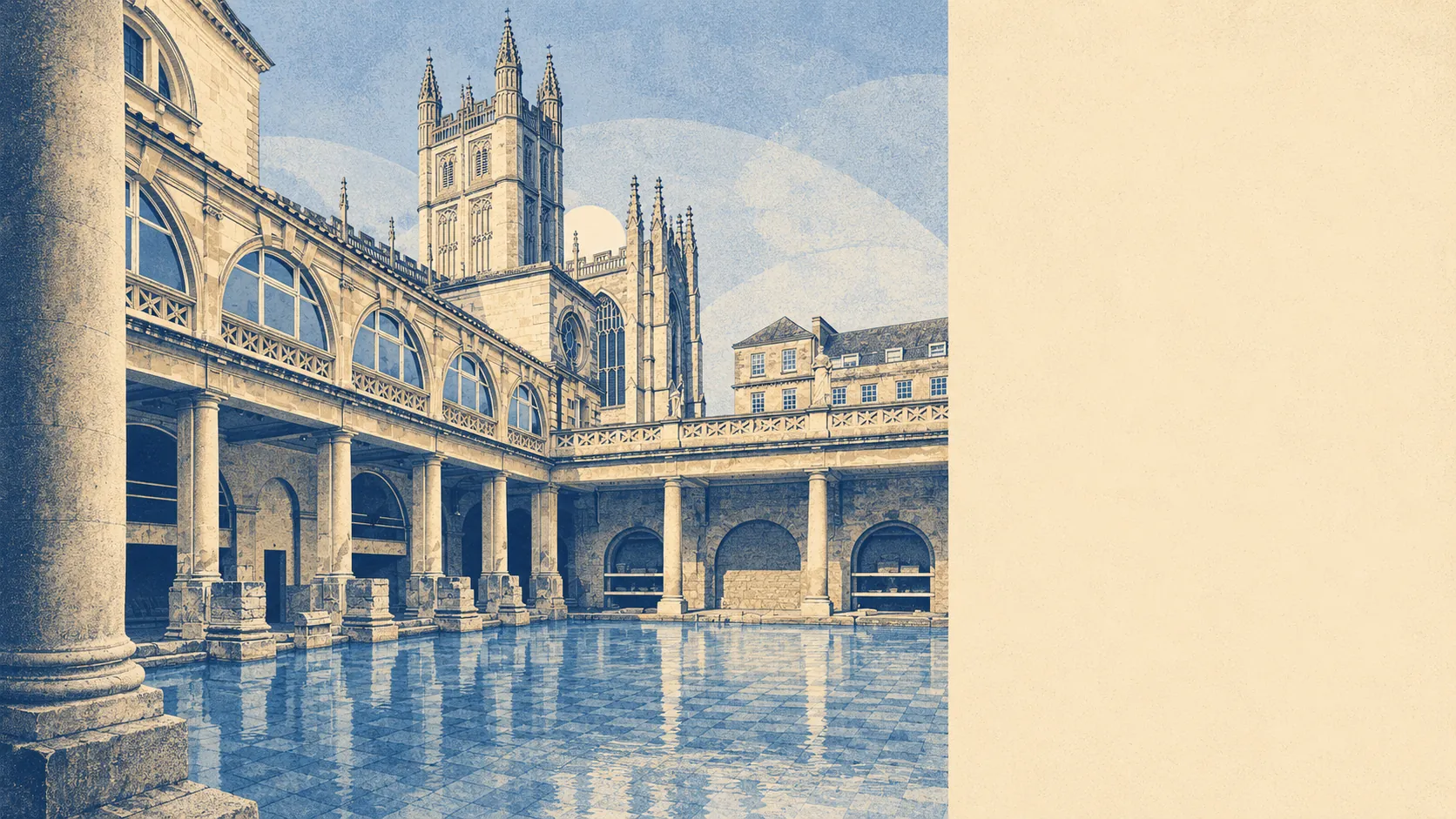
Yes, if you can live in a museum without resenting the curator. Bath is the only English city where the buildings won and everyone else negotiates around them. It is beautiful in a way that stops being a compliment about the third time a planning officer explains why your windows are wrong. It has a river that has flooded, hills that have slipped, and a stone that costs a fortune to repair. It is also one of the few places where the walk to work is genuinely worth having, and most of the people who complain about Bath still live in Bath.
The housing stock is where the money and the misery both come from. On the council-tax valuation list, which covers every dwelling rather than only the ones certificated since 2008, terraced houses are the biggest single group at around 32% of homes, flats at around 34%, semi-detached at 18%, detached at 10%, and bungalows at 4%. Around 41% of the stock was built before 1930, which is the real Bath number: a city built for people who employed staff to keep it warm. Energy certificates back that up, with just under 38% of certificated homes sitting at band D and around 15% at band E or worse. Roughly 48% reach band C or better, which is not a disaster, but the D-and-below half is mostly Georgian and Victorian and mostly expensive to keep at a civilised temperature. Around 75% of homes run on mains gas, and about 13% are heated by electricity alone. Electric-only heating in a pre-1930 building is a running-cost fact worth knowing before the viewing rather than after the first winter quarter.
On price, the Land Registry's last twelve months to late May 2026 put the typical Bath sale at around £445,000 across 942 transactions. The type split is where the honesty lives: flats around £310,000, terraced houses around £442,500, semi-detached around £525,000 and detached around £842,500. The single most common council-tax band is C, and around 32% of dwellings sit in bands A or B, which is a reminder that the Royal Crescent postcard is not the whole valuation list. Bath contains a very large number of ordinary homes wearing an extraordinary skyline.
Renting is not cheap. The typical private rent across the Bath and North East Somerset area is about £1,880 a month as of April 2026, up around 8% over the year. That is an area-wide figure rather than a Bath-specific one, and the area includes a lot of countryside, so treat it as the shape of the market rather than the quote on a specific flat.
On safety, the published rate for the twelve months to May 2026 is around 110 recorded crimes per thousand residents, which sits roughly 22% above the Bath and North East Somerset average. That gap is what a tourist city with a night-time economy looks like on a spreadsheet: shoplifting accounts for around 13% of recorded crime against about 8% nationally, and public order offences around 10% against roughly 7%. Neither of those is what most people mean when they ask whether a place is safe, but both are what push the headline number up.
Schools are the quiet strength. Ofsted has graded 41 settings in the local authority, of which 39 are good or better and 4 are outstanding, with one requiring improvement and one inadequate. Key stage 2 maths across 26 schools in the two postal districts averages around 104, and key stage 4 attainment across 6 schools comes in around 52. Journey times are short: about 9 minutes' walk to a primary and around 20 minutes to a secondary, which in a city built on hills is less pleasant than it sounds and still better than most places manage.
Connectivity is genuinely good, and slightly wasted on people who then drive anyway. Bath Spa railway station sits on the Great Western Main Line, with Oldfield Park as the local alternative and Freshford and Avoncliff further out along the valley. Around 620 bus stops sit within the area, with roughly 22 buses an hour at peak across stops that carry service data, and around 98% of stops have a weekend service. About 43% of residents work mainly from home and around 28% drive to work. Full-fibre gigabit broadband reaches around 72% of premises and superfast around 94%, with effectively no premises below the universal service obligation. Every premises has 4G or 5G coverage from at least one operator.
The environment is the best thing about living here and the thing most likely to bite. Around 11% of postcodes carry a high rating on at least one flood indicator, including surface water, and about 17% a medium one. On the narrower Environment Agency river-and-sea flood zones, around 6% of the area sits in zone 3 and around 7% in zone 2. Roughly 10% of postcodes have a recorded historic flood event. Against that, green space averages around 120 metres away with roughly 32 sites within a kilometre, water around 430 metres, and about 3% of the area falls inside the Cotswolds National Landscape. Radon is worth a mention: around 96% of the area sits in the higher radon bands, which is a survey question rather than a dealbreaker.
Heritage is the constraint that defines ownership here. There are 2,537 listed buildings in the area, including 105 at grade one, and 7 conservation areas including Bath itself, Bathampton, Batheaston, Charlcombe, Englishcombe, Monkton Combe and Southstoke. In practice that means windows, doors, roof materials, solar panels, extensions and sometimes paint colour are decisions you make jointly with the council. Buyers who understand this budget for it. Buyers who do not spend three years discovering that the thing they loved about the house is the thing they are not allowed to change.
The character of the place follows from all that. Around 56% of homes are owner-occupied, the median resident is 35, and typical household income runs around £61,000 before tax for the financial year to March 2023. That combination, older housing and younger-than-expected residents, is two universities doing quiet work in the background. Beyond the city, this page also covers Bathford, Swainswick, Freshford, Limpley Stoke, Hinton Charterhouse, Wellow, Norton St Philip and Farmborough, which are the villages people move to when they want the valley without the coach parties.
Bath suits people who will actually use it: walkers, cyclists, home workers, families who want short school runs and a park at the end of the street, and anyone who would rather own a smaller flat somewhere beautiful than a larger house somewhere convenient.
It suits less well anyone who needs to alter a property to make it work, anyone buying purely on price per square metre, and anyone who wants a quiet, modern, cheap-to-heat house within a short drive of a motorway. That house exists. It is not here.
The verdict is a genuine middle. Its real strength is the setting: the green space, the valley, the National Landscape on the doorstep and the sheer walkability of the place. The weak spot is the freedom to change your own home, where the listed buildings and conservation areas mean the house you buy is broadly the house you keep. Bath is a fine place to live and an expensive place to have ideas.