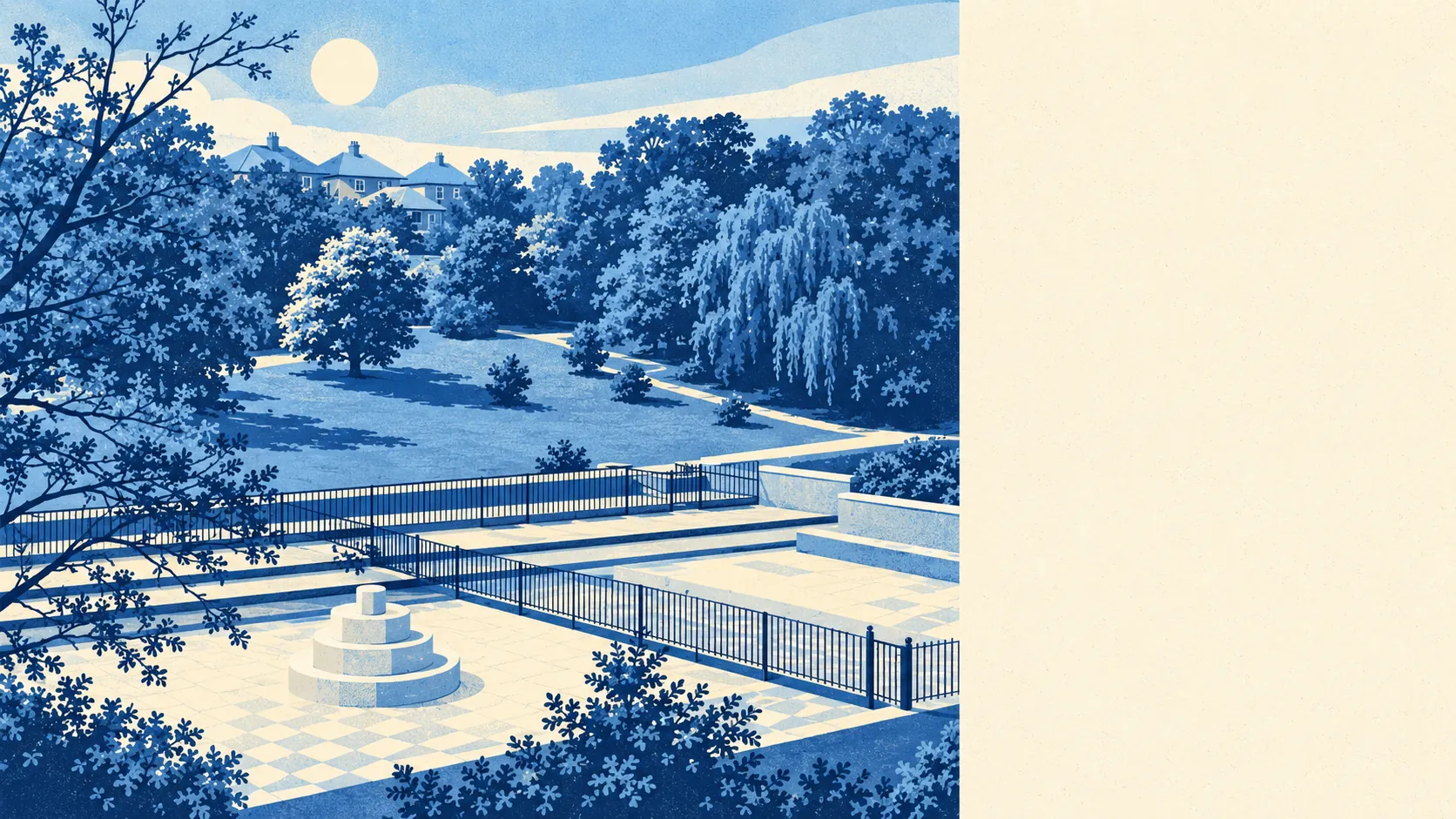
The area around Barnehurst is green, built-up and handy, and the green part is what sets it apart. A park or open space is a couple of minutes from most front doors. The gardens behind the semis are generous by London standards. The high street is mostly shops, with a few pubs. It has no grand protected landscape, and none is needed when there are this many parks within reach.
The average home in Barnehurst is about 170 metres from the nearest public green space, and there are 21 of them within a kilometre. That is a park for most directions you can walk in. The grass outside a semi here belongs to the council, and the grass behind it belongs to you.
Open water is further off. The nearest river, lake or pond is about 1.3 kilometres from the average home, with roughly one within a kilometre. Barnehurst was laid out for commuters, and none of them needed a lake.
The National Cycle Network is about 2.7 kilometres away on average, and no postcode in the area is close to it. Getting onto a signed long-distance route means riding to it first, along roads built for the cars that use them.
Across Barnehurst, the business rates list records 389 premises: 171 shops, 37 offices, 10 restaurants and eight pubs. Those are premises on the Valuation Office Agency's list, so some may be empty or changing hands at any moment. A suburb with 171 shop units and eight pubs mostly does its shopping close to home and its going out somewhere else.
For the London Borough of Bexley, fine-particle air pollution averaged about 8.5 micrograms per cubic metre in 2024.
Barnehurst is a 1920s suburb with older neighbours. The surrounding area holds Danson Park and Lamorbey Park, both registered parks and gardens, along with Hall Place, Red House and the ruins of Lesnes Abbey, a scheduled monument. To the north-east, Dartford Marshes run out towards the river. A Saturday afternoon here can take in a Tudor house or a medieval abbey without leaving the borough. The town itself was built as somewhere to come home to.
The private gardens are the hidden asset. Across the area's neighbourhoods there is about 79,000 square metres of garden for every 1,000 residents, which is a lot of lawn per person for somewhere inside Greater London. The interwar builders gave every semi a long plot, and the owners have been mowing it ever since.
Of the 123 food premises the council's inspectors have rated in Barnehurst, 72% hold the top hygiene score and about 3% sit at the bottom. That is a solid record for a place whose eating out runs to ten restaurants.
No area of outstanding natural beauty, site of special scientific interest or ancient woodland overlaps Barnehurst. Its countryside is the managed kind: parks, playing fields and the strip of green behind every row of houses. No protected landscape here comes with a conservation officer.
Green space is one of Barnehurst's real strengths: a park around the corner, a long garden out the back, and historic grounds a short trip away, all in a suburb that never pretended to be the country.