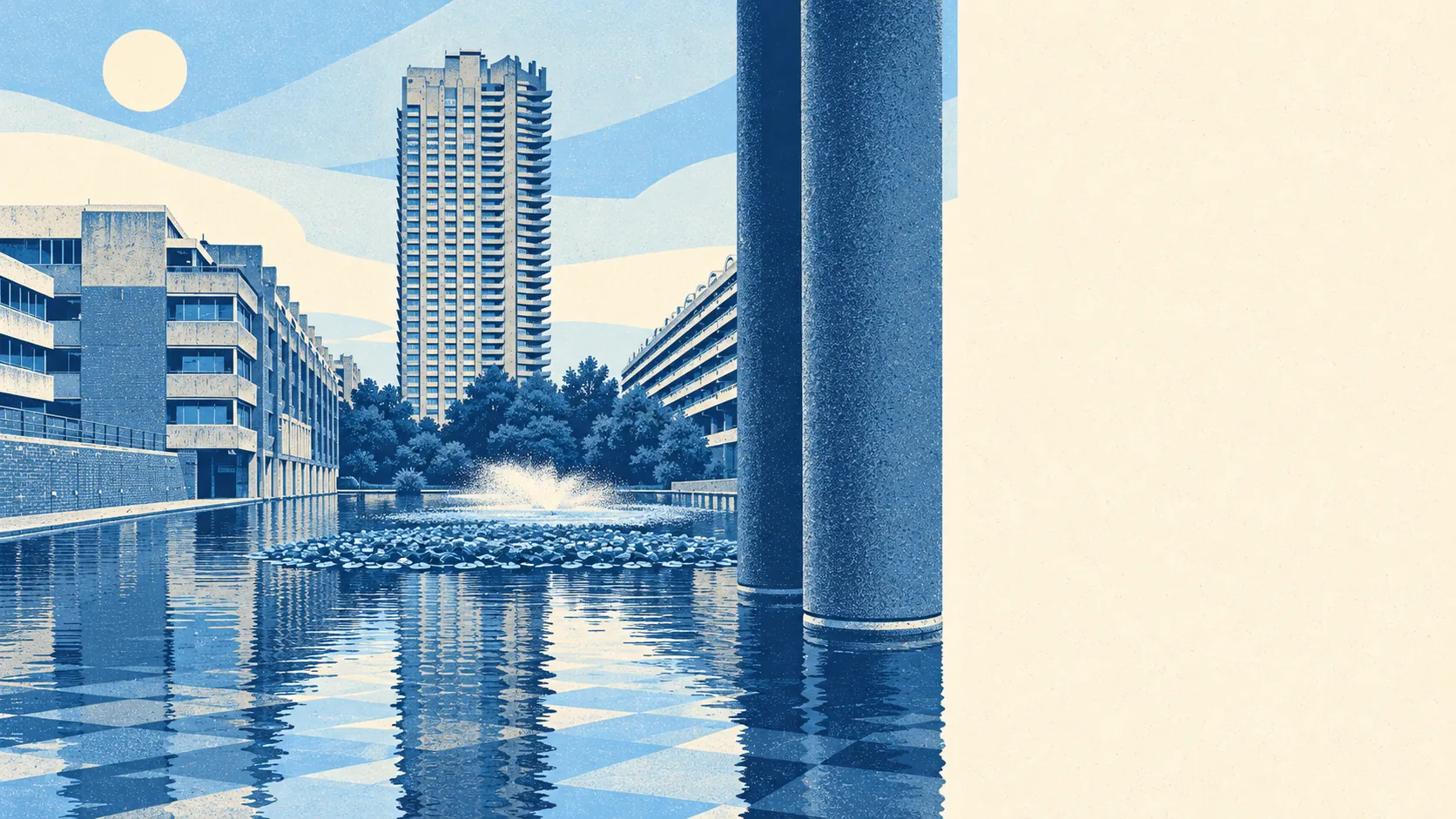
Barbican is a green, watery pocket sitting inside one of the most built-up square miles in Britain. Park or garden space is a short stroll from most front doors. Water is about as close. The local pub count reaches one. Offices outnumber everything else by a distance, and the residents have the gardens to themselves once the office workers go home.
Green space is closer than most suburbs manage. The average home here is about 120 metres from the nearest public green space, with about 57 green spaces inside a kilometre. They range from the estate's own registered landscape, "The Barbican", to Bunhill Fields Burial Ground, the Golden Lane Estate's designed landscape and the squares at Charterhouse. In this corner of London, a fair number of the most peaceful lawns belong to the dead.
Water is the surprise. The nearest blue space is about 120 metres from the average front door, and about 38 bodies of water sit within a kilometre, a remarkable count for a district best known for counting money. Most City workers walk past it at lunchtime without ever living beside it.
Getting out into proper countryside takes more effort. The National Cycle Network is about 1.3 kilometres from the average home, and no postcodes in the area count as close to it. Ancient woodland covers none of the area. The cycling here happens on City streets, among the buses.
The rated-premises list for the area counts 10 shops, one pub and 6 restaurants, set against 143 offices. Those figures describe what the local streets are built for, and it is mostly desks. Anyone who wants a local where the landlord learns their name will be sharing that one pub with a lot of people who left their desks at six.
The City of London recorded fine-particle pollution of about 11 micrograms per cubic metre in 2024, a council-area figure that covers the whole Square Mile.
The character comes from what is packed in around the estate. The Barbican Centre, the Barbican library and the Museum of London are part of or next to the complex, St Paul's Cathedral and Smithfield are among the conservation areas nearby, and Charterhouse Square and Postman's Park add older, smaller green corners. The Church of St Bartholomew the Great and stretches of the Roman and medieval London Wall are within walking distance. Concerts, galleries and two thousand years of masonry come with the address, and so does a weekday crowd that leaves every evening.
Private gardens are scarce. The area has about 1,600 square metres of private garden for every 1,000 residents, very little for a place where nearly every home is a flat. People here use the shared lawns, the lakeside and the squares, and a garden of their own is something they gave up when they bought.
The business rating list for the area holds 450 rateable premises, and offices are one of the largest groups on it. Those are premises on the valuation list, which is a register of property and says nothing about who is trading this week. The office count is what fills the streets by day and empties them by night.
Eating out is safe on the hygiene measure. About 87% of the 53 rated food premises hold the top hygiene score, and about 2% sit at the bottom end. With that few rated outlets, a handful of inspections can shift the shares, though the picture is strong.
No protected landscape overlaps the area: no area of outstanding natural beauty, no site of special scientific interest and no ancient woodland. That is what an inner-city estate looks like, and its green spaces were built and planted by people, which is why the protection here comes from heritage designations.
The surroundings are one of Barbican's real strengths, with lawns, water and culture a few minutes from almost every door in the middle of the City. Very few places in central London keep that much green this close to home.