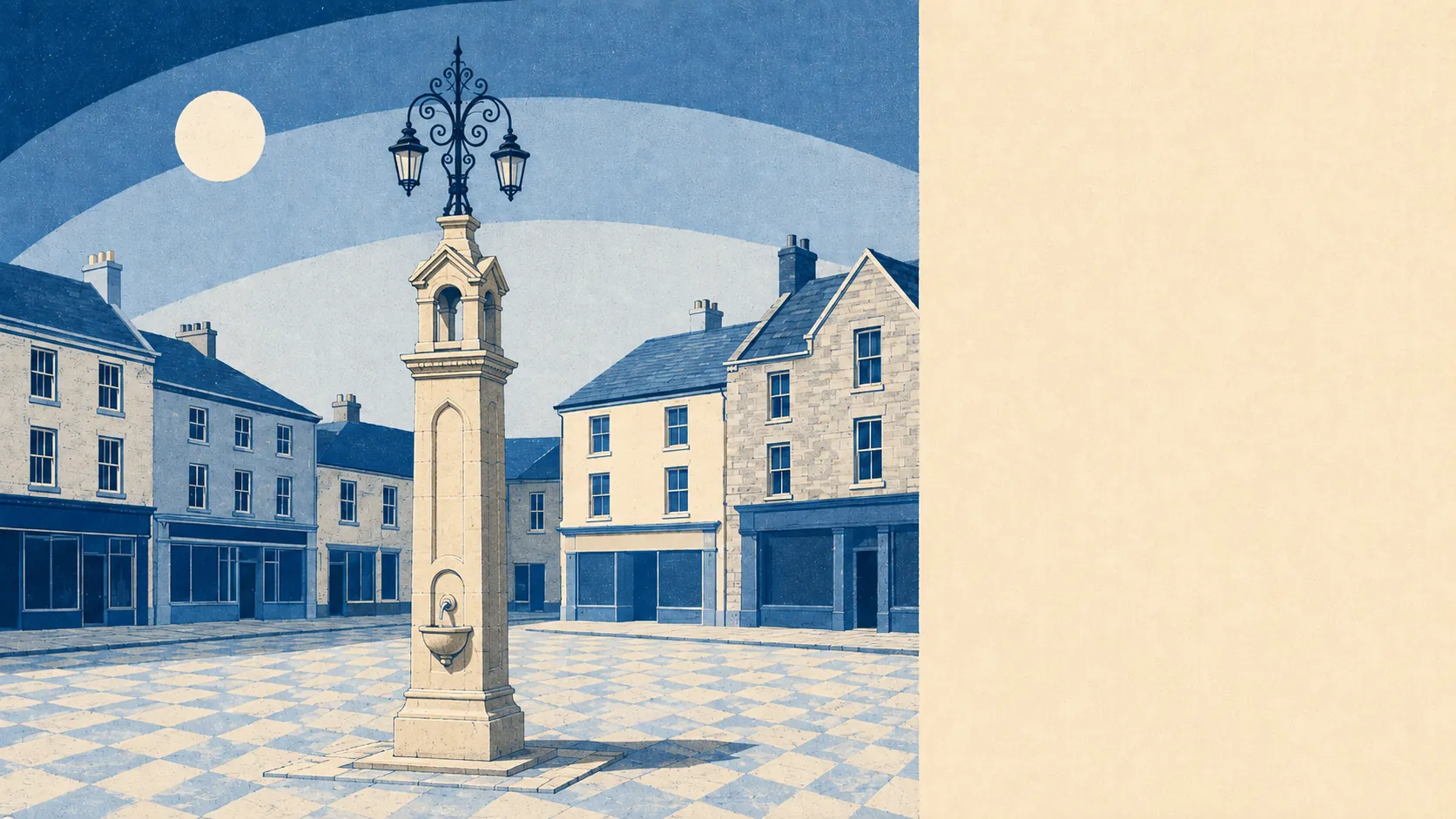
Axminster is a working town that ended up in holiday country by accident of geography. Nearly two thirds own their homes. The London train stops here and almost nobody gets on it. Green space starts at the end of most streets. Nothing about the place is pretending to be a resort. It is a market town that got a mainline station and then carried on exactly as it was.
The housing stock is house-shaped and low-rise. Across every dwelling on the council tax list, terraces run to about 27%, semis about 21%, bungalows about 20%, detached houses about 15% and flats about 15%. One home in five being a bungalow tells you what the town quietly expects your knees to do eventually. About 17% of the stock went up before 1930, so the older frontages near the centre are the exception rather than the rule, and most of what people actually live in is post-war. Around 75% runs on mains gas and about 9% on electricity alone, which is worth establishing before the viewing rather than after the first February bill. On energy certificates, about 63% of certificated property sits in bands A to C, about 27% in band D, and around 10% in band E or worse.
The Land Registry's twelve months to May 2026 put the typical sale at £259,000 across 103 sales. Detached houses ran to a median of £354,000, semis to £281,000, terraces to £230,000 and flats to £123,000. Council tax is banded low: band B is the most common, and about 46% of dwellings sit in bands A or B. For once the bill agrees with the town's opinion of itself.
Rents are counted at district level rather than town level. The typical private rent across the East Devon area was about £970 a month in April 2026, and that number covers the coastal towns and the villages as well as here. Read it as the district's figure, not as a quote for a two-bed off Chard Street.
Safety is the number that will make an estate agent change the subject. The published recorded crime rate is about 69 offences per 1,000 people for the year to May 2026, roughly 38% above the East Devon average. Violence and sexual offences account for about 50% of recorded crime against about 35% across England and Wales, and criminal damage about 12% against about 7%. Devon and Cornwall Police charged or summonsed about 8% of recorded offences over the same period against about 12% nationally, which places the force last of the 42 in England and Wales on that measure. Being burgled in a small Devon town is bad luck. Having the case go nowhere is a policy outcome.
Axminster Rail Station sits on the line from Exeter through Salisbury to London Waterloo, and about 1% of working residents commute by train. Another 1% takes the bus. About 59% drive, about 20% work from home and about 12% walk. There are 28 bus stops in the town, averaging about 94 scheduled weekday departures each, and about 96% of them have a weekend service. Broadband is the quiet win: about 99% of premises can get superfast and about 75% can get gigabit speeds, with none stranded below the universal service obligation, and every mobile network covers about 97% of the area. The modelled 2019 journey times put the town centre seven minutes away by car and nine on foot. The nearest hospital is about 45 minutes by car, and that is the figure that decides things when you are weighing this against a city.
Flooding is the town's real exposure. About 17% of postcodes carry a high rating on at least one flood indicator, surface water included, and about 7% sit inside the Environment Agency's river-and-sea flood zone 3. Around 5% of postcodes fall inside a historically flooded area, and 18 flood events are on record, the most recent in July 2012 when an ordinary watercourse exceeded its channel capacity with no raised defences involved. The town is built on a hill above the Axe, which looks after a good deal of it and does nothing whatsoever for the parts below. Set against that, the surroundings are the best thing about living here: green space averages about 110 metres from the front door, with around 20 separate green spaces within a kilometre and water about 300 metres away. Gardens account for about 16% of the area. The whole town also sits in a high radon band, which means a test kit and a slightly awkward conversation with a solicitor rather than a crisis.
There are 61 listed buildings in the town, 58 at Grade Two and three at the higher Grade Two Star, plus one conservation area over the centre and one scheduled monument. If your house is one of them, or simply inside the conservation area, the window replacement you had in mind becomes a planning conversation. Solar panels, front doors, satellite dishes, all of it. The compensation is that the centre still reads as a town rather than a retail park with a heritage plaque bolted to it.
About 63% own their homes, the median resident is 47, and household income across the area came to roughly £49,000 gross before tax in the financial year to March 2023. That is a settled, middle-aged, mostly owner-occupied place where plenty of people have lived in the same house long enough to hold firm views about the bypass. Raymond's Hill, out towards the county border, is covered here too: same postcode district, slower pace, same weather.
It suits people who want a house with a garden, a station they will use twice a month by choice, and a centre they can walk into. It suits families buying space rather than a postcode, and it suits anyone whose work has moved to a desk at home. It does not suit the daily London commuter who has costed the fare and not the alarm clock, or anyone who needs a hospital inside twenty minutes, or the buyer chasing coastal life at inland prices. Axminster is not the coast. It is the town the coast borrows for its trains and its big shop.
The famous names are a strange little list. William Buckland, born here in 1784, became Dean of Westminster and a geologist and palaeontologist, which is a lot of career for one man and an odd pair of subjects to hold at the same time. John Prince, a century earlier, wrote Worthies of Devon, a book about other people being notable. George Pulman was a journalist and antiquary who wrote about fishing. Nobody left Axminster to be famous. They left to be thorough.
Axminster earns an above-average verdict and is honest about which parts carry it. Its real strength is what surrounds it: green space at the end of the street, water minutes away, and a centre that has not been hollowed out. The weak spot is flood risk, and it is not spread evenly, so the answer for any given house comes down to where that house stands in relation to the Axe. Buy up the hill and the problem belongs to somebody else. Buy down near the water and get the survey done properly before you fall in love with the kitchen.