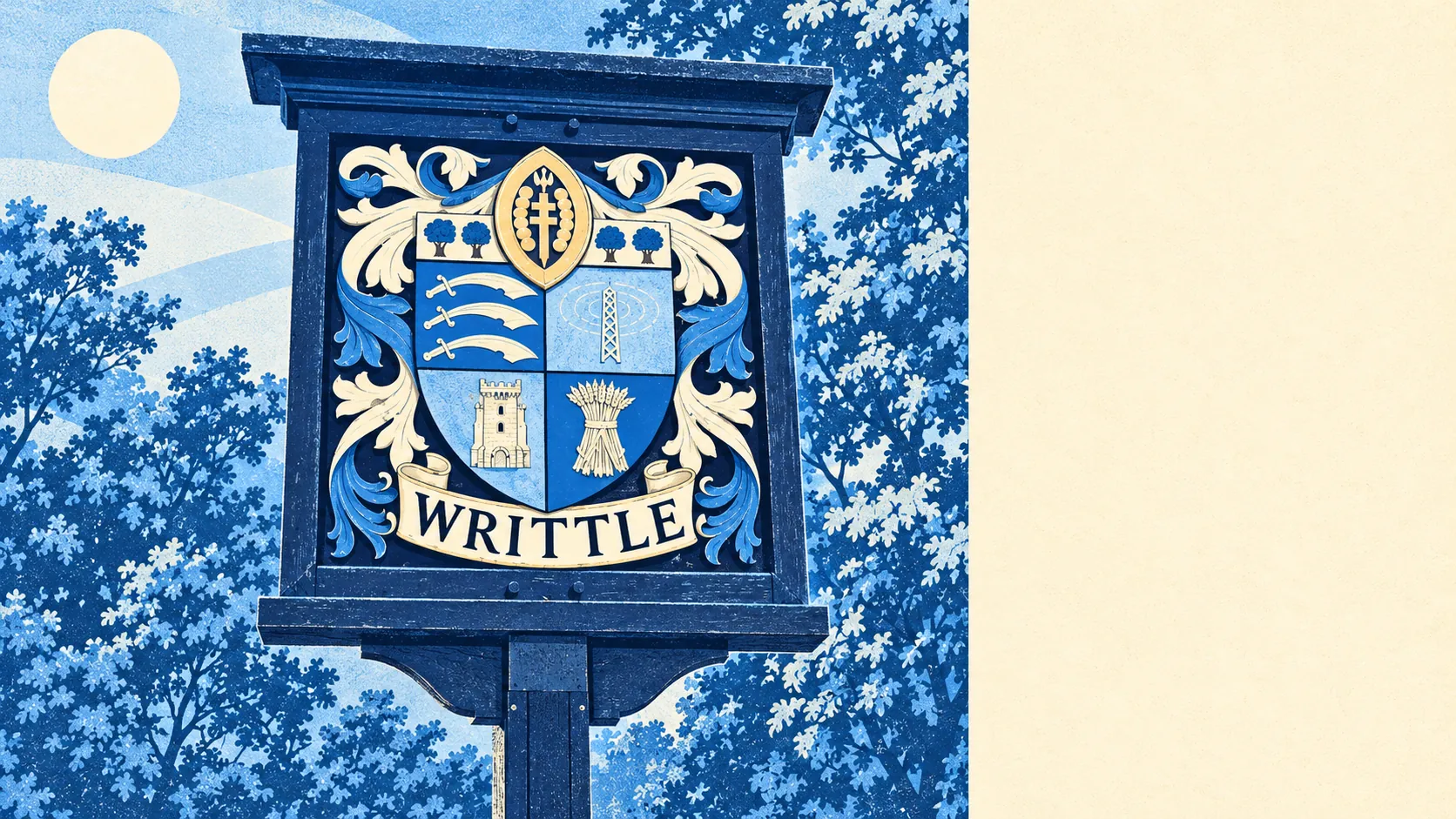
Writtle asks close to half a million pounds for a typical home, and that price is the whole entrance exam. Pass it and you get a village green with a duck pond, a Norman church, less crime than the rest of the district and a park at the end of most roads. Fail it and you can still visit the duck pond on the bus like everyone else.
The Land Registry's sales for the year to May 2026 put the typical Writtle home at about £498,000, across 56 sales. Detached houses went for around £800,000, semis for about £484,000 and terraces for about £449,000. Only five flats changed hands, at a typical £255,000, so the cheap way in is a door that opens a handful of times a year. Band D is the most common council tax band, and only about 22% of homes are in bands A or B. The bottom of the bill is as thin as the bottom of the market.
Renting is the side entrance, and it is narrow. About 11% of households rent privately. Across Chelmsford as a whole, the typical private rent was about £1,440 a month in April 2026, up about 7% on a year earlier, and that council-wide figure includes plenty of city flats along with the village semis. A tenant here is chasing a small slice of a village with a city's rent attached.
The housing is less ancient than its reputation. On the council tax valuation list, semis are the biggest group at about 30% of homes, then detached houses at 22%, terraces at 21%, flats at 13% and bungalows at 12%. About 22% of homes were built before 1930, and most of what has an energy certificate is post-war. Of those certificates, about 45% are rated A to C, 39% D and 16% E or worse. About 75% of homes heat with mains gas and about 8% with electricity alone. The old cottages get the photographs. The post-war semis get most of the buyers.
Crime is lower here than the district around it. Police figures for the year to May 2026 give Writtle about 57 recorded crimes per 1,000 residents, roughly 32% below the Chelmsford council area's average. In August 1914 a whole battalion of the Oxfordshire and Buckinghamshire Light Infantry moved in, spent the winter on physical training and paraded at Hylands House, then left in April 1915. Trouble in Writtle has tended to follow that pattern ever since, turning up, exercising and going home.
Flooding from the river is a small worry, and surface water is a bigger one. None of Writtle's postcodes fall inside the Environment Agency's river-and-sea flood zones 2 or 3. Counting every flood indicator including surface water, about 9% of postcodes carry a high risk on at least one measure, 18% a medium risk and 32% a low risk. The Environment Agency has one recorded flood event for the area, from 1958. The River Wid takes its name from an old word for a babbling brook, and on the river-flood maps it has mostly stayed that way.
Getting about means the car more often than the train. The station is Chelmsford Rail Station, and at the 2021 census only about 2% of working residents commuted by train, against 46% who drove and 39% who worked from home. Writtle has 17 bus stops, averaging about 174 scheduled departures each on a weekday, and 13 of them have a weekend service. The Department for Transport's modelling, done in 2019, puts Chelmsford's centre about 15 minutes away by car and 31 by public transport, and bus timetables have had years to change since. Gigabit broadband reaches about 90% of premises. Commuting into Chelmsford mostly got solved by about two in five people not going.
The village is settled, middle-aged and comfortably off. About 73% of households own their home, the typical resident is 48, and the Office for National Statistics models gross household income at about £66,000 a year for the financial year to March 2023, averaged across a wider area than the village. King John kept a hunting lodge on land that is now the grounds of Writtle University College, which teaches land-based subjects. The site has gone from hunting the wildlife to studying it, a fair trace of how the money in Writtle has mellowed.
Changing a house here can take some patience. Writtle has 45 listed buildings, one at Grade I, two at Grade II* and 42 at Grade II, and the centre of the village is covered by the Writtle conservation area. A listed home needs consent for most alterations inside and out, and the conservation area tightens the rules on outside changes and demolition for unlisted houses too. Anyone planning a rooflight on a cottage facing the green should expect the conversation to take longer than the installation.
The schools results are strong. Primary pupils start at Writtle Infant School and move on to Writtle Junior School, and the government's figures give the two primary schools in the postcode district an average key stage 2 maths score of about 108. The two secondary schools in the district average an Attainment 8 score of about 66 at GCSE. On the 2019 modelling, the nearest primary is about an 11-minute walk for the typical home.
The surroundings are where Writtle earns its money. The nearest green space is roughly 170 metres from the average front door, with about 13 within a kilometre, and water is roughly 210 metres away. Hylands Park, a registered park and garden, is close by on the Chelmsford side. Gardens are generous too, which matters in a village where most homes are houses with something behind them.
Writtle is right for a household that has already done well and wants a village green with a city on the doorstep: a couple trading up from Chelmsford, a family that wants the infant and junior schools on foot, people near retirement who intend to stay put. First-time buyers, anyone who needs a train to be their daily commute, and anyone who wants to take a listed cottage back to the brick should look elsewhere.
The price is the catch, and it stays the catch. Close to half a million is the going rate for an ordinary house here, and the semis that make up most of the village are what that money buys. Pay it, and the green, the park and the walk to the infant school come with the house. Writtle is better than average, and its buyers pay for every bit of the difference.