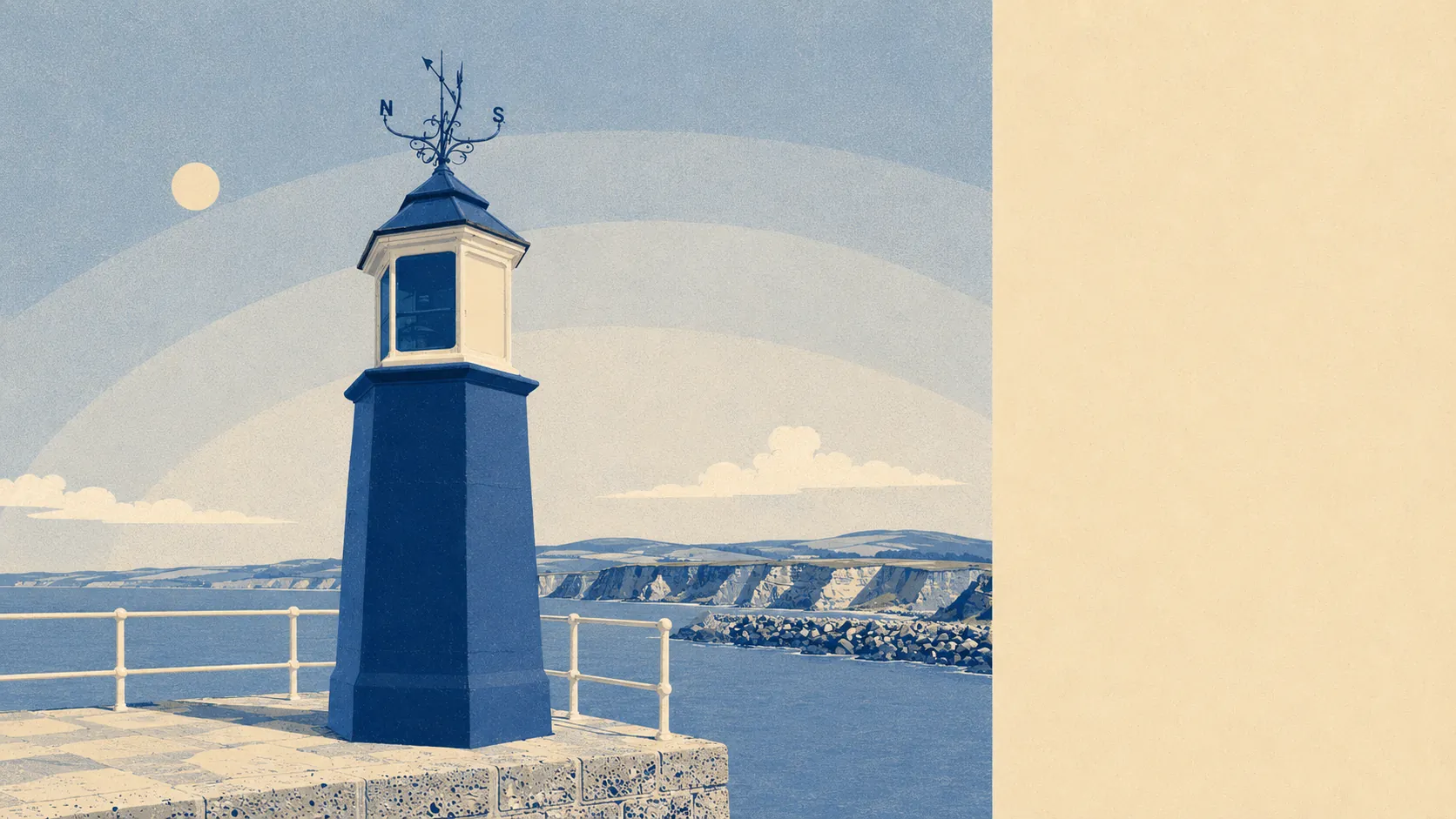
Yes, if the phrase "the sea is right there" outranks "the hospital is not." Watchet is a harbour town that lost its industry and kept its view. The Bristol Channel does the heavy work on the scenery. The nearest big hospital is a long drive. It suits people who have made peace with distance, and quietly punishes people who thought they had.
The housing stock is the first thing that tells you what kind of place this is. Across every dwelling on the council-tax valuation list for the wider Watchet area, about a quarter are detached and another quarter semi-detached, roughly 19% are terraced, and just under 9% are flats. That last figure is the giveaway: this is not a town of converted seafront apartments, whatever the harbour suggests. Bungalows account for about 20% of the stock, which is a substantial slice by any standard and tells you something about who has been buying here for the last fifty years. Around 36% of dwellings were built before 1930. Heating is the part buyers should look at before the viewing rather than after: roughly 48% of homes run on mains gas, which means the rest do not, and about 9% are heated by electricity alone. An electric-only Victorian cottage near the water is a different proposition in February to a gas-fired post-war semi, and the energy certificates bear that out. Around 33% of certificated homes sit at band D, and about 24% are at band E or worse. Only around 43% reach band C or better.
On price, the Land Registry's last twelve months put the typical sale in the Watchet area at about £250,000, across 59 sales. Split by type, terraced homes came in around £205,000, semi-detached at roughly £243,000, and detached at about £370,000. The council-tax picture matches that spread: band B is the most common, and roughly 42% of dwellings sit in bands A or B combined. This is not a place where the tax bill is the thing that stops you sleeping.
Renting is a different conversation, and a thinner one. Typical private rent across the Somerset area runs at about £990 a month. That is a local-authority figure covering a very large and very varied county, so treat it as the regional temperature rather than a Watchet quote. The brief carries no neighbourhood-level rent, and inventing one would be worse than admitting the gap.
Safety is one of the better answers here. The recorded crime rate for the area is about 83 crimes per thousand people over the twelve months to May 2026, which sits roughly 10% below the Somerset average. That is a published rate, calculated on its own population base, not something arrived at by dividing incidents by residents on the back of an envelope. Violence and sexual offences make up the largest share at about 48%, which is a broad statutory category that includes assault without injury and tops the list almost everywhere in England and Wales, so it says less about Watchet than the headline implies.
Connectivity is where the town earns its reputation and not in a good way. Around 52% of working residents drive to work and about 30% work from home, which between them account for the overwhelming majority of the town's daily movement. Roughly 3% take a bus, and rail commuting registers at essentially nothing, which makes sense once you know that Watchet station is a stop on the West Somerset Railway, a heritage line running steam services between Bishops Lydeard and Minehead. Charming, genuinely. Not a commute. Journey-time modelling from the Department for Transport puts the nearest town centre at about 27 minutes by car and roughly 60 minutes by public transport, and a hospital at around 50 minutes by car. Broadband is the sharper problem: superfast is available to about 88% of premises, but gigabit reaches only around 13%. Mobile is better, with at least one operator giving fourth or fifth generation coverage at nearly 100% of premises.
The environment is the town's strongest suit and its most awkward one at the same time. Green space sits about 364 metres from the average postcode, with around nine separate spaces within a kilometre, and water is closer still at roughly 222 metres. Exmoor National Park begins at the edge of town. Then there is the flooding. Around 30% of postcodes in the area carry a high rating on at least one flood indicator, which includes surface water as well as rivers and sea, and a further 25% carry a medium rating on the same basis. Measured differently, about 5% of the area falls inside the Environment Agency's river-and-sea flood zone 3 and roughly 4% inside zone 2, and around 18% falls inside the zone that accounts for climate change. Those are two different measures of two different things, and both belong in the same conversation before an offer, not after. Radon is worth a mention too: roughly 94% of postcodes sit in band 3 or above, with the maximum in the area classed as High.
Heritage is the other constraint on what you can do to a house here. The area holds 384 listed buildings, twelve of them Grade I and 21 Grade II star, along with six conservation areas including Watchet itself, Old Cleeve, Dunster and Stogumber. If you buy inside one of those boundaries, window replacements, solar panels and anything that changes the elevation become a conversation with the planning department rather than a weekend. Two entries in the area sit on Historic England's Heritage at Risk register.
The character of the place follows from all of that. Around 68% of homes are owner-occupied, the median resident is 56, and typical household income runs at about £44,500 before tax. This is a settled town, not a churning one. This page covers the surrounding villages too, so Blue Anchor on the bay, Washford beside Cleeve Abbey, and the Brendon Hills settlements of Roadwater, Luxborough and Treborough all fall inside the same picture, and all of them are quieter than Watchet, which takes some doing.
It suits retirees, downsizers, remote workers who have tested their broadband before exchanging, and anyone who genuinely wants a harbour, a heritage railway and Exmoor rather than the idea of them. It suits people whose weekly routine can absorb a 27-minute drive to a proper town centre without resentment building.
It does not suit anyone who needs to commute daily by train, anyone who wants gigabit broadband today, or anyone buying near the water on the assumption that a coastal town has already solved its flooding. It also does not suit buyers who want a period property and modern running costs, because the older stock here mostly comes with the energy bills the certificates predict.
The town's past is more interesting than its present, which is part of the appeal. Alfred the Great fortified Daw's Castle on the cliff west of town against Viking raiders, the Anglo-Saxon Chronicle records the port being plundered anyway, and Watchet coins have turned up as far away as Copenhagen and Stockholm. Saint Decuman was killed here around 706 and got the parish church named after him. The Wansbrough paper mill became the country's largest maker of paper bags before it closed in 2015. Allan Pearse, who played first-class cricket for Somerset, came from here, as did John Gouriet, who founded the National Association for Freedom.
Watchet is a good place to live for the right buyer and a slow disappointment for the wrong one. Its real strength is the surroundings: Exmoor on the doorstep, the Bristol Channel at the end of the street, green space and water closer than most towns manage. The weak spot is flood risk, and it is not a small one, because the harbour that made this town is the same water the maps keep flagging. Buy on the high ground, check the flood mapping for the exact address, and the rest of it is a bargain.