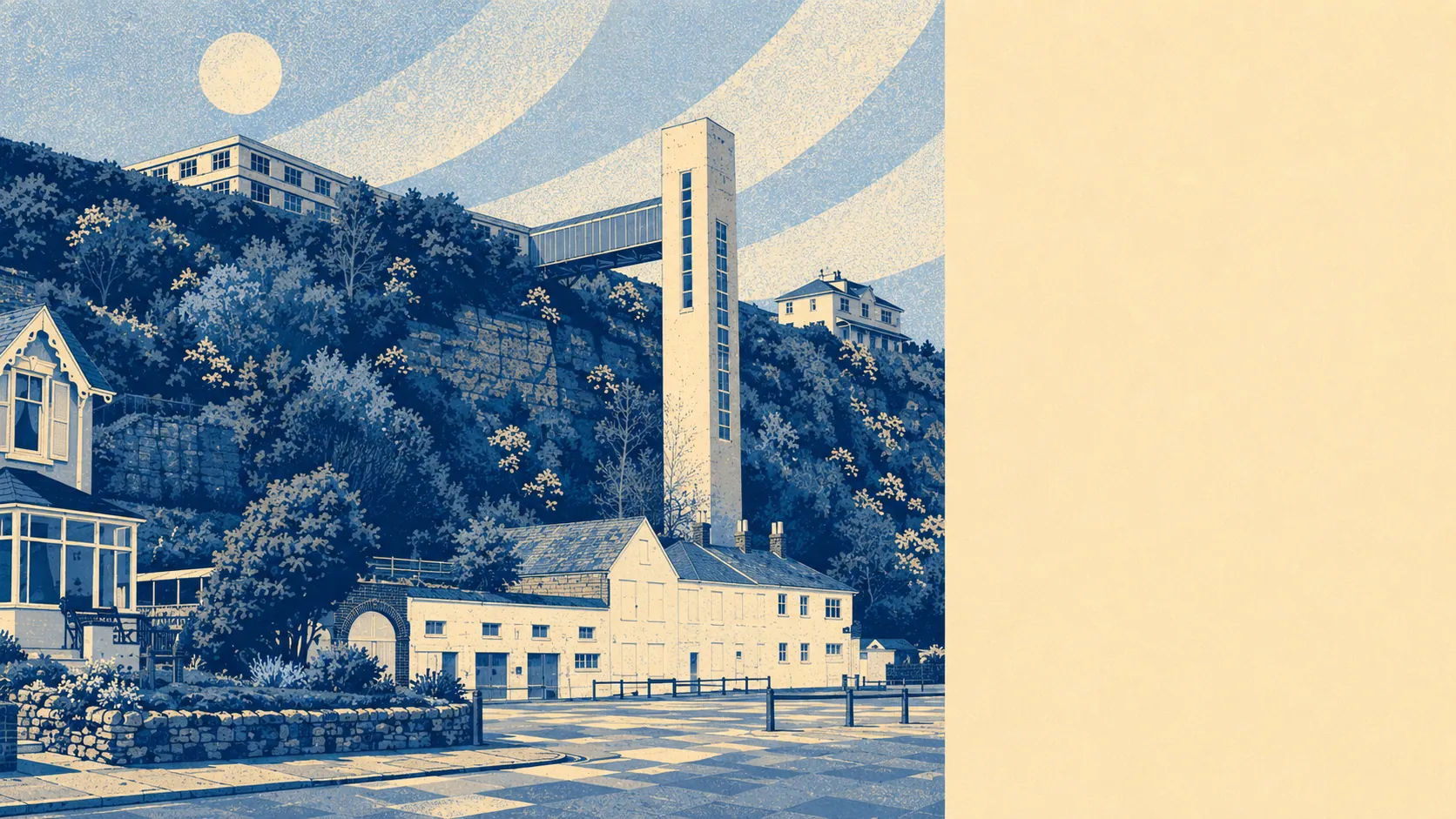
Shanklin is where Sandown Bay quietly turns sixty. Forty-five percent flats. A median age of fifty-six. One in five households is a pensioner living alone. It is a Skegness with a chine and an AONB on the doorstep, and that is meant warmly.
The housing stock is the dominant fact. Flats run the show at roughly forty-five percent of the homes, with houses at just under two in five and bungalows, that great Isle of Wight architectural type, at fifteen percent. The energy ratings cluster around the middle, with about four in ten homes sitting in band C, around four in ten in band D, and roughly one in five in band E or worse. Just over four in ten reach band C or better, which is what happens when a town's housing was mostly thrown up between 1950 and 1982 and has been getting incrementally insulated ever since. The post-war years did most of the building. The Victorian villa stock the town markets itself on is real but it's a quarter of the picture, not the whole one.
Typical sale prices over the last twelve months landed at roughly £261,000, across about 114 sales. That headline hides the split everyone needs. A typical detached house went for around £380,000. A semi for £280,000. A terrace for £230,000. A flat for about £150,000. So the answer to "can I afford Shanklin" depends entirely on which Shanklin you mean. The flat version is one of the cheaper bits of the South Coast that still has a beach attached. The detached version is paying a Sandown Bay premium for the same money that buys a Salcombe shed. Council tax mostly lands in band C, which is the modal band here, and roughly four in ten homes sit in bands A or B, which is the giveaway that this is a working-class town with retirement bolted on.
For rent, the typical private rent across the Isle of Wight area runs around £940 a month. That is the island figure, not the Shanklin figure, but Shanklin sits noticeably below the island average for what you can read in the local sale prices, so anyone treating £940 as the going rate here is being generous to the landlord.
For safety, the published crime rate sits at about 79 incidents per thousand residents, which is roughly six percent below the Isle of Wight average. The island isn't a high-crime place to begin with, so coming in below its average means Shanklin is one of the quieter postcodes on a quiet island. Whatever your assumptions about seaside resorts, the numbers do not back the assumption here.
Connectivity is the part where the brochure gets sheepish. Shanklin Rail Station is the southern terminus of the Island Line, which means the train works if you want to go to Lake, Sandown, Brading, Smallbrook Junction or Ryde Pier Head, and stops working entirely if you want anywhere else. Less than one percent of working residents commute by train. About half drive. A quarter work from home. Buses cover Newchurch, Newport, Ryde, Sandown, Ventnor and Winford, which between them cover most of where an islander needs to go. Gigabit broadband is available across roughly nine in ten postcodes here, which is better than most places this size and is genuinely the strongest practical argument for working from a flat above the seafront.
The environment is where Shanklin earns its rating. Around three percent of postcodes carry any high flood risk and five percent carry medium, which is small numbers for somewhere this close to the sea. The Environment Agency flood zones come in at zero percent for both zone two and zone three because the chine and the cliff did the work that Southsea's seafront engineers are still arguing about. Green space sits at about 226 metres from the average front door with roughly twelve patches within a kilometre, and bluespace at about 252 metres with thirty. The Isle of Wight AONB clips the south of the town. The numbers say Shanklin is a place where you walk somewhere green or blue before you finish thinking about it.
Heritage constraints are real but manageable. Thirty-five listed buildings sit in the town, one of which is grade II*, and there are no conservation areas or scheduled monuments in the immediate boundary. That means if you want to fit triple glazing or a heat pump, you are mostly free to do so. Owning one of the listed thirty-five is a different conversation, but most of the housing stock is not asking for permission to breathe.
The neighbourhood character is what the numbers describe. About two-thirds of homes are owner-occupied. The typical household income is around £41,000, which is fine for a flat and tight for a detached. The single biggest household type is one person living alone, at nearly four in ten homes, and roughly one in five of those is a pensioner. This is a town that downsized into itself.
Shanklin is for people downsizing, semi-retired, or both, who want the sea visible from the kitchen and do not need a career within twenty miles of the front door. It suits a working-from-home flat-buyer who wants Salcombe's view at Sandown's price. It suits anyone whose social life is friends, the pub and a parkrun rather than restaurants and gigs.
It is not for the family with two careers and a school-run. The trains stop at Shanklin in both senses. It is not for anyone who needs evenings out that don't end by ten. And it is not for the buyer who wants Salcombe and thinks Shanklin is the version they can afford, because that buyer will spend the first year unhappy that it isn't Salcombe and the second year unhappy that it isn't Sandown either, which solved every one of those problems by being slightly bigger and slightly less precious.
Shanklin sits at three and a half out of five, above average and honestly itself. The strongest hand is the surroundings: five out of five for green space, AONB at the southern boundary, sea, chine, bluespace inside a five-minute walk. The weakest hand is the local community at two out of five, which is the polite way of recording that the median resident is fifty-six and lives alone. It will never be Salcombe and it isn't trying to be Margate. It is a Skegness with a better postcode and an AONB, and that is exactly the thing some people are looking for.