Marlow is easy to live in and hard to buy into. Seven in ten households own their home. Half the working residents stayed home to work at the last census. The typical sale goes for north of £600,000. Living here is the easy bit, and the town has already done its sorting by the time you get the keys.
Marlow is mostly houses. On the council-tax valuation list, detached homes make up about 30% of the stock, terraces 26%, semis 17%, flats 16% and bungalows 10%. Only about 16% of homes were built before 1930, which surprises anyone who has only seen the High Street. The energy certificates split almost down the middle: 53% rated A to C, 35% D and 12% E or worse. About 79% of homes are on mains gas and about 7% heat on electricity alone. The Georgian frontages are what goes on the postcard, and the post-war house is what most of the town is made of.
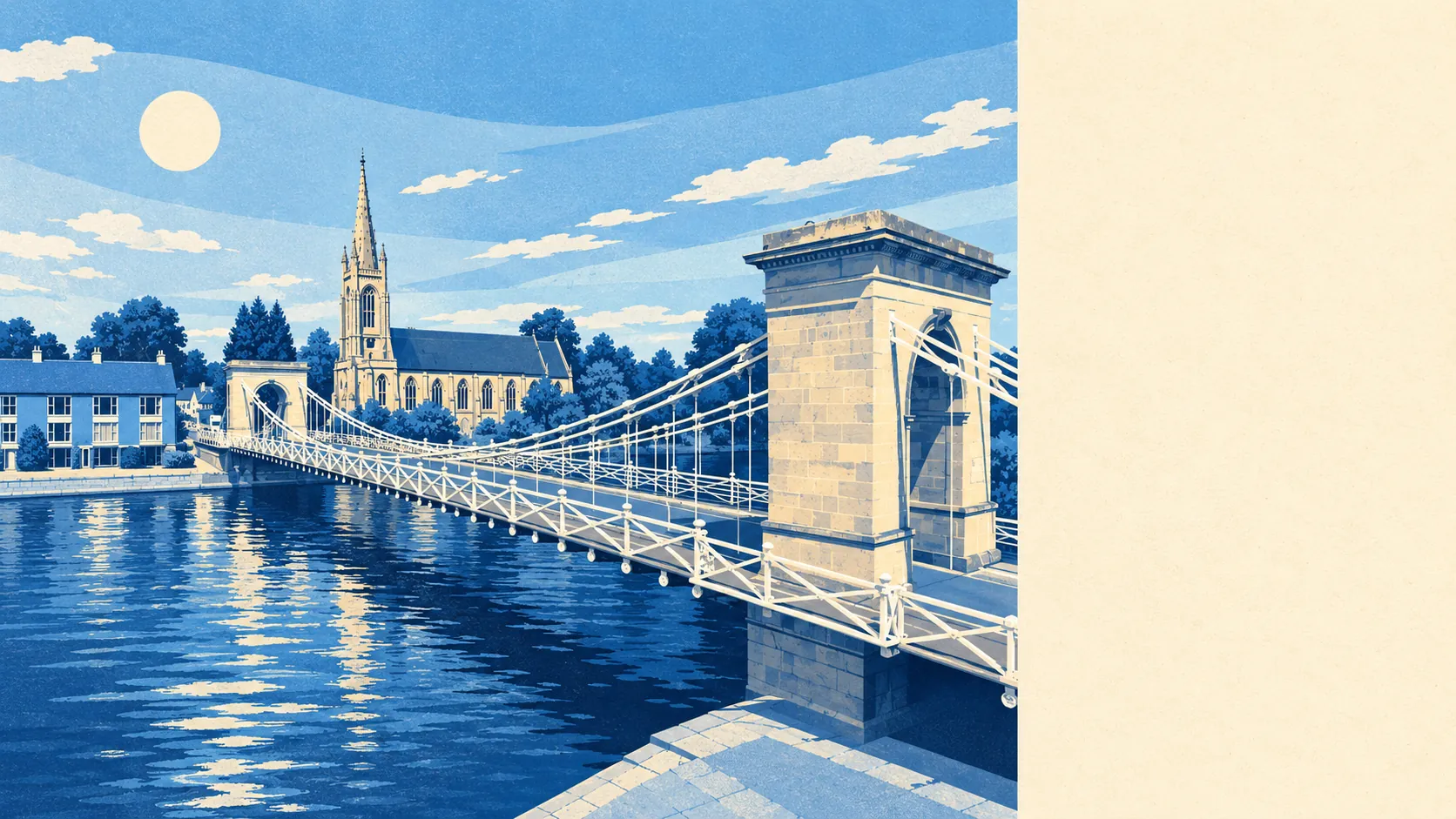
The Land Registry recorded 162 sales in the year to May 2026, at a median of about £608,000. Type moves that figure a long way. The 46 detached sales had a median of about £1,009,000, semis about £638,000, terraces about £542,000 and flats about £328,000. Band D is the most common council-tax band, and bands A and B together cover about 4% of homes. A flat here costs what a family house costs in plenty of towns, and buys a walk to the bridge that served as the prototype for Budapest's Széchenyi Chain Bridge.
About 17% of households rent privately and 11% from a social landlord. Across Buckinghamshire as a whole, typical private rent was about £1,470 a month in April 2026, up 5% on a year earlier, according to the Office for National Statistics' rent index. That is a county average, mixing Marlow with towns whose sale prices look very different, so expect asking rents on the river side of town to argue with it.
Thames Valley Police recorded crime at about 52 per 1,000 residents in the year to May 2026, roughly 21% below the Buckinghamshire average of about 65. Other theft makes up about 12% of recorded crime here, against about 7% across England and Wales, and antisocial behaviour about 11% against 16% nationally. The town tuts more than it shouts.
The seven primary schools in the area averaged about 108 in the end-of-primary maths test, and the two secondaries, Sir William Borlase's Grammar School and Great Marlow School, averaged an Attainment 8 score of about 58. Primaries include Spinfield School, Foxes Piece School, Holy Trinity Church of England School, Marlow Church of England Infant School and St Peter's Catholic Primary School. On the Department for Transport's 2019 modelling, the nearest primary is about a 10-minute walk and the nearest secondary about 22. Ofsted has graded 80 of 94 settings across Buckinghamshire as good or better, 19 of them outstanding, though that covers the whole county. Sir William Borlase is on the list of Marlow's notable residents and his name is still over a grammar school, which is about the level of legacy local parents are aiming for.
Marlow Rail Station is the end of a single-track branch line, with the change for London at Maidenhead Rail Station. At the 2021 Census about 1% of working residents took the train to work, about 37% drove and about half worked from home. The area has 50 bus stops, averaging 27 weekday departures each and between one and two buses an hour at peak, and about half see a weekend service. Carousel Buses took over the routes in July 2024 after Arriva closed its High Wycombe depot. On the 2019 modelling the town centre is about 9 minutes by car and 16 by public transport, and the nearest hospital is about 18 minutes by car or 46 by bus, a gap that has probably widened since. Gigabit broadband reaches about 92% of premises. The railway is the most famous thing about getting around Marlow, and it carries one commuter in a hundred.
On the Environment Agency's mapping, about 12% of postcodes are in flood zone 3 for rivers and sea and another 12% in zone 2. Counting every indicator including surface water, about 16% of postcodes carry high risk on at least one and about 28% medium. The agency holds 50 recorded flood events for the area, the latest in February 2014. The risk follows the water closely, so put the exact postcode into the agency's long-term flood risk service. A river frontage is the thing buyers pay most for and the thing the Environment Agency maps first. The compensation is green space: the average home is about 163 metres from a park or open space, with 24 within a kilometre, and the edge of the Chilterns Area of Outstanding Natural Beauty touches the parish.
Marlow has 174 listed buildings, three of them Grade I, 19 Grade II* and 152 Grade II, and one conservation area covering the old town. The Old Parsonage on St Peter Street dates from the 14th century and is the oldest inhabited building in Buckinghamshire. Listed status means consent for windows, doors and extensions, and the conservation area adds its own controls. Marlow Town Hall has been a hotel, a shop and a cinema since it was finished in 1807, which is more changes of use than the owner of a listed cottage will get approved in a lifetime.
About 72% of households own their home and the median resident is 47. The Office for National Statistics models gross household income at about £77,000 for the financial year to March 2023, averaged across the area, and about 47% of adults hold a degree. Health, education and deprivation all point the same way, and the neighbourhoods have barely moved on the deprivation index since 2019. Nobody here is waiting for the place to improve.
This page also covers Bisham, across the Thames in Berkshire, Little Marlow along the road east, and Medmenham upstream towards Henley.
Marlow suits buyers who can afford it outright or close to it and plan to stay: families aiming at the schools, people who work from home and want the river at lunchtime, and anyone who wants a proper town without commuting from one.
It suits people less well if they need a fast daily train, rely on buses after dark or at weekends, or are trying to buy a first home on one income. Anyone eyeing the riverside streets should budget for the flood questions as seriously as the price.
The roll call of past residents runs from Percy Bysshe Shelley and Mary Shelley to Thomas Love Peacock and Jerome K. Jerome, and Marlow Rowing Club produced Sir Steve Redgrave. Cuthbert Ottaway played for Marlow F.C. and captained England in the first international, in 1872, which finished 0-0. The town's sporting reputation has been improving since.
Marlow is an above-average place to live with a very expensive door. Its strength is the community: settled, well-qualified, healthy and in no hurry to leave. Its weak spot is value, because every one of those qualities is already in the price. The buyers who do well here are the ones who stop haggling with the town and pay for it.