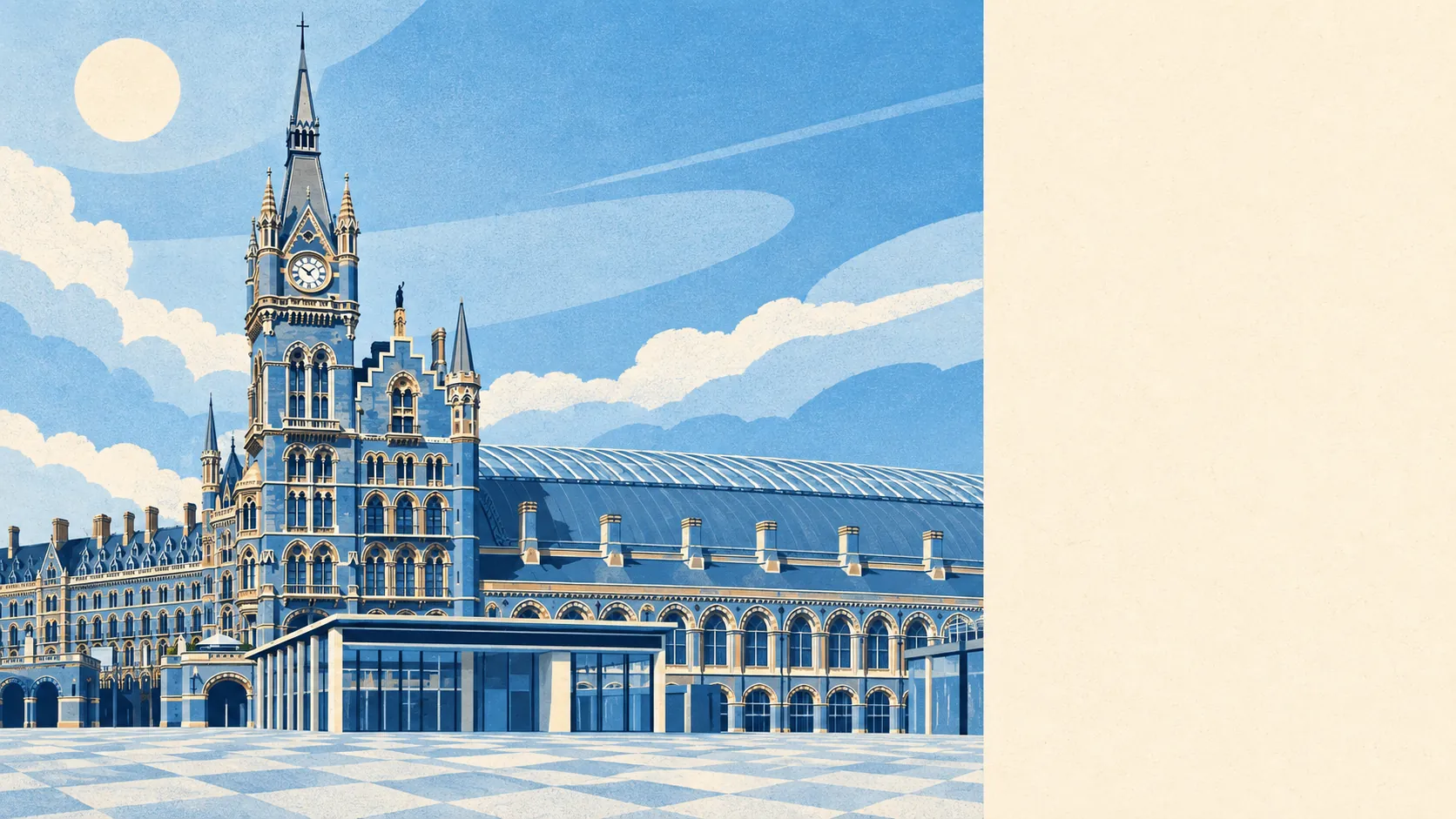
King's Cross is surrounded by more green space than its reputation would ever admit. The nearest patch of grass is a short stroll from most front doors. Dozens of squares and gardens sit within a kilometre. Private gardens are rare. The parks do the job the back gardens can't.
The average home is about 80 metres from the nearest public green space, and there are about 79 green spaces within a kilometre. Russell Square, Bloomsbury Square, Lincoln's Inn Fields and the gardens of Gray's Inn are all within reach. The Georgian developers laid out squares for the gentry, and two centuries later the residents of the surrounding flats use them as their lawns.
Water is a little further off. The nearest blue space is about 810 metres away on average, with around 12 bodies of water within a kilometre, and the Regent's Canal conservation area is among the designations nearby. Water here comes in straight lines, built for barges.
The National Cycle Network is about 2.1 kilometres from the average home, with no postcodes close to a route, and there is no ancient woodland at all. Getting out into actual countryside means taking one of the trains from the end of the road.
On the ground, the rated premises include 118 shops, 13 pubs and 23 restaurants. Most of what people need is here, but the evenings belong to the passing trade as much as to the residents.
Camden's air carried about 9.5 micrograms of fine particles per cubic metre in 2024, a borough-wide average that covers the heath in the north as well as the main roads down here.
The character comes from layers of protected building. The British Library, the Church of St Pancras and the old church in St Pancras Gardens are all listed, and St Pancras Gardens also hold the listed tomb of Sir John Soane, his wife and son. Soane designed some of the grandest buildings in London and ended up as one of the neighbourhood's quieter green-space features. The streets in between are dense, mixed and mostly flats.
Private outdoor space is scarce. The area has about 5,800 square metres of private garden for every 1,000 residents, spread across a district that is almost entirely flats. Ask whether a flat comes with a communal garden or a key to one of the nearby squares, because here that decides more about summer than the floor plan.
The valuation list shows what the area is really built for. Of 1,357 rateable premises, 728 are offices, 278 are car-parking spaces and 115 are shops. These are premises on the council's list, which isn't the same as businesses currently trading. On weekdays the people around you are mostly the office workers in those 728 premises, and most of them go home somewhere else.
Of 127 food outlets with a hygiene rating, about 53% hold the top score of five and about 13% sit at the low end. That spread is wide enough that it's worth checking the rating before ordering, and a takeaway's sticker in the window is easier to read than its menu.
No protected landscape overlaps the area: no area of outstanding natural beauty, no site of special scientific interest and no ancient woodland. King's Cross's green space is all designed, planted and fenced, which is why it sits so close to the front doors.
For greenery right on the doorstep, the area around King's Cross is one of the place's real strengths, with an old square or garden within a short walk of nearly every flat.