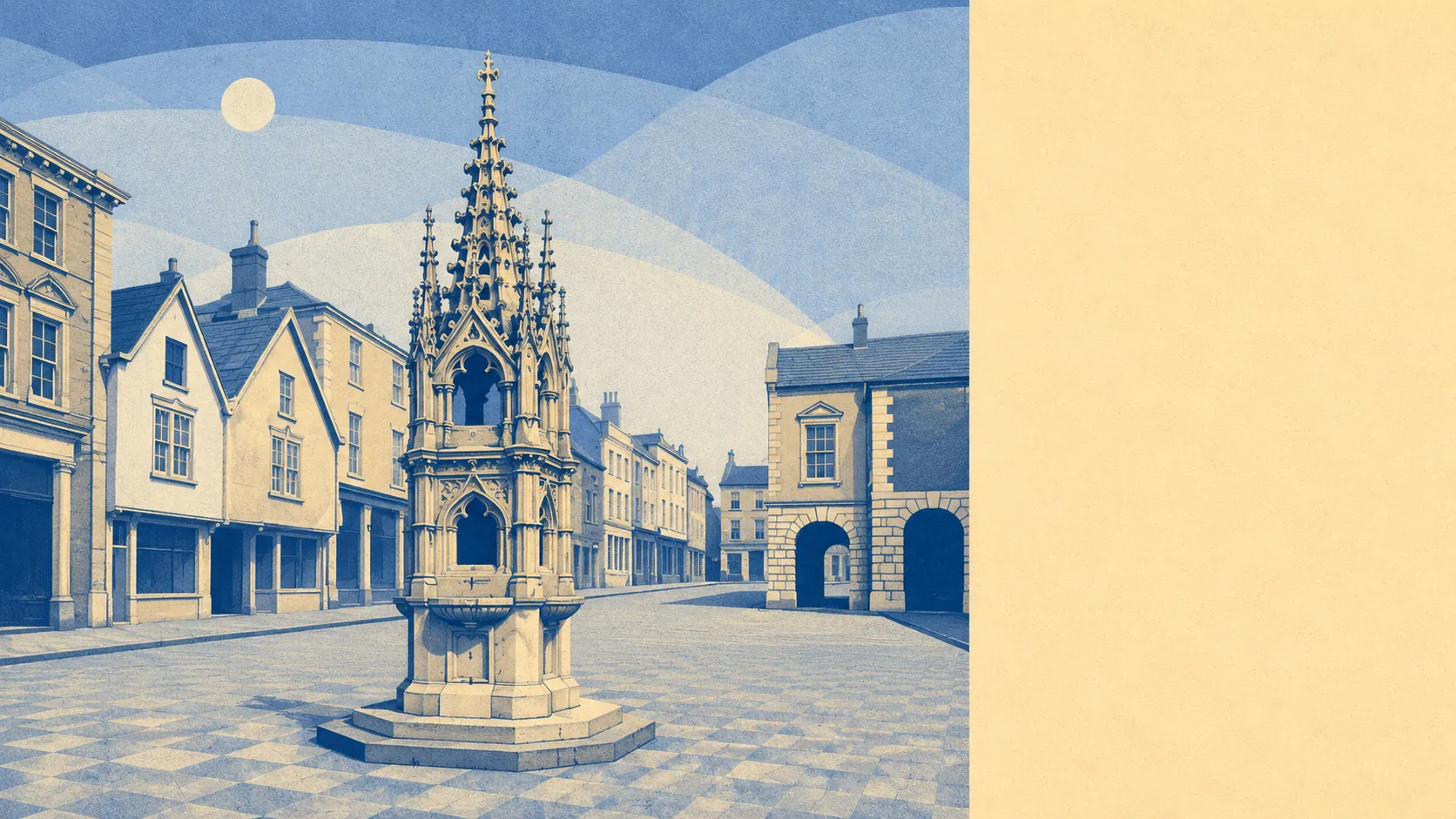
Yes, if you like a town that talks back. Great Torrington sits high above a river valley with the market square at the top and everything else falling away from it. Most people own their homes. The typical resident is heading toward fifty. The place has one of the busiest volunteering scenes in the country, which is a polite way of saying you will be asked. This is not a commuter dormitory that happens to have old buildings. It is a working market town that decided, some time ago, to stay one.
The housing stock is mostly houses rather than flats, and the council-tax valuation list, which covers every dwelling rather than just the recently certificated ones, puts terraces at around 33% of the stock, detached at 22%, semis at 20% and bungalows at 14%. Flats make up about 10%. Roughly 34% of the town's dwellings went up before 1930, which is the bit a buyer feels in the walls and the window reveals. On energy, the certificated stock runs 35% at band D and about 13% at band E or worse, with a shade over half sitting at band C or better. Around 77% of homes are on mains gas, and about 6% are heated by electricity alone, which is a running-cost fact worth having before the viewing rather than after the first winter bill.
On price, the Land Registry's last twelve months to late May 2026 put the median sale at £220,000 across 95 transactions. The type split does the explaining: terraces at about £195,000, semis at £220,000, detached at roughly £325,000, and the handful of flat sales at about £98,000. Council tax reflects the same shape. Band A is the most common band in the town, and around 58% of dwellings sit in bands A or B, which is a low-band town by any English standard.
Renting is a different market and a wider one. Typical private rent across the Torridge area runs at about £790 a month as of April 2026, up around 3% on the year. That is a district figure covering a lot of countryside as well as this town, so treat it as the shape of the local market rather than a quote for a specific street.
On crime, police.uk recorded 386 offences in the year to May 2026, giving a published rate of about 53 per thousand residents. That sits roughly 5% below the Torridge average, which makes it unremarkable in the way a market town usually is. The mix is worth understanding before anyone panics at a headline: violence and sexual offences make up the largest category here as they do almost everywhere, because it is a broad statutory grouping that sweeps in common assault without injury. The totals are small enough that a handful of incidents moves a share by several points, so nobody should read the mix as a settled characteristic of the place.
Connectivity is where the town takes its knocks. There is no railway station, and the branch line that once ran here closed to passengers under the Beeching cuts and to goods traffic in 1984. About 0.2% of residents commute by train, which is what happens when the nearest option is a bus ride away. Around 58% drive to work and roughly 17% walk. The 22 bus stops in the town average about 28 scheduled weekday departures each, with around 86% of stops seeing some weekend service, so it is a real network rather than a token one, but the peak-hour frequency averages under one bus an hour per stop. The Department for Transport's 2019 modelling puts a hospital at about 41 minutes by car and nearly 78 minutes by public transport, which is the number that matters most to anyone with an ageing parent. Broadband is better than the roads suggest: superfast reaches around 99% of premises, gigabit around 30%, and no premises fall below the universal service obligation.
The surroundings are the strongest thing about living here. Green space averages around 112 metres from the front door, with roughly 20 accessible sites within a kilometre, and water is about 424 metres away on average. The old railway trackbed became the Tarka Trail, which is a rare case of a closure leaving something better behind. On flooding, the picture depends entirely on which measure is being quoted, and both appear on this site. Around 6% of postcodes carry a high rating on at least one flood indicator including surface water, with about 8% at medium and 28% at low. The Environment Agency's river-and-sea flood zones tell a much tighter story: under 1% of the town's area falls inside flood zone 3, and the same share carries a recorded historic flood, the last logged event dating to December 1965 when channel capacity was exceeded. The high ground is genuinely high ground. The lower parts near the river are the parts to ask about. Radon sits in the elevated band across the whole town, which means a test rather than an alarm.
Heritage is a real constraint here, not a decorative one. There are 93 listed buildings, five of them at grade two star, and the town centre sits inside the Great Torrington conservation area. In practice that means window replacements, roof materials, solar panels and anything visible from the street become a conversation with the planning department rather than a weekend job. Buyers who understand this before they offer pay for a building they can live in. Buyers who do not tend to discover it holding a quote for double glazing they will never be allowed to fit.
The character follows from the numbers. Around 65% own their homes, the median age is about 47, and modelled household income runs at roughly £43,000 gross before tax for the financial year to March 2023. That is a settled town with money that works rather than money that shows. Household composition leans toward smaller households and older ones, which is exactly the profile that produces the volunteering culture the town is known for.
It suits people who want space, a proper high street, a short walk to green space and a low council-tax band, and who either work from home, work locally, or have made peace with the car. It suits families reasonably well, given Devon's inspected settings run around 80% good or better.
It does not suit anyone whose life depends on a train. If the job is in Exeter three days a week, or the hospital appointments are frequent, the arithmetic points somewhere on a rail line, and that trade is honest in both directions: Great Torrington buys you the valley and the trail, and it costs you the commute.
The history is unusually loud for a town this size. The Parliamentarians under Sir Thomas Fairfax took the town in 1646 and ended Royalist resistance in the West Country, an occasion marked when seventy barrels of gunpowder stored in the church went up with the prisoners still inside. George Monck, the soldier who later engineered the Restoration, came from here. So did Tristram Risdon, the antiquarian who spent decades cataloguing Devon, and Theophila Gwatkin, the painter and niece of Joshua Reynolds. The town hall went up in 1861 and the railway arrived in 1872, which is roughly the order in which places like this decided what they were going to be.
So, a good place to live, with the strengths and the weakness both obvious from the first visit. Its real strength is the setting: the green space, the trail, the valley and the amount of it that is walkable from an ordinary front door. The weak spot is getting out, because a town with no station and under an hour of buses at peak is a town that assumes a car. Everything else here is priced, banded and built for people who already knew that.