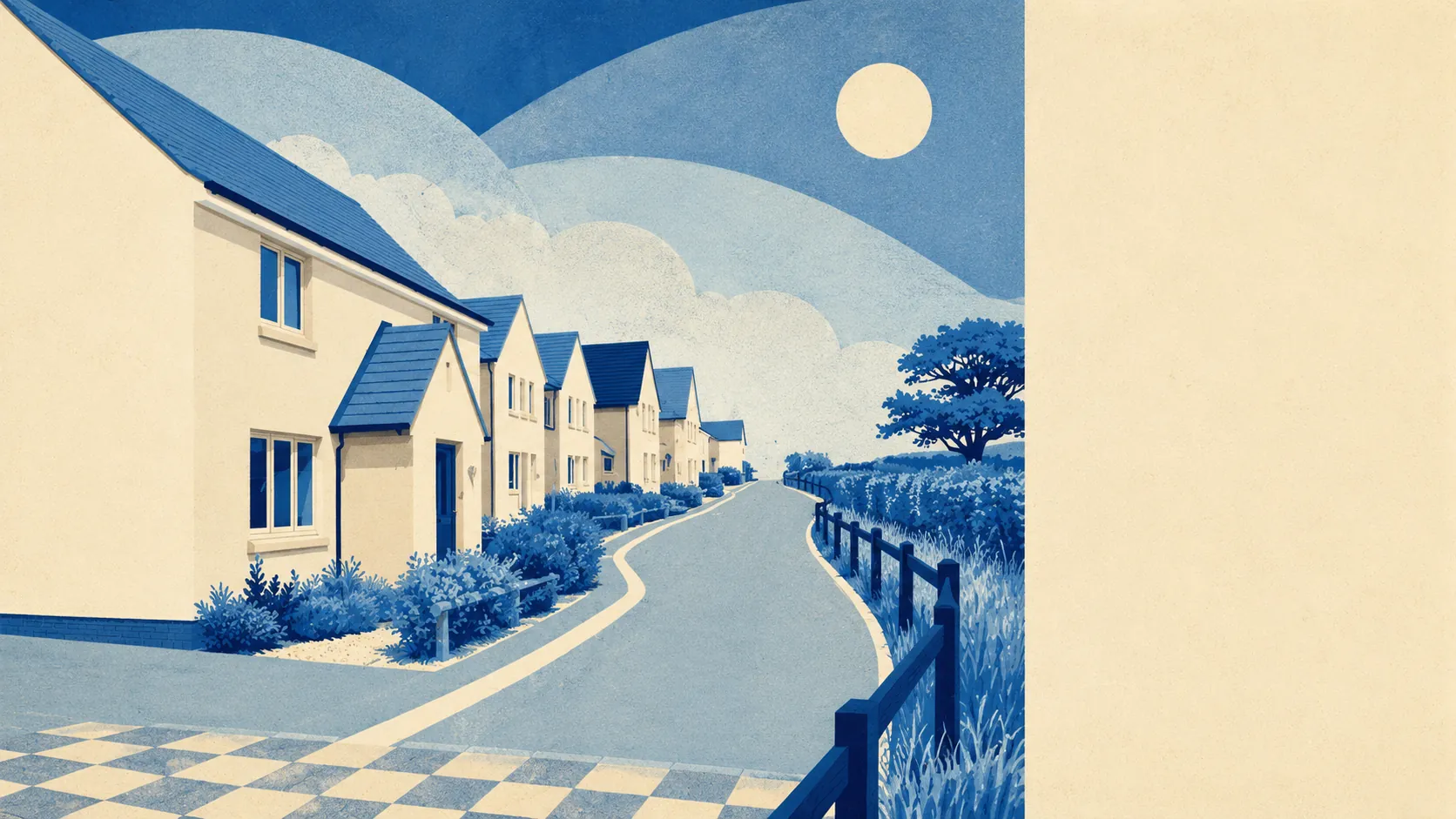
Yes, if you came to Devon for a life rather than a postcard. Six in ten own their homes. Almost every house is new enough to make the heating bill boring. The typical resident is in their early thirties, and almost nobody retired here. Cranbrook is not a thatched village and has never pretended to be, and the people who settle happily are the ones who worked that out before the second viewing.
The stock is what a planner draws when nobody is arguing back. Terraced houses are the largest single type at about 35% of dwellings on the council tax valuation list, with detached at 25%, semis at 24%, flats at 8% and bungalows at 6%. Around 14% of those dwellings were built before 1930, and none of that is on the new streets. Energy performance is where the place genuinely wins: about 97% of certificated homes sit in the top three bands, roughly 2% in band D and about 1% at band E or worse. Heating is the twist. Only about 13% of households run on mains gas and about 17% heat by electricity alone, so the warm house and the cheap-to-run house are not automatically the same house. Ask which one you are being shown.
Over the Land Registry's last twelve months, to mid-May 2026, the typical sale came in at about £267,000 across 88 transactions. Detached houses sat at roughly £375,000, semis around £265,000, terraces about £233,000, and flats near £203,000. Council tax sits mostly in band C, with about 21% of dwellings down in bands A and B. That is a modest set of numbers for a town with a station in it.
Renting is priced by the district rather than the town. Typical private rent across the East Devon area runs at about £970 a month as of April 2026, up around 7% over the year. That is the wider area figure and not Cranbrook's own, so read it as the shape of the market rather than a quote on a specific flat.
Safety is the least comfortable part of the record. Recorded crime over the twelve months to May 2026 works out at about 66 offences per 1,000 people, roughly 32% above the East Devon average of about 50. Violence and sexual offences account for about 54% of the recorded total against about 35% across England and Wales, though that category is a broad statutory grouping that sweeps in common assault without injury, so the share reads harder than the street feels. Devon and Cornwall Police charge in about 8% of cases against about 12% nationally. A town this new is not supposed to have a crime problem, which is precisely why it belongs in the conversation before the offer goes in.
Schools are why a good number of families are here at all. Cranbrook Education Campus runs all the way through from primary to secondary on one site, with St Martin's Church of England Primary and Nursery the other option inside the town, and Broadclyst Community Primary School serving the older village. Key stage 2 maths across the five schools covering these postcodes averages about 103. At key stage 4, the Attainment 8 score across the two secondaries comes in at 45. Across Devon as a whole, Ofsted has graded 138 of 172 settings good or better, with three outstanding and 31 requiring improvement. Primary is about a seventeen minute walk and secondary about forty, so the school run here is footwear rather than a queue of idling engines.
Cranbrook Rail Station is on the West of England line and under 1% of residents commute by train, which is either a scandal or a comment on where the jobs actually are. About 56% drive to work and about 30% never leave the house to do it. Buses do better than the rural stereotype allows: 45 stops, an average of about 94 scheduled weekday departures per stop, around seven an hour at the average stop in peak, and about 83% of stops carrying a weekend service. Broadband is the standout. Gigabit-capable connections reach about 87% of premises, superfast about 96%, and only about 0.1% falls below the minimum service standard, with all mobile operators covering about 97% of the area. The internet arrived on schedule, which in this town's history counts as a plot twist.
Flood risk is real but narrow. Around 15% of postcodes carry a high rating on at least one flood indicator, surface water included, with about 12% at medium and 30% at low. On the Environment Agency's river-and-sea flood zones the figures shrink: about 1% of postcodes fall in flood zone 3, under 1% in zone 2, and about 2% once the climate change allowance is applied. Green space is the quiet triumph. The average postcode sits about 230 metres from open green space with roughly nine patches inside a kilometre, and about 250 metres from water. There is no national landscape designation, no site of special scientific interest and no ancient woodland, so what you get is ordinary countryside, close by and usable on a wet Tuesday rather than admired through a gate.
Heritage constraints barely graze the new streets. There are 40 listed buildings across the area, two at grade two star and 38 at grade two, none at grade one, and the conservation areas sit out in the older villages at Broadclyst, Sowton and Whimple. For most buyers here that means the extension, the panels and the replacement windows are a matter between you and the planning department, with no conservation officer holding the other end of the rope. Broadclyst, which this page also covers, is the counterweight: parish church, older cottages, a conservation area, and every constraint that comes with all three.
About 61% own their homes and about 30% rent, split roughly 17% social and 14% private. The median age is 32. Around a third of households are couples with children, while single pensioner households run at about 3%. The rhythm of the place is buggies, trampolines and the school gate, not bowls and bridge.
It suits a family buying their first proper house who want a warm building, a school within walking distance and a station they could use if the job ever moved. It suits anyone working from home most of the week who wants a garden without a city price, and who is honest enough to admit that period charm is mostly a maintenance schedule with a nice front door.
It does not suit anyone who moved to Devon for the Devon of the tourist board. There are no crooked lanes here, no pub with four hundred years of low beams, no accumulated centuries. It also does not suit anyone who assumed a brand new town would come with a spotless crime record, because the figures politely decline to cooperate.
Cranbrook is a good place to live, and what lifts it is almost entirely where it sits. Its real strength is the setting: green space a few minutes from nearly every front door, water close, countryside that is available rather than protected and admired from a stile. The weak spot is safety, where the recorded rate runs above the district's and no amount of new brick argues it away. Buy here for the house that works and the fields at the end of the road. Six hundred years of ancestors and a crooked chimney are available a few miles away, at a premium, with a boiler that predates the buyer.